China's 10 Most Dangerous Roads
Bolivia is (sadly) famous for the danger of its roads. Thus, tragic accidents are often to be regretted along their edges, with no fewer than 200 to 300 travelers killed each year. Less in the spotlight on this subject, China nonetheless has a plethora of routes that can easily rival Bolivian roads. We've had fun listing a few of them...
Bolivia is (sadly) famous for the danger of its roads. Thus, tragic accidents are often to be regretted along their edges, with no fewer than 200 to 300 travelers killed each year. Less in the spotlight on this subject, China nonetheless has a plethora of routes that can easily rival Bolivian roads. We've had fun listing a few of them...
1 Highway 318: Sichuan-Tibet Section
We naturally start with the most symbolic: the highway connecting Sichuan province to Tibet is considered China's most dangerous road. It begins in Chengdu to the east and ends in Lhassa to the west. It features two routes: on one side the Northeast road stretching 2412 km with the peak of "Queers Mountain" (at 4916m altitude) located in Garzê xian; on the other the Southeast road 2149 km long, whose highest point is none other than Litang Xian (at 4700m above sea level). The path thus crosses 14 mountains, each more majestic than the last, such as Mount Erlang and Sejila, and cuts through major waterways like the Jinsha, Dadu rivers and the Lancang River (another name given to the Mekong). You will have understood, the danger of certain sections is equal to their variety and beauty, and no doubt you will keep an unforgettable memory if you have the chance to attempt the adventure!
2 Guoliang Tunnel
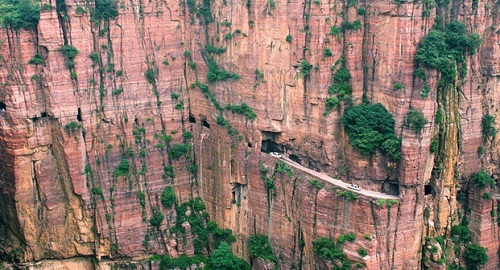
The Guoliang Tunnel is not only one of the most dangerous roads in China, but also in the world! It is located within Mount Taihang, in the central Henan province. It was imagined and carved in just 5 years by 13 local villagers, and inaugurated in 1977. This 1.2 kilometer-long tunnel is approximately 5 meters high and 4 meters wide, and features about thirty "windows" opening onto the void. It is thus nicknamed "The Road That Allows No Mistakes", although unfortunately many accidents are attributable to driver negligence.
3 Taike Road (Shanxi)
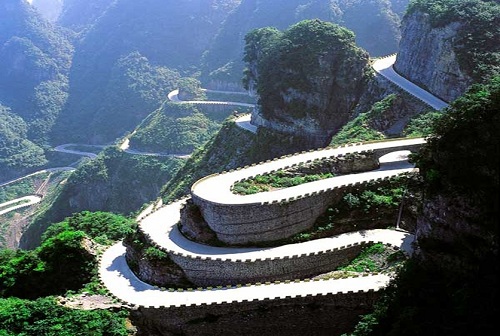
This is a mountainous road whose traffic conditions are nonetheless very good. Nevertheless it finds its place in our top in that its most dangerous section, located between Taiyuan and Jiaogu, is commonly called "The Devil's Road". This route has many climbs, descents and turns that have caused at least one accident per week for 20 years.
4 Tianmen Mountain Road (Tiānmén Shān)
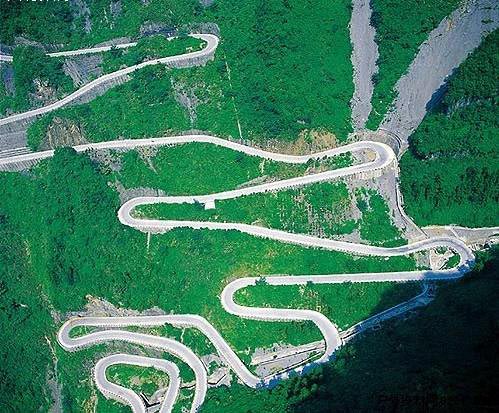
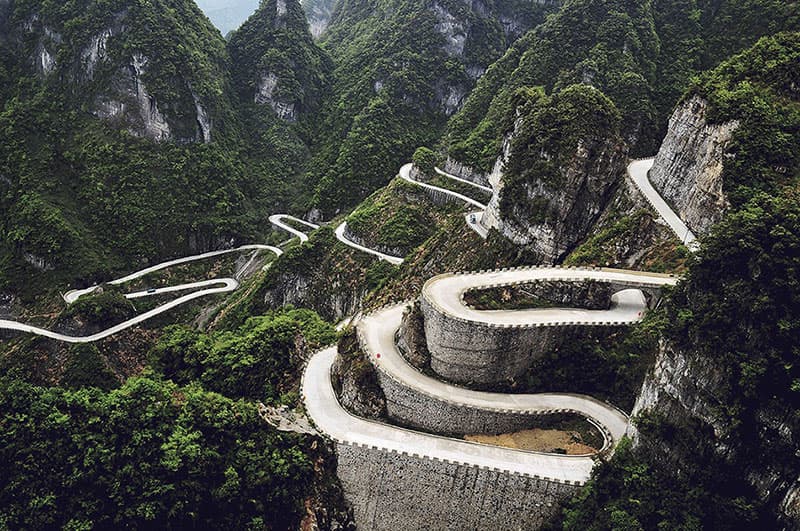
Tiānmén Shān literally means "Mountain of the Heavenly Gate", no need to draw you a picture! This road is located in the beautiful Hunan province. It is 10km long with an elevation gain of 1100 meters: its highest point peaks at 1300 meters above sea level, while its lowest point sits at only 200 meters. The track is composed of 99 turns and hairpin bends, enough to make your head spin! Indeed, if you tend to be prone to vertigo, we recommend you not take your eyes off the road...
5 Highway 320: Huanghuaqiao Section (Jiangxi)
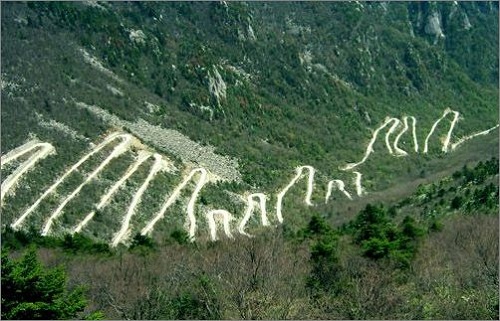
This road is located near the city of Pingxiang, in Jiangxi province, and is part of Highway 320. Although only 1 kilometer long, it is certainly the most dangerous section, in that it is composed of extremely tight and vertiginous curves. Consequently, many accidents occur there each year, leading locals to call it "The Earthly Bermuda Triangle".
6 Pan Mountain Road (Panshān)
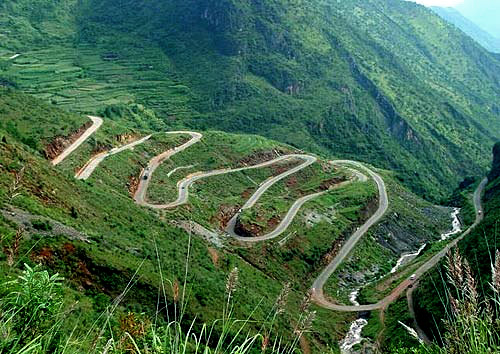
Located in the municipality of Tianjin, Pan Mountain Road is considered one of the most perilous in China. Pan Mountain (Panshān in pinyin) is regularly described as the most beautiful mountain located East of Beijing... at the cost of its accessibility! Its peak, the Moon Hanging Peak, is situated at 864 meters above sea level. Suffice to say you'll have to climb!
7 Mêdog Xian Road

As its name suggests, this section is located in the Mêdog District, itself situated in the Tibet Autonomous Region. This is a hazardous road that crosses numerous pristine cliffs, valleys, glaciers and rivers. It is made particularly impassable by frequent landslides and torrential rains affecting the region.
8 The 24 Bends of the Burma Road
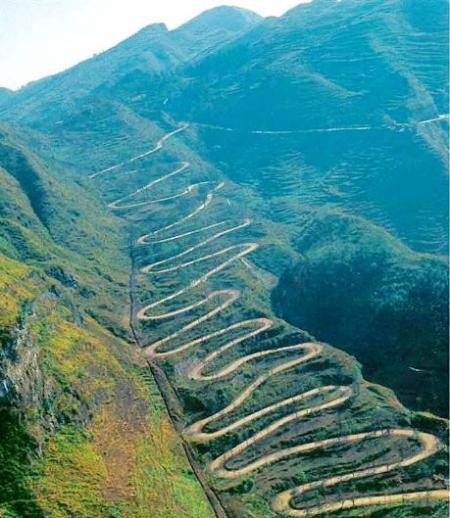
The 24 Bends road is located in Southwest China, more precisely in Qinglong Xian, itself situated in Guizhou province. Stretching 3.7 kilometers, it consists as its name suggests of 24 tight bends along a high mountain, requiring a good vehicle and excellent driving. This road is part of the Burma Road, built by the Chinese during World War II to supply the Kuomintang revolutionary army, then at war with the Japanese.
9 Highway 213
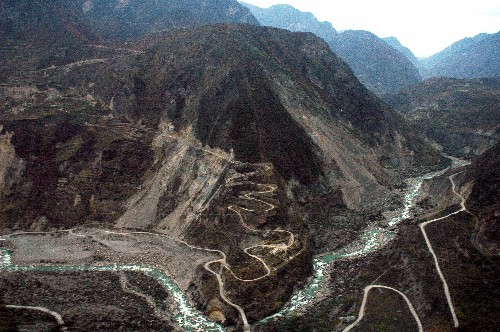
Highway 213 connects the city of Kunming, located in Yunnan province, to the city of Lanzhou, which is found in Gansu province. The section of this road we're interested in winds through numerous valleys and mountainous areas, connecting the districts of Maoxian, Songpan and Wenchuan. This is an extremely narrow path with many winding passages. This is why the speed limit there is 50km/h and drivers are formally requested not to overload their vehicle.
10 The Old Kun Yi Road (旧昆宜公路)
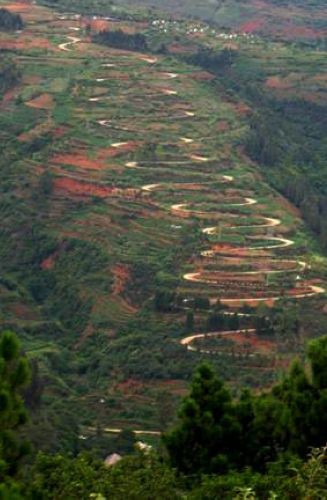
Forgive this approximate translation for what is undoubtedly China's most winding road! This section is located just 2 kilometers from Yiliang District (Yunnan), and yet many locals have never dared to venture it. There are no fewer than 68 bends over a distance of just 7 kilometers... Don't forget the pain relief! We hope you enjoyed this non-exhaustive ranking. If by chance you had the opportunity to take one of these roads during your trip to China, don't hesitate to share your experience in the comments!
Frequently asked questions
The most dangerous road in China is generally considered to be Highway 318 connecting Sichuan province to Tibet. It extends over 2000 km and crosses 14 mountain ranges, with passes exceeding 4900 meters altitude.
Yes, Guoliang Tunnel is accessible to vehicles, but it requires great caution. Approximately 4 meters wide and 1.2 km long, this hand-carved tunnel in the rock offers about thirty openings overlooking the void. Inexperienced drivers are strongly discouraged.
Entry to Tibet is subject to obtaining a special permit (Tibet Travel Permit) issued by Chinese authorities. It is essential for traveling the Tibetan section of Highway 318. It is recommended to inquire with a specialized agency before your departure.
The best time is generally spring (April-May) and fall (September-October), when weather conditions are more favorable. In summer, torrential rains cause landslides, particularly on the Mêdog Xian road. In winter, snow and ice make some passes impassable.
Yes, the 24 Bends of the Burma Road, located in Guizhou province, are still accessible and even constitute a tourist attraction for thrill-seekers. The road extends 3.7 km and requires a vehicle in good condition and experienced driving.