First Watchtower of the Great Wall at Jiayuguan
First Watchtower of the Great Wall at Jiayuguan
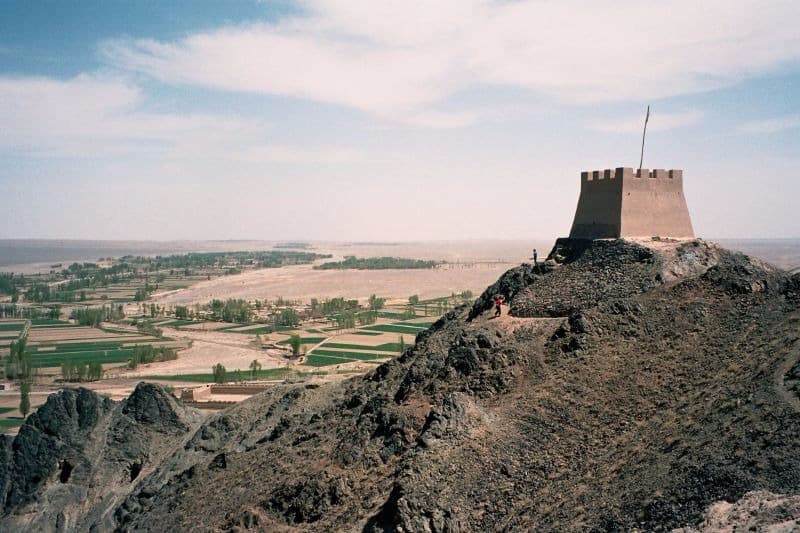
At the western extremity of the Great Wall, the first watchtower of Jiayuguan marks the historical frontier between imperial Chine and the Central Asian steppes, facing the Gobi Desert.
At the western extremity of the Great Wall, the first watchtower marks the historical boundary between imperial Chine and the Central Asian steppes. Erected during the Ming dynasty, it flanks the Jiayuguan fortress — the final defensive stronghold before the Gobi Desert. Its silhouette of grey brick, perched on an arid plateau, encapsulates the military and symbolic logic of the Wall itself: to watch, to signal, to deter.
Quick practical information
- Access: the watchtower is part of the Jiayuguan fortress complex, accessible from downtown by taxi or tourist shuttle.
- Recommended duration: allow 30 to 45 minutes for the watchtower and its immediate surroundings, longer if you explore the entire fortress.
- What to wear: closed-toe shoes recommended — the rampart paths are uneven.
- Accessibility: steep staircases and ramparts make access difficult for persons with reduced mobility.
What you'll see
The watchtower is a massive structure of fired brick, elevated on a foundation of compacted earth. From the summit, your gaze extends across the Gobi Desert to the north and the snow-capped foothills of the Qilian range to the south. The Wall stretches eastward toward the fortress, while to the west it quickly disappears into the sands — a reminder that the empire's frontier ended here.
History and context
Jiayuguan was founded in 1372 under the reign of the Hongwu Emperor, first sovereign of the Ming dynasty. The fortress and its watchtowers constituted the "First Pass Under Heaven" — an expression carved into the western gate. Soldiers, merchants and diplomats traveling the Silk Road crossed this point as their final contact with Chinese civilization. Exiles, by contrast, passed through without hope of return.
Highlights of your visit
The panorama over the Gobi and Qilian
The contrast is striking: to the north, the mineral immensity of the desert; to the south, the snow-capped peaks of the Qilian range rising above 5,000 meters. This natural framing explains why Ming strategists chose this precise location to seal off the Hexi corridor.
The adobe wall to the west
Beyond the watchtower, the Wall changes material: fired brick gives way to sections of rammed earth and reeds, typical of Ming construction in arid zones. These less-restored segments offer a rawer sense of the original structure.
Jiayuguan fortress
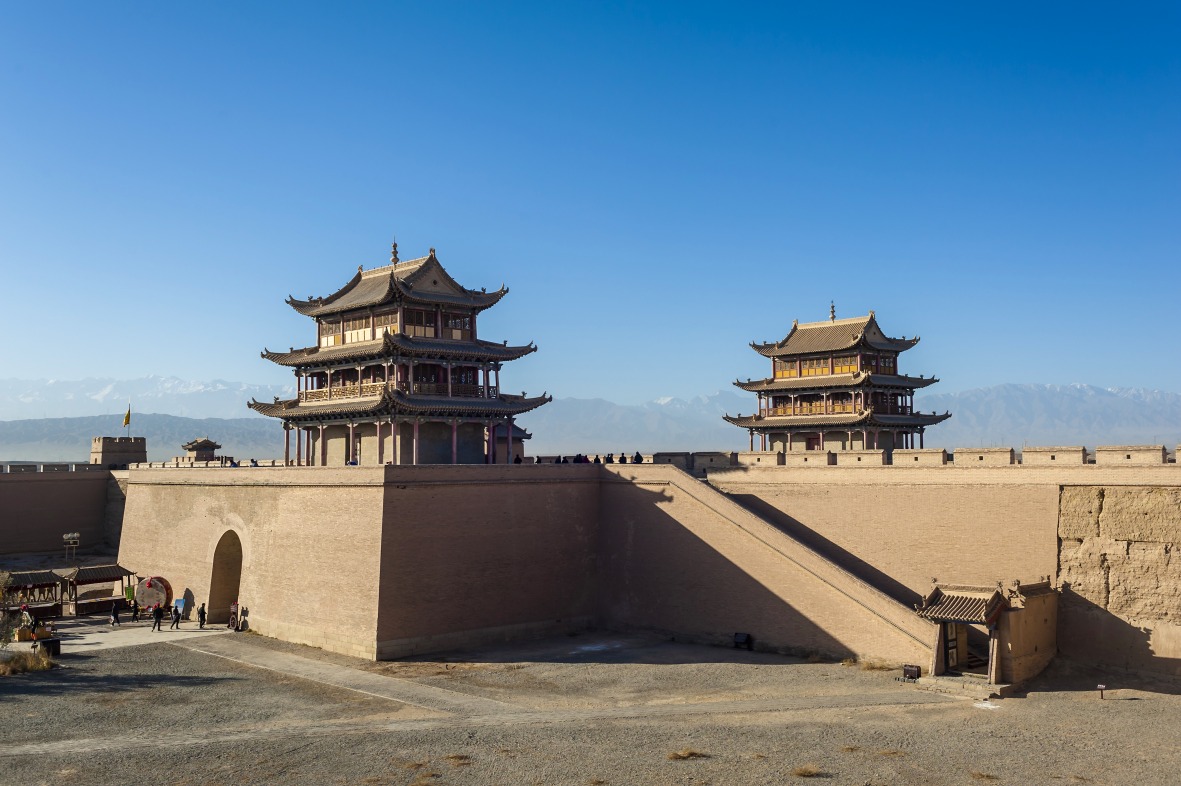
The watchtower integrates into a larger complex comprising two walls, corner towers and a monumental gate. The fortress is among the best-preserved of the entire Ming Wall — a combined visit is naturally recommended.
Photography tips
Morning light, raking across the grey brick, brings out the texture and shadows cast by the crenellations. In late afternoon, the setting sun tints the desert ochre and provides striking contrast. Avoid midday: flat light flattens the reliefs. No known photographic restrictions on the exterior site.
Location and access
The site lies some ten kilometers southwest of downtown Jiayuguan, a city in Gansu province. The Jiayuguan high-speed rail station (Lanzhou–Urumqi line) allows you to reach the city quickly from Lanzhou or Dunhuang. Taxis and tourist shuttles serve the fortress from downtown. The Jiayuguan fortress is the main entry point to the complex.
Nearby attractions
- Jiayuguan Fortress — the best-preserved Ming fortified ensemble on the western Wall, to be visited as a complement.
- Mogao Caves (Dunhuang) — a major Buddhist site on the Silk Road, several hours west by train.
- Crescent Lake (Dunhuang) — an emblematic oasis in the heart of singing sand dunes.
- Hexi Corridor — the historic axis linking central Chine to Central Asia, with Jiayuguan as its western lock.
Frequently asked questions
Spring (April–May) and autumn (September–October) offer pleasant temperatures. Summer is hot and sunny but bearable; winter is cold and windy, with possible snow on the Qilian peaks in the background.
The watchtower is part of the Jiayuguan fortress complex. Entry is typically via the fortress ticket; it is advisable to plan a visit to both in a single half-day.
Allow two to three hours to explore the watchtower, adjacent wall sections and the fortress as a whole, depending on your pace.
Steep staircases and uneven rampart paths make access to the summit difficult. The exterior surroundings remain walkable on flat ground.
Yes. Jiayuguan and Dunhuang are connected by the Lanzhou–Urumqi high-speed rail line. A multi-day circuit along the Silk Road allows you to visit both stops without major logistical difficulty.
No photographic restrictions are noted in the exterior areas of the complex. Check rules inside restored buildings at the time of your visit.
Interested in this visit?
We can include it in your personalised itinerary.