Milarepa Palace
Milarepa Palace
A nine-story Tibetan Buddhist temple in Hezuo, Milarepa Palace blends Sino-Tibetan architecture with a tribute to the saint founder of the Kagyu school.
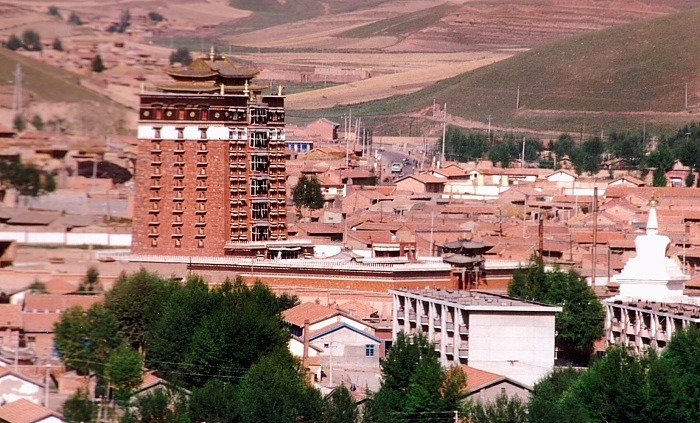
In Hezuo, in Gansu Province, the Milarepa Palace rises nine stories on a hillside visible from the city. This Tibetan Buddhist temple, neighboring Tso Gompa Monastery, pays homage to Milarepa, a Tibetan philosopher, magician, yogi, and poet, regarded alongside Padmasambhava as one of Tibet's two great archetypal saints.
Why visit Milarepa Palace
The palace combines several interests in a single visit: a major figure in Tibetan Buddhism, architecture blending Chinese and Tibetan design codes, and a journey through nine floors where each level showcases a distinct collection of statues, paintings, and ritual objects. Located in Hezuo on the main road leading to Xiahe and the renowned Labrang Monastery, it makes for a logical stop on any itinerary through Gansu's Tibetan margins.
History and the figure of Milarepa
Tradition attributes the palace's foundation to Milarepa himself, around 1100. A disciple of Marpa Lotsawa, Milarepa is considered the founder of the Kagyu school, one of the major schools of Tibetan Buddhism.
The legend associated with him explains the building's origins. Persecuted by his aunt and uncle who had seized the family inheritance, Milarepa is said to have resorted to black magic for revenge, destroying his village. Consumed by remorse, he sought forgiveness from his master Marpa Lotsawa. As penance and instruction, Marpa asked him to build towers across the region: the Hezuo palace is said to be one such testament.
The structure was entirely devastated during the Chinese Cultural Revolution. The current building is a reconstruction that follows the original nine-story layout.
Exterior architecture
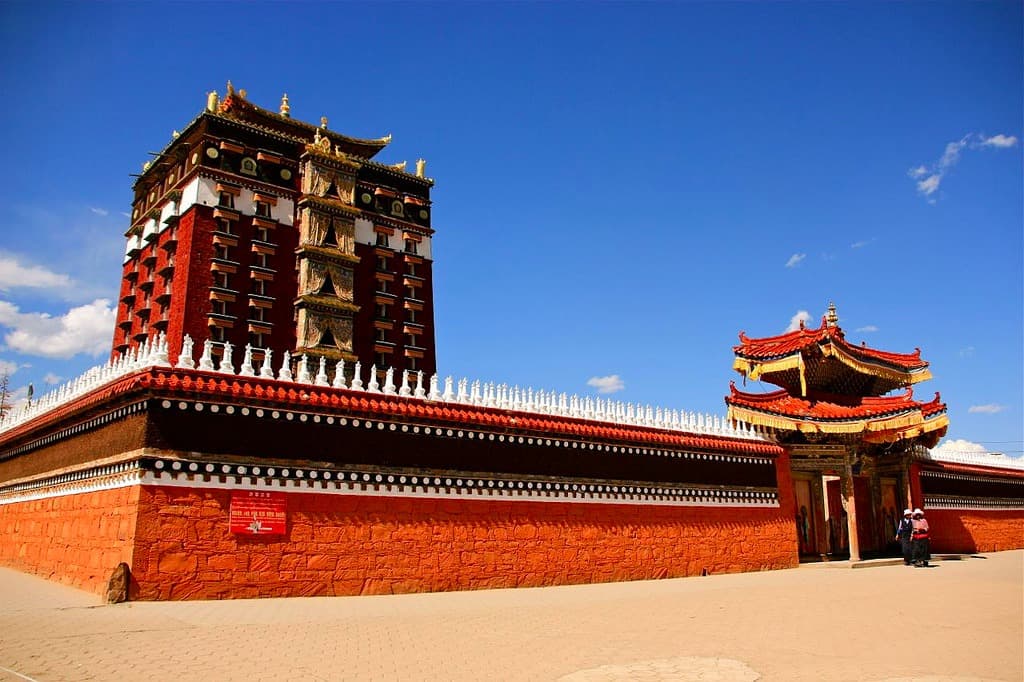
The palace stands out for its deliberate blend of traditional Chinese and Tibetan styles. Its scarlet-hued facade is topped by a gilded roof with upturned eaves in the manner of grand Chinese structures. The windows are adorned with distinctly Tibetan decorations, and the whole is enclosed by a Tibetan-style boundary wall pierced by a Chinese-style gateway.
Before entering, custom calls for circling the temple three times clockwise. At the entrance, two bronze statues of Tibetan deities with fierce expressions stand guard.
What to see inside
Each floor of the palace houses distinct chapels containing Buddha statuettes, thangkas, precious stones, and funeral urns. A thangka—literally "something to be unrolled"—is a painting, drawing, or painted fabric on canvas, characteristic of Tibetan Buddhist culture.
Ground floor
Lit by yak butter lamps, it displays several bodhisattvas—Buddhist sages who have reached all degrees of perfection except the final one—surrounded by other Buddhist statues.
First floor
An exhibition devoted to lamas and representations of Buddha.
Fourth floor
A gallery of portraits of deities from the Tibetan Buddhist pantheon.
Sixth floor
Turquoise tantric effigies, linked to the esoteric practices of Tibetan Buddhism.
Eighth floor
Representations of Sakyamuni—Siddhartha Gautama, the historical founder of Buddhism in the 6th–5th centuries BCE—and Guanyin, a bodhisattva associated with compassion in East Asian Buddhism. This level opens onto views of the surrounding hills and the city of Hezuo.
Practical information
- Duration: allow approximately 1 to 1.5 hours to tour all nine floors.
- Admission: modest entrance fee, payable in cash on site.
- Hours: open during daylight hours. Hours vary by season, so check locally before visiting.
- Dress code: shoulders and legs covered; shoes removed in certain chapels.
- Photography: generally prohibited inside the chapels.
Nearby attractions
- Tso Gompa Monastery: located immediately beside the palace, it makes a logical addition to your visit.
- Hezuo: capital of the Gannan Tibetan Autonomous Prefecture, the city serves as a practical base for exploring the region.
- Xiahe and Labrang Monastery: approximately 70 km to the northwest, one of the six great monasteries of the Gelug school and a major stop on any itinerary through Tibetan Gansu.
How to get there
The palace sits along the main road serving Xiahe from Hezuo, on an easily recognizable hillside. From central Hezuo, a short taxi ride of a few minutes will get you there. Hezuo itself is connected by bus to Lanzhou (Gansu's capital) and to Xiahe, making it an easy transit point for travelers moving through the region.
Frequently asked questions
Frequently asked questions
Organize your trip
Milarepa Palace fits into an itinerary through Tibetan Gansu, a region still little frequented but rich in monasteries and high-altitude landscapes. To plan your circuit through Chine, consult our tailor-made trips to Chine and our suggestions for cultural stops throughout the country.
Interested in this visit?
We can include it in your personalised itinerary.