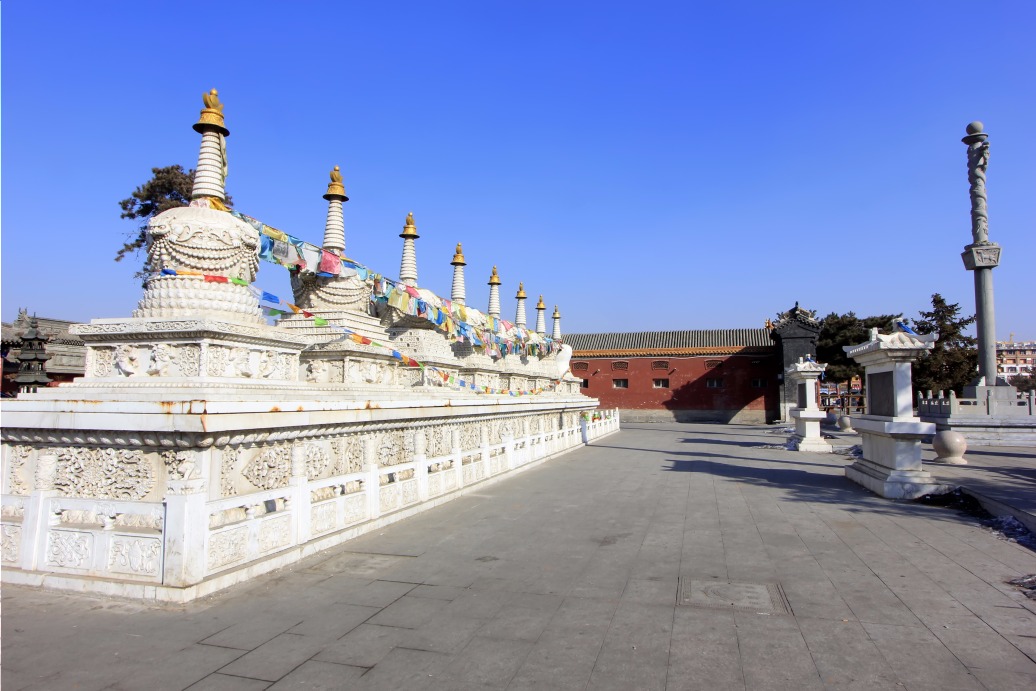
Tholing Monastery (Tuolin Si)
The first great monastery of western Tibet, Tholing houses 11th-century frescoes and marks the renaissance of Tibetan Buddhism. A rare site, accessible only with Ngari permits.
Tholing Monastery stands in the Sutlej valley at Zanda, in Ngari Prefecture in western Tibet. Founded at the turn of the 11th century, it was the first major Tibetan Buddhist centre in this region and the starting point of the "Second Diffusion of Buddhism" in Tibet. Its rammed-earth temples, partially in ruins, preserve frescoes of rare antiquity—witnesses to an Indo-Tibetan artistic tradition that has vanished almost everywhere else.
Quick facts
- Access: Zanda is accessible from Shiquanhe (Ali/Gar), several hours away on rough roads; a 4×4 vehicle with driver is essential.
- Permit: The Tibet Alien Travel Permit (ATP) is mandatory, along with an additional permit for Ngari Prefecture (Restricted Area Permit).
- Dress code: Respectful attire required in temples; shoulders and knees must be covered.
- Recommended duration: Plan half a day for the monastery and its immediate surroundings.
- Altitude: Around 3,600 m—allow time for acclimatisation.
What to see
The complex comprises several temples including the Lhakhang Karpo (White Temple) and the Lhakhang Marpo (Red Temple), both partially restored. The interior frescoes, dating from the 11th–12th century at their oldest, blend Kashmiri, Indian and Tibetan influences. The ochre rammed-earth walls merge seamlessly with the canyon landscape surrounding the site.
History and context
Tholing was founded around 996 by King Yeshe Ö of the Guge kingdom, with the aid of the great translator Rinchen Zangpo. It became the seat of the Indian master Atisha during his stay in Tibet (1042–1045), a decisive event in the reform of Tibetan Buddhism. The monastery suffered severely during the Cultural Revolution; partial restoration work has been carried out since the 1980s.
Highlights of your visit
Medieval frescoes
Some of the surviving murals rank among the oldest in western Tibet. Their vivid palettes and figures with Indo-Kashmiri features have no public equivalent elsewhere in the region.
Rammed-earth architecture
The massive volumes of the temples, built in adobe and rammed earth, integrate naturally into the cliffs of the Zanda valley. The ensemble creates an impression of continuity between architecture and geology.
The Zanda valley setting
The monastery is neighbour to the Zanda earth forests (Zhada Tulin), spectacular erosion formations that stretch for dozens of kilometres. The raking light of morning and evening transforms this landscape into a monochromatic tableau.
Etiquette and visiting rules
- Remove your shoes before entering prayer halls.
- Circumambulate stupas and prayer wheels clockwise.
- Ask permission before photographing monks or ceremonies.
- Avoid disrespectful gestures or remarks toward sacred objects.
Photography tips
Golden morning light illuminates the ochre temple façade from the east. For interior frescoes, natural light is often insufficient; a tripod may be useful if site rules permit. The Zanda earth formations are best photographed in late afternoon, when shadows accentuate the relief.
Location and access
Tholing is located in the town of Zanda, the county seat of Zanda County. The nearest city with an airport is Shiquanhe (Ngari Gunsa Airport), several hours' drive away. Any visit to Ngari Prefecture requires prior arrangement with an authorised agency for permit acquisition. Disabled access is very limited due to terrain and building condition.
Nearby sites
- Zanda earth forests (Zhada Tulin) — clay erosion formations stretching around the town, accessible by vehicle.
- Ruins of Guge Kingdom (Tsaparang) — medieval capital perched on a rocky spur, about an hour's drive from Zanda.
- Lake Manasarovar (Mapam Yumco) — high-altitude sacred lake, several hours east, a classic stop on the Ngari circuit.
- Mount Kailash (Gang Rinpoché) — sacred peak for Buddhists, Hindus and Jains, the culmination of the Ngari pilgrimage.
Frequently asked questions
May to October offer the most passable roads. Winter often closes the access tracks to Zanda due to snow and frost.
You need at minimum the Tibet Travel Permit (TTP), the Alien Travel Permit (ATP) and the Restricted Area Permit for Ngari. These documents are obtained through an approved travel agency in China; individual applications are not possible.
Yes, the two sites are close and are typically visited over two days from Zanda. Tsaparang (Guge) is about an hour's drive away.
Rules vary by room. Photography fees may be charged for certain spaces. Check with the attendant at the entrance.
Zanda sits at around 3,600 m. Plan at least one day of acclimatisation in Lhassa or Shiquanhe before arriving. Stay well hydrated and avoid strenuous activity for the first few days.
Interested in this visit?
We can include it in your personalised itinerary.