Mount Cangyan
Mount Cangyan
Massif of the Taihang Mountains, 80 km from Shijiazhuang: Mount Cangyan is home to the suspended temple Qiaoloudian and several Buddhist sanctuaries linked to the Sui dynasty.
Mount Cangyan, whose name literally means "the mountain of pale green rocks," rises in Hebei province, approximately 80 km southwest of Shijiazhuang, near the border with Shanxi. This massif belongs to the Taihang Mountains chain (Taihangshan) and stands out for its vertical cliffs, ancient cypresses, and temples clinging to the rock face, most notably the famous Qiaoloudian.
Why visit Mount Cangyan
The site combines mid-mountain landscapes with Buddhist heritage. Three elements particularly stand out:
- the suspended temple Qiaoloudian, considered in Chinese tradition as one of the three most renowned suspended mountain temples in the country;
- a collection of pavilions and Buddhist sanctuaries scattered along the trails;
- a natural setting marked by narrow gorges, centuries-old cypresses, and streams between the East and West peaks.
The entire site can be explored on foot in a single day and remains accessible to casual hikers, although some staircases are steep.
History and legend
Mount Cangyan owes part of its reputation to an ancient legend: Princess Nanyang, the eldest daughter of Emperor Yangdi of the Sui dynasty (581-618), allegedly renounced court life to become a Buddhist nun in these mountains. The account, very prominent in local guides, explains the placement of sanctuaries on the cliff faces and the devotion that developed around the site.
In 1998, China's State Council designated Mount Cangyan as a national folklore site, recognizing both its scenic value and its role in the region's Buddhist culture.
What to see on site
The suspended temple Qiaoloudian
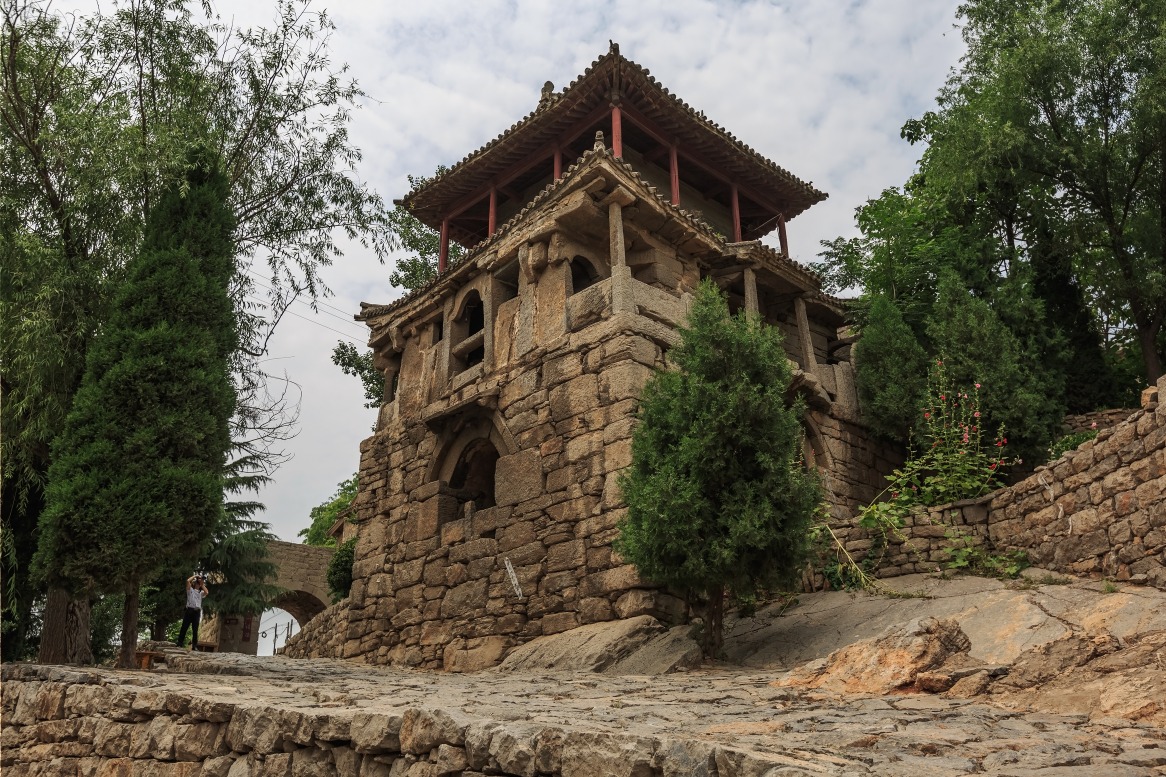
It is the centerpiece of the site. Built on a cliff face above a gorge, the pavilion rests on a stone arch spanning the void between two walls. The wooden architecture interlocks with the rock and remains one of the most reproduced images in Hebei. Chinese tradition counts it among the three most renowned suspended temples in the country's mountains.
Other temples
By following the park's trails and staircases, you will encounter several less spectacular but interesting sanctuaries:
- Fuqing Temple;
- Longyan Temple;
- Shigu Temple.
They house Buddhist statues and frescoes, and allow you to understand the layering of the religious site across dynasties.
The natural setting
The East and West peaks face each other, with ridges running north-south. Vegetation is dominated by ancient cypresses, interspersed with massive stones, narrow valleys, and streams of clear water. The panorama unfolds gradually along the route, alternating between gorges and viewpoints.
When to visit
Hebei experiences a continental climate. The best periods to visit Mount Cangyan are:
- late April to June: mild temperatures, verdant vegetation;
- September and October: dry air, clear skies, autumn colors on the cypresses and deciduous trees;
- summer remains feasible but can be hot and stormy;
- winter is cold, sometimes snowy, and certain sections can be slippery.
If possible, avoid Chinese national holiday periods (Labor Day in early May, National Day in early October), when crowds are at their peak.
How to get there
The logical starting point is Shijiazhuang, capital of Hebei, connected to Beijing by high-speed rail in just over an hour.
- By bus: from Shijiazhuang Xiwang bus station, direct buses serve Mount Cangyan park. Expect approximately 2 to 3 hours of travel depending on traffic.
- By private car or long-distance taxi: a more flexible option if you combine the visit with other Hebei sites.
Practical information
- Duration of visit: plan a full day on site to explore the main temples and viewpoints.
- Hours: the park opens during the day, with reduced hours in winter. Check current hours with your guide or accommodation.
- Admission fee: entrance at a moderate rate, subject to change by season.
- Equipment: hiking shoes, water, windbreaker; there are numerous staircases.
- Accommodation: most visitors stay in Shijiazhuang; a few options exist near the park for hikers.
What to see in the region and beyond
If you extend your itinerary in Chine, several sites complement a Mount Cangyan visit well:
- The Great Wall at Juyongguan, accessible from Beijing;
- The Great Pagoda of the Wild Goose in Xi'an, another major Buddhist site;
- The Thousand Buddha Caves of Bezeklik in Xinjiang;
- Hexigten Geopark in Inner Mongolia.
Frequently asked questions
Frequently asked questions
In Hebei province, approximately 80 km southwest of Shijiazhuang, near the border with Shanxi. It is part of the Taihang Mountains chain.
A full day allows you to see the suspended temple Qiaoloudian, secondary sanctuaries (Fuqing, Longyan, Shigu), and main viewpoints, at a moderate hiking pace.
Buses depart from Shijiazhuang Xiwang bus station heading to Mount Cangyan park. The journey takes 2 to 3 hours. A private car is more flexible if traveling with others.
Late spring (May-June) and autumn (September-October) offer the most pleasant conditions, with temperate weather and good visibility.
Yes. Several temples are maintained and frequented there, and the site has been associated for centuries with the legend of Princess Nanyang, who became a nun in these mountains according to Sui tradition.
Incorporating Mount Cangyan into your trip
Mount Cangyan works well as a few-day stop in Hebei, complementing a classic itinerary between Beijing, Xi'an, and northern China. To build a customized route, explore our Chine travel ideas.

Interested in this visit?
We can include it in your personalised itinerary.