Nine Dragons Wall
Nine Dragons Wall
In Datong, the ceramic-glazed nine dragons wall, erected under the Ming dynasty, is the oldest and largest in China.
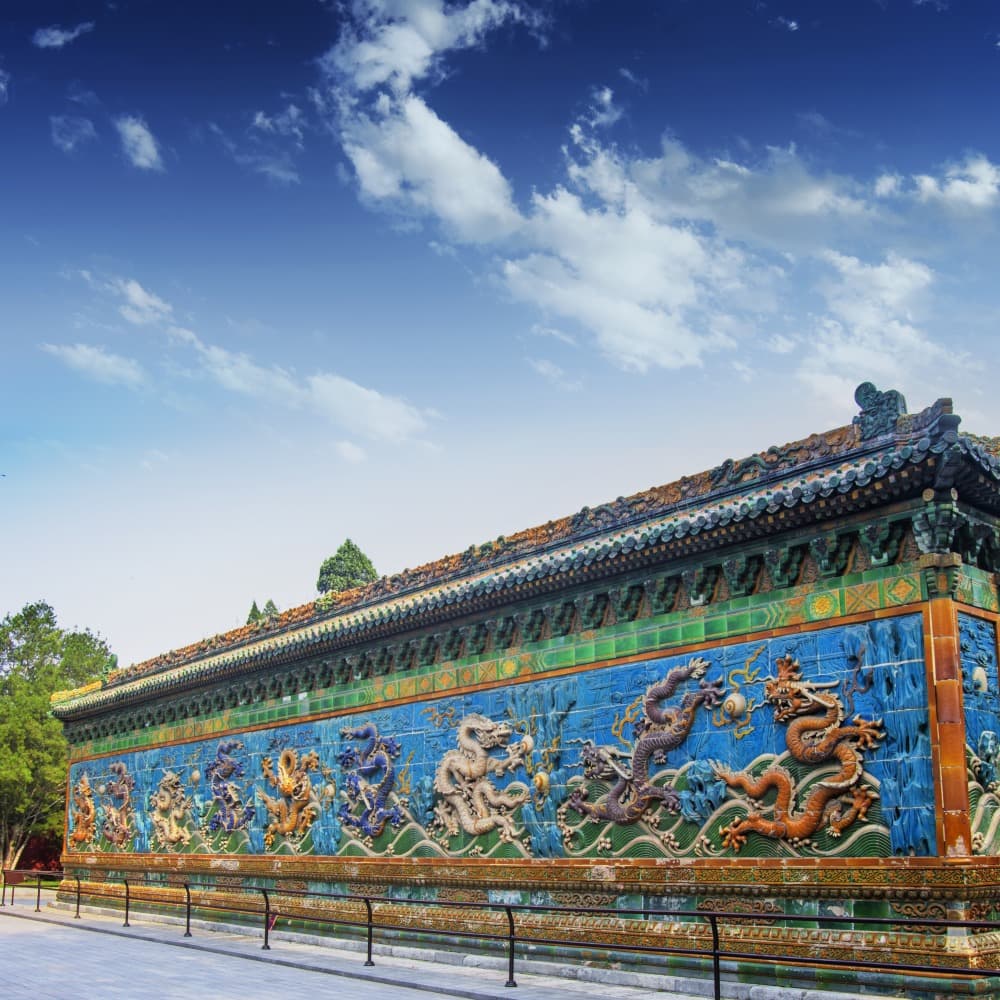
The Nine Dragons Wall of Datong, in Shanxi province, is one of three major nine-dragon walls remaining in China, alongside those in Beijing's Beihai Park and the Forbidden City. At 45 metres long and entirely composed of glazed ceramic tiles, it bears witness to imperial craftsmanship under the Ming dynasty.
Why visit the Nine Dragons Wall
This screen wall (yingbi) is the oldest and largest nine-dragon wall still visible in China. Its glazed ceramic façade, where colours have retained remarkable vibrancy despite nearly six centuries of existence, stands as precious testimony to Ming decorative arts. The symbolism of dragons—protective and imperial creatures—and the iconographic composition make it both an artistic and cultural monument, accessible within minutes of central Datong.
History and symbolism
The wall was erected in the late 14th century, during the reign of Emperor Hongwu, founder of the Ming dynasty, known by his personal name Zhu Yuanzhang (1328–1398). It was built before the residence of his thirteenth son, Prince Zhu Guidai, stationed in Datong. Its function is typical of Chinese screen walls: to ward off evil spirits, believed to travel only in straight lines, and to mark the entrance to a princely residence.
The choice of the number nine is no accident. In Chinese culture, 9 embodies perfection and imperial power, being the greatest yang number. The nine sculptured dragons also reference the "nine sons of the dragon" mentioned in the collection Huailutangji, each endowed with distinct character and attributes in Chinese mythological tradition.
What to observe on site
The wall measures 45 metres long, 8 metres high, and 2 metres thick. Its façade is composed of 426 glazed and varnished ceramic tiles, assembled to form a vast continuous frieze.
The iconography reads across multiple planes:
- At the centre, two dragons dispute a flaming pearl, symbolising wisdom and knowledge, a recurrent motif in Chinese art.
- Around them, the other seven dragons move among stylised clouds and waters, in varied postures of play, combat, or motion.
- The base and cornice, also ceramic, complete the composition with floral and geometric patterns.
Take time to observe the glaze variations (yellow, green, blue, violet) that give each dragon its distinct identity, as well as reflections in the basin sometimes positioned before the wall, which extends the composition through a mirroring effect.
Practical information
The wall stands on Dongjie Street in Datong's old town. The visit is quick: allow 30 minutes to 1 hour to tour the site and observe tile details.
- Hours: daytime opening, generally morning through late afternoon. Hours vary by season; verify on-site or with the tourist office.
- Admission: modest entry fee, sometimes included in a combined ticket with other old town sites.
- Best time: morning light particularly enhances the enamels. Avoid midday in summer, when Datong heat is intense.
How to get there
The site is central and easily accessible:
- From Datong railway station, bus line 4 serves directly the old town sector, near the wall.
- From major city-centre hotels, the wall is reachable on foot in 10 to 20 minutes.
- Local taxis and ride-hailing services offer a simple and affordable alternative.
Datong is connected by train to Beijing (approximately 5 to 6 hours by standard train, less by high-speed train) as well as to Taiyuan and Xi'an.
What to see in the region
Datong's old town lends itself to a walking visit after the wall. To extend your stay in China, several major historical sites are within reasonable distance:
- Datong, former northern capital, with restored ramparts and Buddhist temples.
- The Great Wall at Juyongguan, accessible on the route between Datong and Beijing.
- The Big Wild Goose Pagoda in Xi'an, another major Buddhist monument of the imperial era.
Frequently asked questions
Frequently asked questions
The number 9 is associated in Chinese culture with perfection and imperial power. The nine dragons also echo the "nine sons of the dragon" from Chinese mythology, mentioned in the collection Huailutangji, each endowed with particular symbolic attributes.
It is a screen wall (yingbi) placed before the residence of Prince Zhu Guidai, thirteenth son of Emperor Hongwu. Its function was to protect the palace entrance from evil spirits, believed to move only in straight lines, and to mark the rank of its occupant.
The two other major walls are located in Beijing: one in Beihai Park, the other in the Forbidden City. Datong's is the oldest and largest of the three.
Allow 30 minutes to 1 hour to observe the wall in detail. The visit easily fits into a half-day devoted to Datong's old town.
The wall does date from the Ming dynasty and retains most of its original structure and tiles. It has undergone successive restoration to preserve the glazed ceramics, particularly vulnerable to weathering.
Include Datong in your journey
Datong and its Nine Dragons Wall fit naturally into an itinerary linking Beijing, Shanxi, and Xi'an. To craft a bespoke stay blending imperial heritage, Buddhist sites, and grand landscapes, explore our China trips.
Interested in this visit?
We can include it in your personalised itinerary.