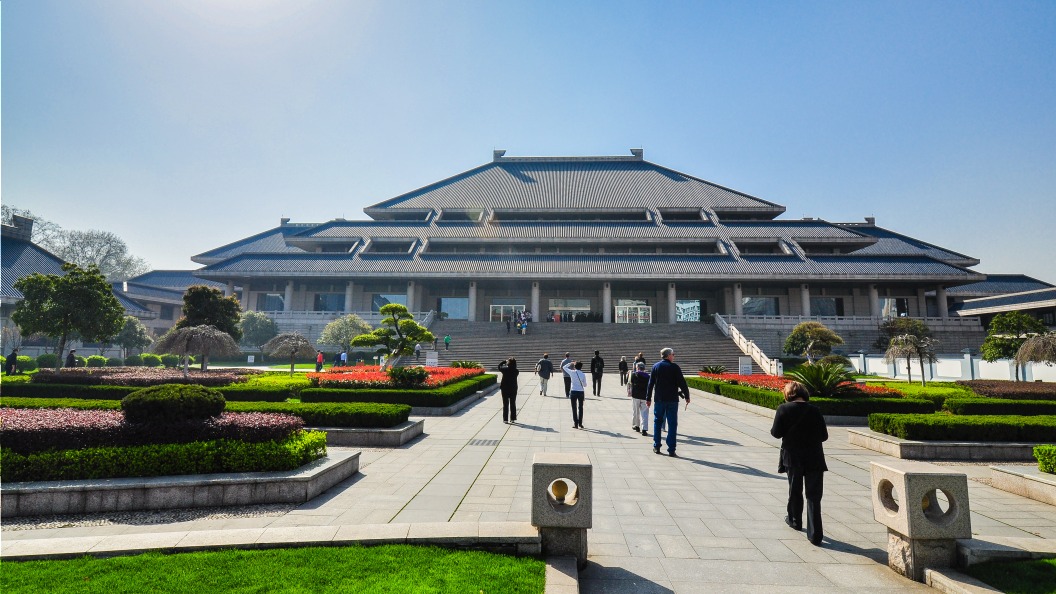
Gansu Provincial Museum
Gansu Provincial Museum
In Lanzhou, the Gansu Provincial Museum houses Han bronzes, Neolithic pottery and fossils—one of the great collections related to the Silk Road.
The Gansu Provincial Museum, located in Lanzhou on the banks of the Yellow River, preserves one of the most representative collections of Chinese archaeology linked to the Silk Road. Paleontological fossils, Han bronzes, Neolithic pottery and Buddhist objects trace several millennia of the province's history.
Why visit the Gansu Provincial Museum
- A reference collection on the Silk Road, including the famous Flying Horse bronze from the Han dynasty.
- A rich paleontological tour, featuring more than 400 fossils and a dozen restored skeletons.
- Painted pottery from the Dadiwan and Yangshao cultures, among China's oldest ceramic remains.
- Contemporary scenography in an 18,000 m² building inaugurated in late 2006.
- Free admission, making it an easy stop to include when passing through Lanzhou.
History of the institution
The museum was founded in 1939 as the Gansu Center for Scientific Education, at a time when the province sought to document its natural and archaeological heritage. It became the Northwest Science Museum in 1950, before taking its current name in 1956, after three years of renovation work carried out with the support of Soviet specialists.
A new exhibition building, larger and adapted to contemporary museum standards, opened to the public on December 26, 2006. The conservation center, established in 1961, operates a 212 m² workshop combining scientific laboratory, restoration space and assembly area. Its mission is to protect and restore objects from archaeological digs in the region.
What to see in the collections
The Flying Horse bronze
An emblematic piece of the museum, this Han dynasty bronze horse was unearthed from the Leitai tomb near Wuwei. It evokes the cavalry of Emperor Wudi, launched against the Xiongnu during the great campaigns of the 2nd century BCE. The figurine has become an official symbol of Chinese tourism.
The Pingliang bronze incense burner
Discovered at Zhuang temple in Pingliang, this bronze incense burner intrigues with its mechanism: its structure changes when opened and closed, and the object seems to resonate when used. Its design reveals advanced metallurgical skill, likely intended for aristocratic use.
Paleontological fossils from Gansu
The province is one of China's major fossil deposits. The dedicated hall presents more than 400 paleontological fossils and a dozen restored animal skeletons, including dinosaurs and Cenozoic mammals. The scenography plays with colors: blue to evoke the primordial ocean, ochre and red for the Mesozoic layer where dinosaur remains rest.
Painted pottery
The painted pottery of Gansu ranks among China's earliest ceramic testimony. Coming notably from the Neolithic Dadiwan and Yangshao cultures, they are decorated with geometric and symbolic patterns revealing the beliefs and daily life of their makers, thousands of years before our era.
Practical information
- Address: 3 West Xijin Street, Qilihe District, Lanzhou.
- Opening days: Tuesday to Sunday, closed Monday.
- Hours: open during the day, generally from mid-morning to late afternoon (verify seasonal hours before your visit).
- Admission: free entry, upon presentation of identification.
- Duration of visit: allow 2 to 3 hours to tour the main halls.
How to get there
The museum is located on the south bank of the Yellow River, about 8 km from Lanzhou railway station, in the Qilihe District. The most convenient landmark is the Friendship Hotel, located in the immediate vicinity. Many urban bus lines serve the Qiao Qilihe station, a few minutes' walk from the entrance. Taxi remains the simplest option from the station or downtown.
What to see around Lanzhou
The city is a transition point toward the Hexi corridor and the Silk Road. To extend your visit, consult our Lanzhou guide. Further west, the Thousand Buddha caves of Bezeklik offer another perspective on Buddhist art. Travelers heading toward Xi'an will appreciate the Great Wild Goose Pagoda, another major site of Chinese Buddhism.
Frequently asked questions
Frequently asked questions
Preparing your stop in Lanzhou
The Gansu Provincial Museum naturally fits into an itinerary combining the Silk Road, the Hexi corridor and major cities of western China. To build a tailor-made journey including this stop, explore our suggestions on traveling in China.
Interested in this visit?
We can include it in your personalised itinerary.