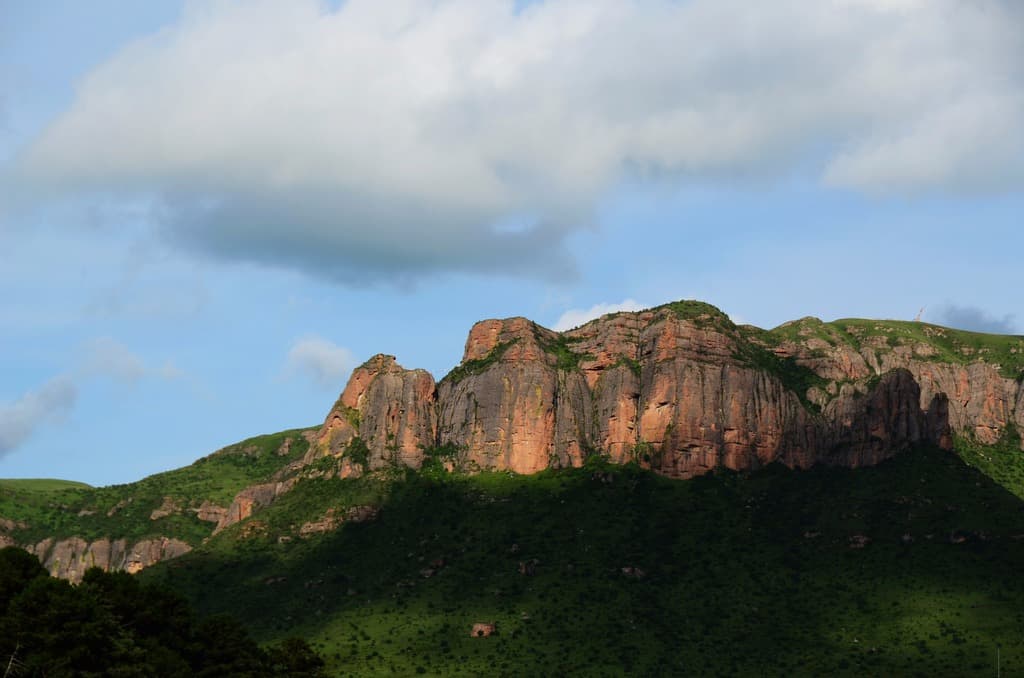
Red Rock Cliff Mountain (Hongshi Ya)
Red Rock Cliff Mountain (Hongshi Ya)
Above the Tibetan village of Langmusi, red sandstone cliffs offer panoramic views of two monasteries and yak-dotted meadows. An accessible hike from the village center at 3,500 meters elevation.
At the border between Gansu and Sichuan, the Tibetan village of Langmusi is framed by vivid red sandstone cliffs that stand in sharp contrast to the surrounding alpine grasslands. These rock formations, known locally as Hongshi Ya, rise dramatically above the village and rank among the region's most accessible hiking destinations. The climb offers direct views of the two Tibetan Buddhist monasteries that anchor community life in the valley.
What to See
The red sandstone cliffs rise steeply above the valley floor. From the ridgeline, the panorama sweeps across the gilded roofs of Sertri and Kirti monasteries, yak-grazed meadows, and forested hills that frame the horizon. Tibetan prayer flags punctuate the trails. Under clear skies, the golden light of dawn or dusk intensifies the ochre and vermillion hues of the stone.
History and Context
Langmusi is a Tibetan cultural crossroads inhabited by Tibetan, Hui, and Han communities. The red cliffs form part of the sacred landscape surrounding two monasteries founded in the 18th century. They serve as the setting for sky burial ceremonies practiced in the heights—a living Tibetan Buddhist tradition still observed in the region.
Highlights of Your Visit
The Northern Trail Ascent
A trail departs from near Sertri Gompa monastery and climbs toward the rocky ridgeline. The ascent is moderate, requiring no technical equipment. Plan for approximately one to two hours round-trip depending on your pace.
Panoramic View of Both Monasteries
From the cliff summit, both monasteries appear simultaneously in view—a rare perspective that illustrates the coexistence of the two religious communities separated by the Bailong River.
Light on Stone
Late afternoon sun, hanging low, intensifies the red sandstone's color. This is the most photographed moment by visitors present on site.
Etiquette and Visiting Guidelines
- Funeral sites: Certain high-altitude areas are used for Tibetan funeral ceremonies. Respect marked perimeters and do not photograph these spaces.
- Prayer flags: Do not touch or move prayer flags placed along trails.
- Discretion: If you encounter monks or families conducting ceremonies, keep your distance and avoid photography.
Photography Tips
- Morning light (around 7–9 a.m.) illuminates the cliffs from the valley floor.
- In late afternoon, climb to the ridge to photograph the monasteries with red rock in the foreground.
- Avoid photographing funeral sites and religious ceremonies.
- A wide-angle lens is useful for capturing the cliff-meadow-monastery vista in full.
Location and Access
Langmusi sits at the administrative border of Gansu and Sichuan at approximately 3,500 meters elevation. The village is accessible by bus from Hezuo (Gansu side) or Zoige (Sichuan side). The red cliffs are visible from the village center and reachable on foot. No motorized transport is needed to access the main trail.
Nearby attractions with links:
- Sertri Gompa Monastery — natural departure point for reaching the cliffs.
- Kirti Gompa Monastery — across the river, visible from the heights.
- Langmusi Gorges — narrow canyon accessible on foot from the village.
Surroundings
- Sertri Gompa Monastery — one of two major Tibetan monasteries in the village, active and open to visitors.
- Kirti Gompa Monastery — on the Sichuan side, known for monk debates in late afternoon.
- Zoige Prairie (Ruoergai) — vast Tibetan wetland a few hours south, home to black-necked cranes.
- Hezuo — Tibetan garrison town to the north, transit point with a nine-story monastery.
Frequently asked questions
May through October, when meadows are green and roads are clear. Winter is harsh at 3,500 meters elevation, and some access routes may be snow-covered.
The main trail is manageable without a guide. For exploring more remote areas or understanding the cultural context of funeral sites, a local Tibetan guide is recommended.
Yes. Langmusi is a compact village. One full day suffices to visit both monasteries and climb to the cliffs if you start early in the morning.
Photos of the cliffs and panoramic views are permitted. However, it is essential not to photograph funeral sites or ongoing religious ceremonies.
Langmusi sits at approximately 3,500 meters. If arriving from low elevation, allow a day to acclimatize before ascending the cliffs to avoid altitude sickness.
Interested in this visit?
We can include it in your personalised itinerary.