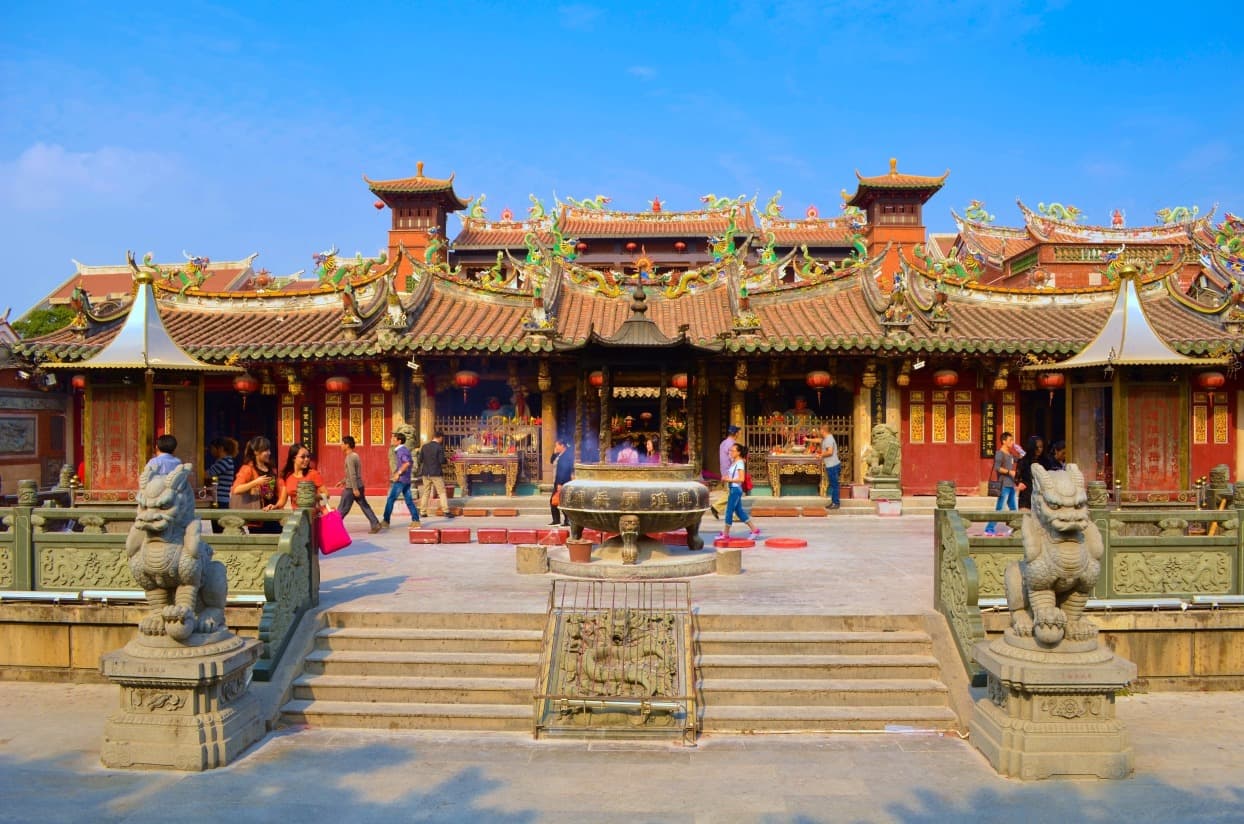
Guandi Temple in Quanzhou (Tonghuai Guandi Miao)
Guandi Temple in Quanzhou (Tonghuai Guandi Miao)
Dedicated to Guan Yu, god of loyalty and commerce, the Guandi Temple in Quanzhou is an active Taoist place of worship in the heart of the old town, a UNESCO World Heritage site.
In the heart of Quanzhou's old town, the Guandi Temple — officially Tonghuai Guandi Miao — is dedicated to Guan Yu, a deified general from the period of the Three Kingdoms. Revered as the god of war, loyalty, and commerce, it attracts both the faithful and visitors curious about the religious architecture of Fujian. It is one of the most frequented Taoist temples in southeastern Chine.
Practical information at a glance
- Admission: free
- Suggested duration: 30 to 45 minutes
- Dress code: modest attire recommended; shoulders and knees preferably covered
- Access: located on Tujie Street (Tonghuai Road), accessible on foot from the historic center
What to see
The temple features typical Fujian architecture: saddle-shaped roofs with pronounced curves, glazed green and yellow tiles, carved wooden beams. The main courtyard houses an imposing statue of Guan Yu, flanked by his lieutenants Zhou Cang and Guan Ping. Monumental incense burners occupy the courtyard, constantly replenished by devotees.
History and context
The temple is said to have been founded during the Song Dynasty (960–1279), a period when Quanzhou was one of the world's most active ports. Guan Yu, a figure of absolute loyalty, was adopted by merchants as a protector of commerce. The site has been restored several times, notably under the Ming and Qing dynasties. It bears witness to the religious syncretism characteristic of Quanzhou, a city inscribed on the UNESCO World Heritage List in 2021.
Highlights of your visit
The incense courtyard
The atmosphere is striking: incense spirals suspended from the ceiling, sticks burning continuously, dense smoke filtering the light. Devotees practice divination using jiaobei (crescent-shaped wooden blocks) and consult the oracles.
Wood and stone carvings
The beams and columns bear finely worked bas-reliefs: dragons, phoenixes, battle scenes. The columns in local granite are characteristic of southern Fujian architectural style.
Daily religious life
Unlike many temples that have become museums, this one remains an active place of worship. Attending morning or evening rituals offers an authentic glimpse into Chinese popular devotion.
Etiquette and visiting rules
- Speak in hushed tones and avoid loud behavior during rituals.
- Do not touch the statues or ritual objects.
- Ask permission before photographing devotees at prayer.
- Avoid pointing your feet toward the altars.
Photography tips
Early morning light, before crowds arrive, is ideal for photographing carved details and the play of incense smoke. A standard or slightly wide-angle lens works well for the main courtyard. Photography is generally permitted, except as noted in interior halls.
Location and access
The temple is located on Tonghuai Road, a historic artery in Quanzhou's city center. It is a few minutes' walk from the Qingjing Mosque and the Kaiyuan Temple. The neighborhood is dense and lively; walking remains the best way to reach it from the main historic sites. Wheelchair access is limited due to traditional doorway thresholds.
Nearby attractions
- Kaiyuan Temple — a grand Buddhist temple from the Tang Dynasty, a few hundred meters to the northwest.
- Qingjing Mosque — one of the oldest mosques in Chine, testament to medieval Arab presence in Quanzhou.
- Zhongshan Street — a historic axis lined with colonial arcades, ideal for a stroll between sites.
Frequently asked questions
Admission is free. The temple remains an active place of worship open to all.
Modest attire is recommended: shoulders and knees covered. No strict rules are imposed, but respect for the place of worship is essential.
Photography is generally permitted in the courtyard and common areas. Avoid photographing devotees at prayer without their consent.
Allow 30 to 45 minutes for a leisurely visit. Combined with the Qingjing Mosque and Kaiyuan Temple, plan half a day for the historic district.
Spring (March–April) and autumn (October–November) offer pleasant temperatures. Taoist festivals, particularly around the Lunar New Year, are especially lively at the temple.
Access is limited: traditional doorway thresholds and steps make wheelchair access difficult.
Interested in this visit?
We can include it in your personalised itinerary.
