Qingshui Yan Temple (清水岩)
Qingshui Yan Temple (清水岩)
Clinging to the forested cliffs of Anxi, Qingshui Yan Temple is the mother sanctuary of a Hokkien faith present in over 1,000 temples worldwide. A major pilgrimage site in Fujian, where Song architecture meets pristine nature.
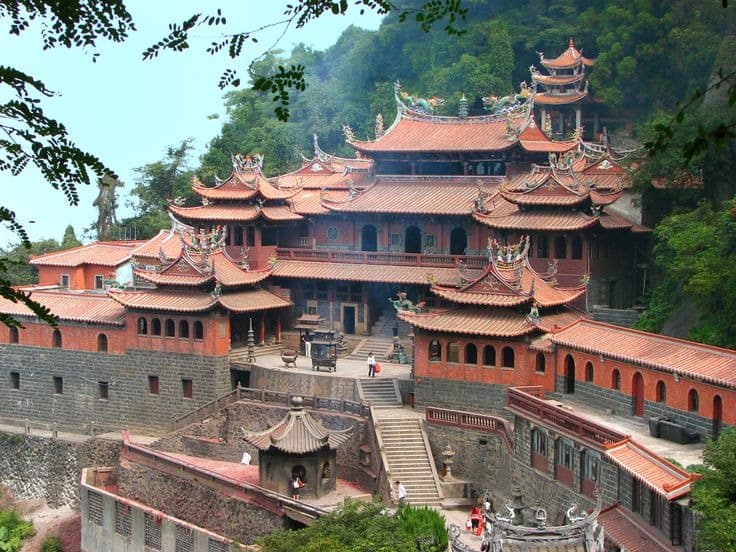
Qingshui Yan Temple clings to the forested cliffs of Anxi District, west of Quanzhou. Dedicated to "Master Qingshui," a deified Buddhist monk from the Song Dynasty, it ranks among Fujian's most frequented pilgrimage sites. Its renown extends far beyond mainland Chine: millions of devotees from Taiwan, Southeast Asia, and Hokkien communities worldwide make the journey here annually.
Quick Facts
- Access: Anxi is reachable from Quanzhou by bus or car (roughly 1 hour 30 minutes). Local buses connect Anxi town to the temple.
- Recommended duration: 2 to 3 hours for the temple and surrounding trails.
- Dress code: Smart casual recommended; avoid very short shorts in worship halls.
- Rules: Respect ceremonies in progress; do not touch offerings or statues.
What You'll See
The complex rises across multiple tiers carved into the rock face. The main buildings house the statue of Master Qingshui, surrounded by altars thick with incense smoke. The glazed tile roofs with their distinctive upturned eaves—typical of Fujian's religious architecture—contrast beautifully with dense vegetation. Covered galleries connect secondary pavilions, offering views across the wooded valley below.
History and Context
The temple was founded during the Song Dynasty (960–1279) in honour of Chen Rongzu, a monk renowned for his healing powers, later canonised as "Master Qingshui." Worship spread with Hokkien migration to Taiwan and Southeast Asia during the 17th–19th centuries. Today, Anxi's temple stands as the mother sanctuary of over 1,000 temples dedicated to this deity worldwide.
Highlights of Your Visit
The Main Hall and the Statue of Master Qingshui
The temple's heart houses an ancient statue of the deified monk, darkened by centuries of incense smoke. The atmosphere grows dense during pilgrimages, with chanting, burning of spirit money, and fruit offerings.
The Cliffs and Natural Caves
The site's name—"pure water rock"—comes from a spring that gushes from the cliff face. Natural caves integrated into the architecture shelter secondary altars. Trails along the rock wall reveal how the buildings embrace the terrain itself.
Pilgrimages and Festivals
Events tied to the lunar calendar, especially Master Qingshui's birthday, draw crowds from Taiwan and overseas. These moments offer vivid insight into Hokkien religious life.
Etiquette and Visiting Rules
- Remove your shoes if a sign indicates so at a hall's entrance.
- Do not photograph worshippers at prayer without their consent.
- Avoid pointing your feet toward altars when seated.
- Speak softly in active worship halls.
Photography Tips
Morning light, before pilgrims arrive in large numbers, is ideal for capturing the tile roofs and carved details. Incense smoke creates compelling backlighting effects. From upper trails, you can frame the entire complex against the forest backdrop.
Location and Access
The temple lies in Anxi District, west of Quanzhou, in Fujian Province. From Quanzhou's centre, allow roughly 1 hour 30 minutes by bus or car. Local buses run between Anxi town and the site. Accessibility for mobility-impaired visitors to upper levels is limited due to elevation changes and stairs.
Nearby
- Qingjing Mosque, Quanzhou — one of Chine's oldest mosques, testament to the city's mercantile past.
- Kaiyuan Temple — major Buddhist complex in central Quanzhou, crowned by two iconic Song pagodas.
- Zhongshan Street — historic thoroughfare in Quanzhou lined with colonial arcades and traditional shops.

Interested in this visit?
We can include it in your personalised itinerary.