Zhiyuan Temple (祗园寺)
Zhiyuan Temple (祗园寺)
Zhiyuan Temple is the largest monastery on Jiuhuashan, a sacred Buddhist mountain in Anhui Province. Dedicated to Dizang Bodhisattva, it blends Ming architecture, active monastic life, and an atmosphere of authentic pilgrimage.
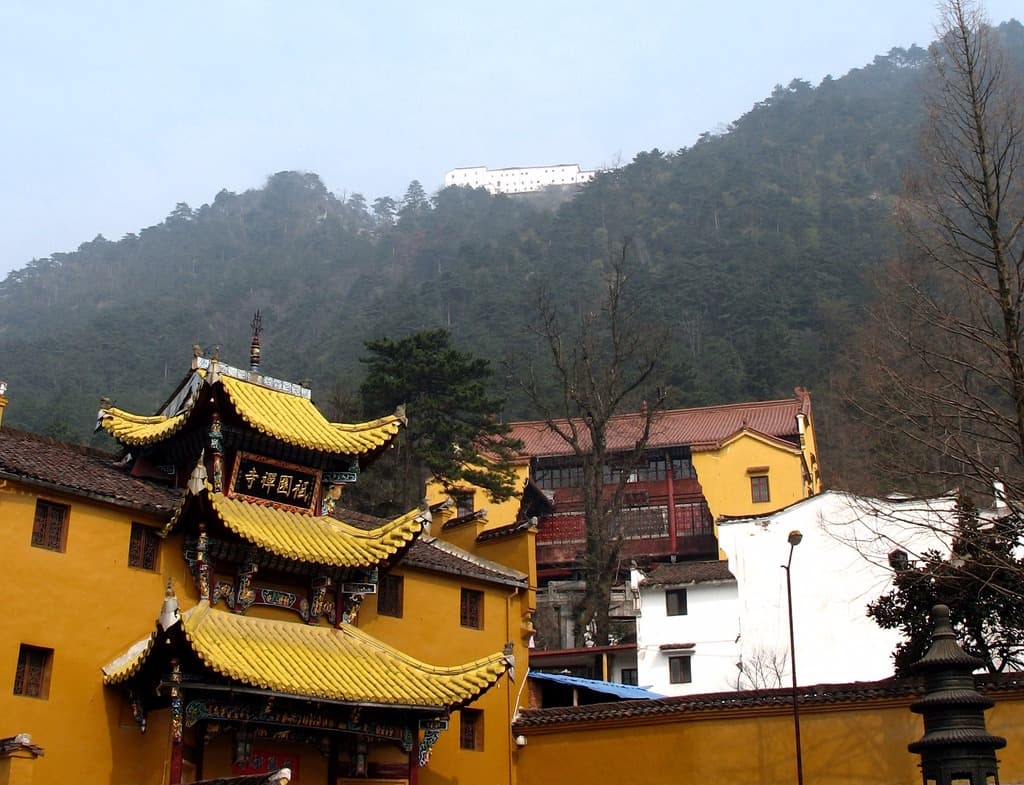
Zhiyuan Temple is the largest monastic complex on Jiuhuashan, the sacred Buddhist mountain in Anhui Province. Dedicated to Dizang Bodhisattva (Kṣitigarbha), guardian of the souls of the deceased, it forms the spiritual and architectural heart of the site. Its golden roofs stand in contrast to the dense forest surrounding the massif, and its inner courtyards host an active monastic community year-round.
Quick Reference
- Entrance: fee required (included in Jiuhuashan's main ticket or available separately at the temple gate)
- Dress code: shoulders and knees must be covered; respectful behaviour in prayer halls is expected
- Recommended duration: 1 to 1.5 hours for a complete tour of the courtyards and main pavilions
- Access: from Jiuhuajie village, on foot or by local shuttle; the temple is accessible without a cable car
What You'll See
The complex is organised around several successive courtyards connected by stone staircases. The main hall houses an imposing statue of Dizang Bodhisattva surrounded by eighteen arhats. The double-eaved roofs covered with golden yellow tiles are characteristic of the region's Buddhist architectural style. Grey-robed monks move between pavilions, maintaining an atmosphere of genuine practice rather than mere tourist spectacle.
History and Context
Jiuhuashan is one of the four sacred mountains of Chinese Buddhism. Zhiyuan Temple was founded during the Ming Dynasty and reconstructed or enlarged several times, notably under the Qing. Its name, "Zhiyuan," evokes Jetavana, the Indian garden where the Buddha taught. The site is closely linked to the Korean monk Kim Gyo-gak (Jìnqiáojué), venerated as an incarnation of Dizang, who lived and died on this mountain in the 8th century.
Highlights of Your Visit
The Hall of Dizang Bodhisattva
This is the temple's central sanctuary. The main statue, tall and gilded, is surrounded by permanent incense offerings. Attending a morning prayer session allows you to hear liturgical chanting in its authentic context.
The Golden Roofs Viewed from the Lower Courtyard
From the first courtyard, you can take in the entire main façade with its layered roofs. This is the most photographed angle of the temple, especially when morning mist envelops the surrounding hills.
The Side Courtyards and Secondary Pavilions
Less frequented, these areas house calligraphed stelae, bells, and ritual drums. They offer a glimpse into monastic daily life, away from the crowds in the central courtyards.
Etiquette and Visitor Guidelines
- Remove your shoes before entering certain interior halls (signage on site indicates where).
- Do not point at statues; a slight bow as a sign of respect is appreciated.
- Speak in low voices, particularly during services.
- Do not photograph monks without their explicit consent.
- Incense can be purchased at the entrance; follow staff instructions for proper use.
Photography Tips
Morning light (before 9 a.m.) is ideal: it strikes the golden roofs directly, and mountain mist creates natural depth. From the lower courtyard, a wide-angle lens captures the entire façade. On days of light rain, reflections on the stone paving add interesting graphic dimension. Photography is generally permitted in the outer courtyards; check signage before photographing inside halls.
Location and Access
Zhiyuan Temple is located in Jiuhuajie village, at the foot of the Jiuhuashan massif, in Qingyang County (Anhui). It is accessed from the city of Chizhou, which is connected to Nanjing and Shanghai by high-speed rail. Local buses link Chizhou station to the Jiuhuashan entrance. The temple is accessible on foot from the main village square, with no cable car required. Accessibility for visitors with reduced mobility is limited due to numerous stone staircases.
Nearby Attractions
- Roushen Temple (肉身殿) — houses the mummified body of Kim Gyo-gak, venerated as a sacred relic; a major pilgrimage site on the mountain.
- Tiantai Peak — the main summit of Jiuhuashan offering a panorama of the entire massif and temples below.
- Baisui Temple (百岁宫) — a monastery perched on a rocky outcrop, accessible by cable car, housing another mummified venerated monk.
Frequently asked questions
Spring (April–May) and autumn (September–October) offer pleasant temperatures and spectacular vegetation. Summer is misty and cool at altitude, but very busy during Chinese national holidays. Winter sometimes brings snow, transforming the site but making some trails slippery.
Yes. Shoulders and knees must be covered. Covering garments can sometimes be borrowed or purchased at the entrance, but it is best to wear appropriate clothing. Avoid overly bright colours or prints considered disrespectful.
Yes. Zhiyuan Temple, Roushen Temple, and Baisui Temple are the three most visited sites. Starting early, it is possible to see all three in one day using local shuttles and the cable car for Baisui. Plan a full day to avoid rushing.
In the outer courtyards, yes. Inside prayer halls, signage indicates photography-restricted zones. Respect these restrictions and never photograph monks without their consent.
Take a high-speed train to Chizhou, then a bus or taxi to the Jiuhuashan entrance. From Nanjing, the train journey is about one hour. From Shanghai, allow two to three hours depending on the train.
Photos
Interested in this visit?
We can include it in your personalised itinerary.