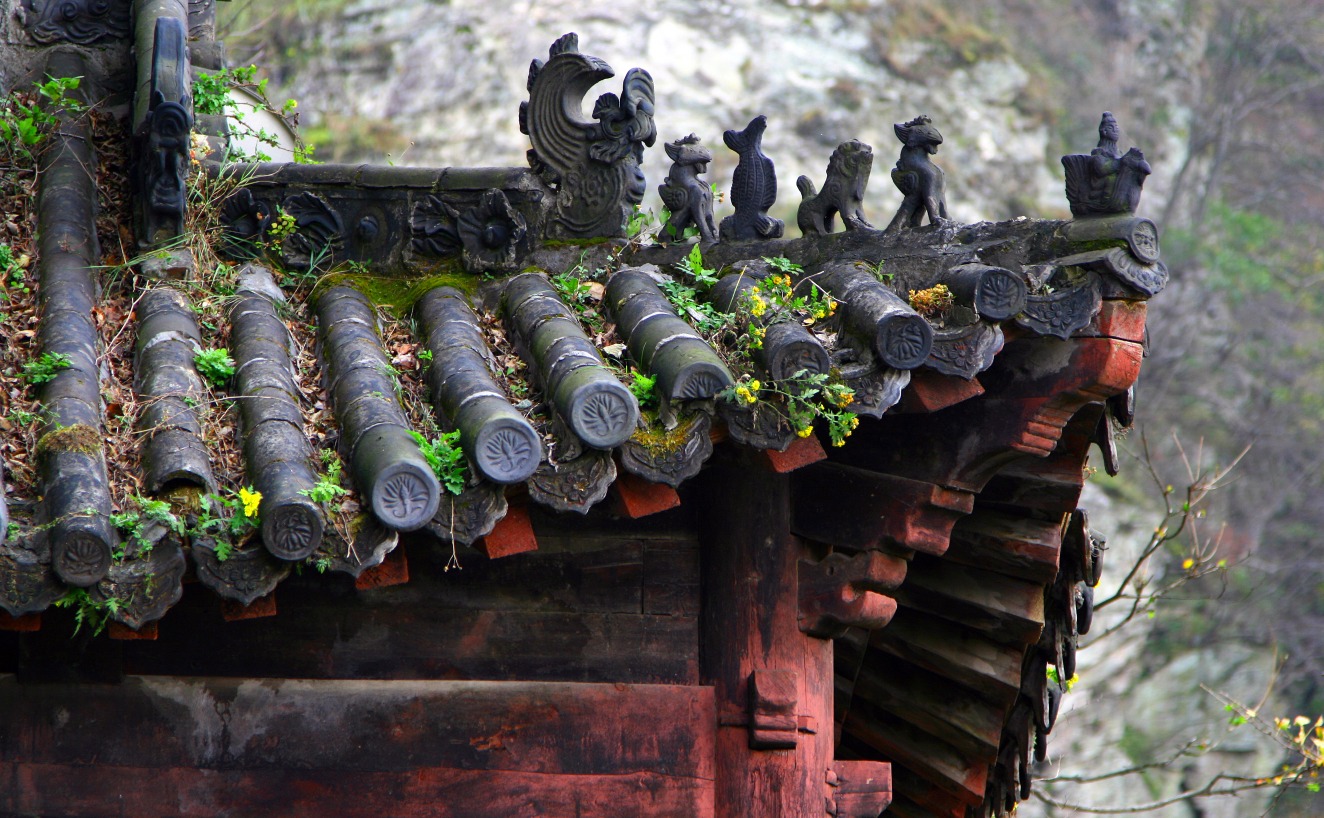
Hua Shan
Hua Shan
One of China's five sacred mountains, Hua Shan combines thousand-year-old Taoist temples, vertiginous trails and spectacular vistas just 120 km east of Xi'an.
Mount Hua, or Hua Shan, located approximately 120 km east of Xi'an in Shaanxi province, ranks among China's five sacred mountains.
Hua Shan owes its renown to its exceptional trails, considered among the world's most challenging for hikers.
History
In the 2nd century BCE, Taoist practitioners built a temple at the mountain's base. At that time, Taoists believed the mountain was home to the god of the underworld. This sanctuary was frequently used by mediums to contact the deity and his subordinates. Unlike Taishan, which became a major pilgrimage site, Huashan remained relatively isolated due to its inaccessible peaks, welcoming only a few imperial pilgrims and local visitors.
Mountain Hua was nonetheless significant for those seeking immortality. Its dense vegetation sheltered numerous medicinal plants, enabling the creation of healing remedies. Kou Qianzhi (365–448), founder of the Celestial Masters of the North (a Taoist movement), and Chen Tuan (920–989), a legendary Taoist sage who spent much of his life on the mountain's western ridge, are said to have received revelations here.
In the 1230s, all temples on the mountain were placed under the authority of the Quanzhen Taoist school. In 1998, Hua Shan's management committee transferred responsibility of most temples to the China Taoist Association to protect the environment and discourage poaching and illegal logging in these sacred spaces.
The Peaks of Hua Shan
Huashan sits 120 km east of Xi'an. The mountain comprises five peaks and reaches nearly 2,200 meters in elevation. To the north, the Cloud Terrace Peak (North Peak) rises to 1,613 meters; at the center, the Jade Maiden Peak stands at 2,042 meters; to the east at 2,100 meters lies the Sun Peak (Zhaoyang Peak or East Peak); the Lotus Peak (Lianhua Peak) to the west reaches 2,038 meters; and finally, to the south, the Luoyan Peak (South Peak) culminates at 2,154 meters.
Ascending the North Peak and Other Summits
Climbing the North Peak, Hua Shan's lowest summit, allows you to continue toward the other peaks.
Three routes lead to the North Peak: the first is simply taking the cable car, which reaches the summit in minutes.
The second option follows the steep hiking trail beneath the cable car, nicknamed the Soldiers' Path. It takes about two hours to reach the summit. The ascent is very steep, consisting mainly of stairs carved into the rock face. More challenging than the main 6 km hike, this trail offers genuine difficulty and an adrenaline rush. However, an alternative route has been constructed to minimize unnecessary risks and provide an easier path for those prone to vertigo or needing a break. The view that gradually unfolds as you climb more than compensates for your physical effort.
The final option follows the most frequented yet visually spectacular route. This 6 km path starts from the Huashan village and reaches the North Peak summit. The trail presents no difficulties for the first 4 kilometers but finishes with steep stairs. Plan for approximately 4 hours of hiking to reach the top. The walk takes you through the mountain across lush forest, occasionally offering breathtaking views of mountains and valleys. Along the way, you can stop to visit several standing Taoist temples and monasteries, such as the Jade Spring Temple or the Xiyue Temple.
Once you reach the North Peak, enjoy the magnificent panorama before you. You may then descend by cable car or continue toward the other peaks.
The trail connecting the other peaks, called the Green Dragon Ridge, is sometimes extremely narrow and can be dangerous in rain.
To reach the South Peak, the highest summit, you can attempt the "Hillside Path," the world's most dangerous hiking trail, formed of wooden planks nailed into the rock face. Those who venture here typically rent safety harnesses to cross this vertiginous passage. The vastness surrounding the peak creates the impression of standing on the roof of the world.
The East Peak, or Sun Peak, features an observation platform to enjoy the sunrise. Tourists sometimes set out in the middle of the night to reach the summit and watch the sun emerge from behind the mountains.
The complete peak circuit takes about 4 hours of hiking; be careful not to be caught by darkness, as descending without light can be dangerous. Back at the North Peak, you can opt for convenience by taking the cable car or descend via the main trail, requiring approximately 2 additional hours of hiking.
Mount Hua: The World's Most Dangerous Hiking Trail
Myth or reality? Are the trails leading to the summit truly dangerous?
The Mount Hua known to tourists as the "world's most dangerous hiking trail" is not actually as risky as its reputation suggests. Climbing to the North Peak requires no particular technical rock climbing skills or exceptional physical fitness. However, some older trails still in use do present difficulties with very steep stairs carved into cliff faces. Although certain passages have been closed and replaced with more manageable paths, you can add difficulty by following the "Soldiers' Path," which consists mainly of stairs carved into rock.
The greatest safety concern often stems from overcrowding during summer months. As one of China's five sacred Taoist mountains, Hua attracts hundreds of thousands of Chinese tourists annually. Although most prefer the cable car option, the trails among the peaks frequently become congested in summer.
Access
From Xi'an Railway Station, the train heading to Zhengzhou stops at Huashan North. Afterward, minibuses transport travelers to the mountain.
Regular buses shuttle from Xi'an station to the small Huashan village.
Return to Xi'an is available late in the day by bus or train.
Admission Prices
Prices vary by season, but visiting in winter with snow is strongly discouraged.
Expect 200 Yuan per person for natural park entry. Those with a valid student card benefit from substantial discounts.
A round-trip cable car to the North Peak summit costs 150 Yuan. A one-way trip is 80 Yuan.
The cable car to the West Peak costs 150 Yuan for a one-way journey.
Want to discover this destination?
Our local advisors design your tailor-made trip.