Zhenjiang
Zhenjiang
Just 70 km from Nanjing, Zhenjiang unveils its Three Hills crowned with Buddhist temples, its thousand-year-old Grand Canal and its legendary black vinegar.
Name: Zhenjiang
Chinese name: 镇江市
Province: Jiangsu
Status: Prefecture-level city
Population: 3,113,384
Area: 3,847 km²
Zhenjiang is a city in the southwest of Jiangsu Province, just 70 km from Nanjing. Located at the confluence of the Yangtze River and the Grand Canal, the city is surrounded by mountains that create a stunning landscape cherished by travelers.
History
The history of the region surrounding Zhenjiang may stretch back more than 3,000 years to the Zhou Dynasty.
It bore many different names throughout successive dynasties until it acquired its current name during the Northern Song Dynasty (1127–1279). Its geographical position became exceptionally advantageous when the Grand Canal was constructed. It then served as a hub for collecting and shipping agricultural taxes before specializing in silk production, satin, and metalwork.
During the First Opium War, the city fell into British hands, followed by the Taiping during the Taiping Rebellion (1850–1864). The closure of part of the Grand Canal in the 1850s forced Zhenjiang into decline.
From 1928 to 1949, when Nanjing was the capital of Chine, Zhenjiang was considered the provincial capital of Jiangsu.
Today
Zhenjiang is a rather pleasant city that has unfortunately allowed its old town to gradually disappear in favor of modern new construction. Nevertheless, it is still possible to discover, around street corners, cobblestone alleys that have retained all their former charm.
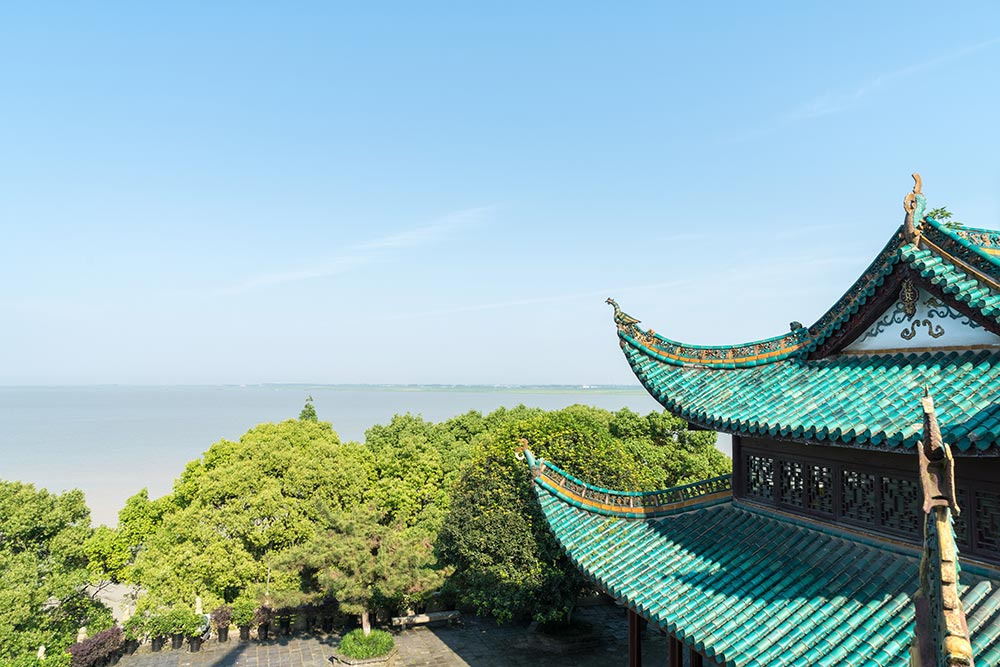
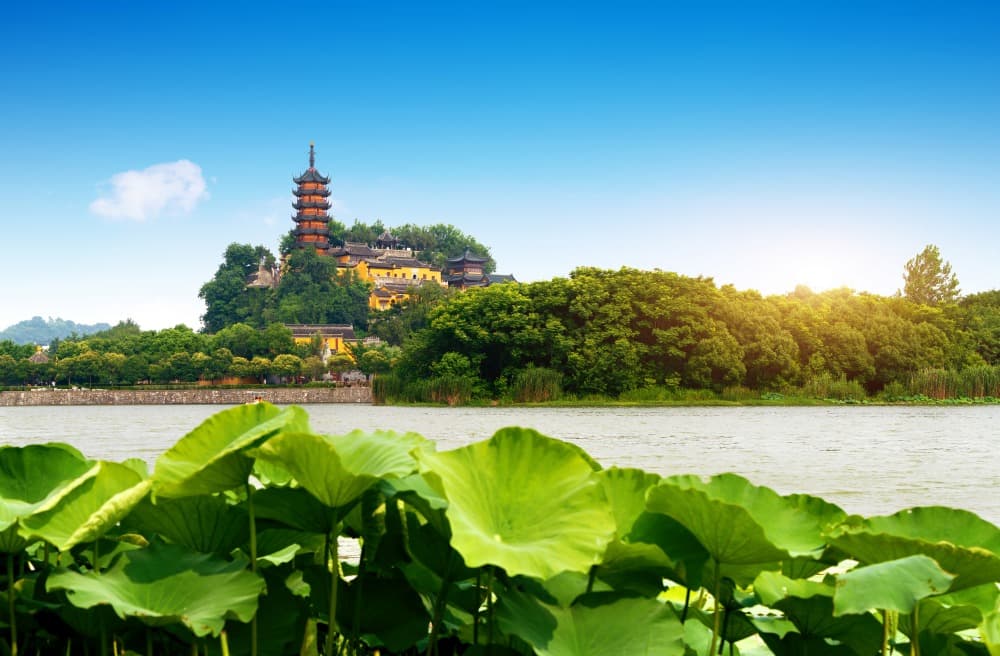
The most sought-after tourist attraction in Zhenjiang remains the Three Hills: Gold Hill, Jiao Mountain, and Beigu Hill. With heights under 100 meters, they overlook the Yangtze River with steep and dramatic cliffs. They shelter a few temples that struggle to maintain their presence amid dense vegetation.
The Jinshan Park or Gold Hill Park is one of Zhenjiang's most popular tourist sites. This park forms a small peninsula crowned by a hill on the Yangtze. It houses the Jinshan Temple, a Buddhist structure, and the Cishou Pagoda, a seven-story tower from which you can enjoy magnificent views of the city and river. The hill also features several small grottos, two of which are regularly featured in children's fairy tales.
The Beigu Hill Park or North Hill is an ideal place to discover the vast Yangtze River. This small oasis welcomes the Ganlu Temple, built during the Tang Dynasty, as well as the picturesque Ascending Clouds Pavilion.
Complete your visit with Jiao Mountain, distinguished from the other two by its lush vegetation and mountainous terrain. Jiao Mountain is a perfect opportunity for outdoor exploration. Stop at the Xijiang Tower to enjoy another beautiful view of the Yangtze, and continue to the Buddhist monastery, Dinghui Si.
Climate
Like Nanjing, Zhenjiang experiences a subtropical monsoon climate with four distinct seasons.
Summers are very humid with heavy rainfall from the monsoon. Winters are cold and damp, making them less pleasant.
The best months to visit Zhenjiang are April, May, September, and October.
Train
Zhenjiang lies on the Nanjing–Shanghai railway line and is therefore easily accessible by train from these cities.
Bus
Zhenjiang has three bus stations. One primarily operates local service, another offers express buses to and from Nanjing, Shanghai, Wuxi, and Suzhou, and the third handles long-distance routes to and from major surrounding cities.
Taxis and local buses make it easy to navigate throughout the city. Buses 2 and 4 follow convenient routes for visiting sites of interest.
What to Do in Zhenjiang?
- Stroll through Jinshan Park, Jiao Mountain, and Beigu Hill respectively.
- Take in the city rooftops while discovering some artifacts at the Zhenjiang Museum.
- Wander through the well-preserved alleyways of the old town.
Want to discover this destination?
Our local advisors design your tailor-made trip.