Dongyue Taoist Temple
Dongyue Taoist Temple
Founded in 1319 east of Beijing, the Dongyue Taoist Temple brings together 76 ritual departments, 90 ancient stelae and the Beijing Folklore Museum.
The Dongyue Taoist Temple, whose name means "Eastern Peak," stands east of central Beijing, in the Chaoyang district. Dedicated to the great deity of Mount Tai, the Taoist god of the underworld, it represents one of the most extensive Taoist complexes in northern Chine and also houses the Beijing Folklore Museum.
Why visit Dongyue Temple
The site combines three interests rarely found in a single location in Beijing: Yuan-Qing architectural heritage spanning 47,000 m², comprehensive Taoist iconography through its 76 departments populated with statues, and an ethnographic museum containing over 1,600 artifacts. Unlike more frequented monuments in the center, Dongyue remains an active temple where one can still observe the ritual practices of the faithful: incense offerings, money deposits, red tokens (fupai) hung in the courtyards.
History
The temple was constructed in 1319 during the Yuan dynasty, at the initiative of Taoist monks, Chinese officials and descendants of the founder of Taoism. Only the main hall and entrance gates were completed initially; the entire complex was finished in 1322.
The complex was expanded during the reign of Emperor Qianlong (1735-1799), under the Qing dynasty. This phase added secondary courtyards and several ritual pavilions.
During the Cultural Revolution, the temple was damaged, stripped of its religious function, then transformed into an administrative office before serving as a school. A first restoration campaign took place in 1996, followed in 1999 by a renovation of the main courtyard, which then reopened to the public.
What to see
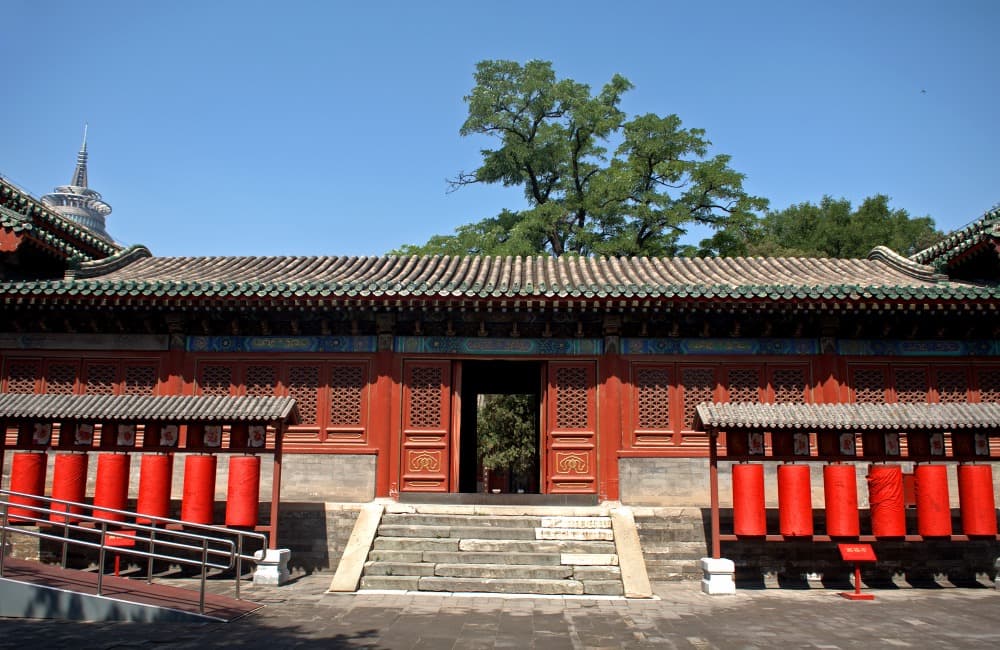
Beyond the red gate, a royal pathway called "the road of happiness" traverses the complex from south to north and leads to three successive courtyards. The layout remains faithful to the original Yuan plan, expanded during the Qing period.
The main palace and the god of Mount Tai
The central palace contains a main hall flanked by two secondary halls. Pillars and roofs are enhanced with gilded dragon sculptures. The central hall houses the statue of the god of Mount Tai, surrounded by his courtiers, beneath a colorful framework typical of ritual architecture in the north.
The 76 Taoist departments
A major feature of the site: more than 350 rooms house the 76 departments that structure the temple's cosmology. Each compartment is identified by a plaque specifying the deities represented and has a box for offerings: money, incense, or "fupai" (red tokens). Among the most renowned departments are those of compassion, mercy, accumulation of wealth and punishment. The latter, populated with demonic figures, particularly attracts visitors curious about infernal iconography.
Stelae and folklore museum
The lateral pavilions preserve 90 stone stelae from the Yuan, Ming and Qing dynasties, one of the densest epigraphic collections in Beijing. The Beijing Folklore Museum, integrated into the site, displays over 1,600 artifacts covering the customs, trades, festivals and popular beliefs of the region.
When to visit
The site is open year-round. The most lively period is the temple fair organized during Chinese New Year (late January to mid-February depending on the year): decorated courtyards, traditional games, performances, calligraphy demonstrations and exhibitions of Beijing folk culture. Outside festival periods, spring and autumn are ideal for enjoying the courtyards without summer heat or the dry cold of Beijing winters.
Practical information
- Moderate entrance fee, combined ticket with the folklore museum.
- Allow 1.5 to 2.5 hours to tour the three courtyards, central palace and museum.
- Open daily during daytime hours; the museum closes earlier than the temple, verify current hours before your visit.
- Appropriate dress recommended, as the site remains an active place of worship.
How to get there
The temple is located approximately 500 meters east of Chaoyang metro station, in the Chaoyang district east of central Beijing. Several metro lines and bus routes serve the area; the simplest option is the metro, followed by a short walk. Local navigation apps (Baidu Maps, Amap) are the most reliable sources for bus routes, which are subject to change.
Nearby attractions
The Chaoyang district and Beijing's historic center offer several natural extensions to your visit:
- The Bell Tower and Drum Tower, in old Beijing, for another perspective on imperial heritage.
- The Baigongfang Crafts Museum, a useful complement to Dongyue's folklore museum.
- The Beijing Botanical Garden, for a half-day nature experience on the outskirts.
Frequently asked questions
Frequently asked questions
Planning your visit
Dongyue Temple fits easily into a Beijing visit, as a half-day excursion combined with other sites in the Chaoyang district. To plan a coherent itinerary across the country, consult our journeys in Chine.
Interested in this visit?
We can include it in your personalised itinerary.