Garden of Virtue and Harmony
Garden of Virtue and Harmony
At the heart of Beijing's Summer Palace, this garden houses the private theatre of Empress Cixi, one of the three great opera pavilions of the Qing dynasty.
The Garden of Virtue and Harmony (Deheyuan) is a complex of courtyards and pavilions located within the Summer Palace of Beijing, in the Haidian district northwest of the capital. Designed during the reign of Emperor Guangxu for Empress Dowager Cixi, it houses one of the three great opera theatres of the Qing dynasty and has been part of UNESCO's World Heritage since 1998.
Why visit the Garden of Virtue and Harmony
This garden concentrates, within a compact space, several complementary points of interest. It first offers rare testimony to court life at the end of the Qing dynasty, through the private apartments and theatre of Empress Cixi. It also allows visitors to observe an intact example of imperial theatrical architecture: the Grand Theatre is one of the three surviving opera pavilions from that era, alongside the Qingyin Pavilion in Chengde and the Changyin Pavilion in the Forbidden City.
The site distinguishes itself finally through the quality of its collections displayed on-site: carved throne, jade screen, songbirds in cages from various countries, opera costumes and accessories. The ensemble forms a coherent stop during a visit to the Summer Palace, into which it integrates naturally.
History of the garden
A first garden was laid out on the site as early as 1750, when the sector was part of the imperial lands northwest of Beijing. The complex was then called the Qingyi Garden and served as a place of leisure for the Qing court.
The site was severely damaged in 1860 during the Second Opium War, when Franco-British troops devastated the imperial gardens in the surrounding area. Major reconstruction was launched at the end of the 19th century: the Garden of Virtue and Harmony as seen today was built from 1891 to 1896, during the reign of Emperor Guangxu, at the request of Empress Dowager Cixi, who wished to have a private theatre at the heart of the Summer Palace.
In 1900, during the intervention of the Eight-Nation Alliance against the Boxer Rebellion, the complex was again damaged, then restored in the following years. The garden was opened to the public in 1924, after the fall of the empire. Its inscription to UNESCO World Heritage in 1998, as part of the Summer Palace, consecrated its historical and architectural significance.
What to see on-site
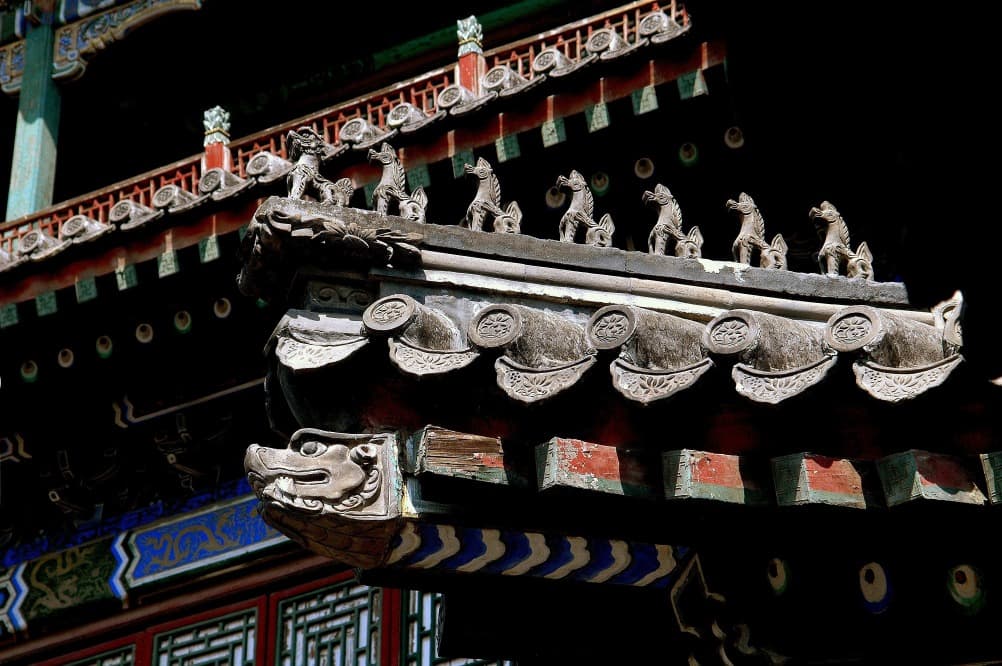
The garden follows a traditional Chinese plan, with four courtyards aligned on a north-south axis. Each courtyard fulfilled a specific function: reception, theatrical performances, worship, and access to the hill and Jingfuge hall at the rear.
The Grand Theatre
This is the most imposing building in the garden. This three-storey pavilion reaches 21 metres high. The levels each bear a symbolic name: Fu (happiness), Lu (comfort) and Shou (longevity). The floors are equipped with trapdoors allowing characters to appear between levels, and the Shou stage features a deep well designed to amplify the actors' voices and produce sound effects. According to historical sources, more than 200 operas were said to have been performed there for Empress Cixi, a great enthusiast of the genre. Some of the original costumes and accessories, as well as a sedan chair and a portrait of Cixi, are today displayed in the adjoining buildings.
The Nurtured Joy hall (Yiyuan)
Located opposite the Grand Theatre, this hall served as the imperial box: Cixi attended performances here. Its base was raised 22 cm above the first floor of the theatre to ensure an unobstructed view of the stage. Inside is a carved throne adorned with about a hundred larks flying towards a phoenix, a jade screen with floral and bird motifs, and a collection of songbirds in cages gathered from various countries.
Temple of Celebrating Virtue and Jingfuge hall
The third courtyard houses the Temple of Celebrating Virtue, dedicated to worship. At the rear, a gate leads to a path ascending to the Jingfuge hall, on the heights. This sector is considerably quieter than the central courtyards and has preserved some of its original buildings.
Practical information
- Visit duration: allow approximately 3 hours to explore the garden and its surroundings within the Summer Palace.
- Ticket: access is via the Summer Palace ticket, with a modest surcharge to enter the Deheyuan garden. Prices vary by season (low season from November to March, high season from April to October).
- Hours: opening in the morning, closing in late afternoon, with longer hours during peak season. Check official hours before your visit.
- Tip: starting your visit early helps avoid the largest crowds, especially around the Grand Theatre.
How to get there
The Garden of Virtue and Harmony is located within the Summer Palace complex, accessible by several entrances.
- By metro: Line 4, Beigongmen station (north gate, closest to Deheyuan) or Xiyuan station, exit C2.
- By bus: numerous municipal lines serving the Yiheyuan stop, in direct proximity to the east and north gates.
- By taxi or ride-hailing: convenient option from central Beijing, provided you indicate the desired entrance gate to the Summer Palace.
Nearby attractions
The garden is part of a larger ensemble. Once your visit is complete, several sites naturally extend your discovery:
- The rest of the Summer Palace and the city of Beijing, including the Forbidden City, the Temple of Heaven and the hutongs.
- The Great Wall at Juyongguan, one of the most accessible sections from Beijing.
Frequently asked questions
Frequently asked questions
Planning your trip
To integrate the Garden of Virtue and Harmony into a broader itinerary, explore our ideas for tailor-made journeys in Chine.
Interested in this visit?
We can include it in your personalised itinerary.