13 Ming Tombs
13 Ming Tombs
Located 50 km north of Beijing, the imperial necropolis of the Ming Dynasty comprises 13 mausoleums, three of which are open to the public, and the Sacred Way lined with monumental statues.
About fifty kilometers north of Beijing, the necropolis of the Thirteen Ming Tombs spreads across the basin of Mount Yanshan. This vast funerary complex houses the remains of 13 emperors, 23 empresses, and numerous princes, princesses, and concubines of the Ming Dynasty (1368-1644). Inscribed on the UNESCO World Heritage list since 2003, the site is visited primarily through three mausoleums open to the public and the Sacred Way that connects them.
Why visit the Thirteen Ming Tombs
The site offers a tangible understanding of the Ming Dynasty, which ruled China for 276 years with 16 successive emperors. The tombs preserve the ritual organization of the imperial court, its relationship with ancestor worship, and its architectural mastery. Excavations unearthed nearly 3,000 precious objects in the Dingling tomb alone: imperial robes, jewelry, golden crowns, and red lacquered chests, many of which are now displayed on-site.
The site's significance also lies in its landscape scale. The mausoleums are set within a natural environment chosen according to fengshui principles, with mountains in the background and an open plain to the south. This staging of imperial power remains legible today, despite the passage of centuries.
History of the site
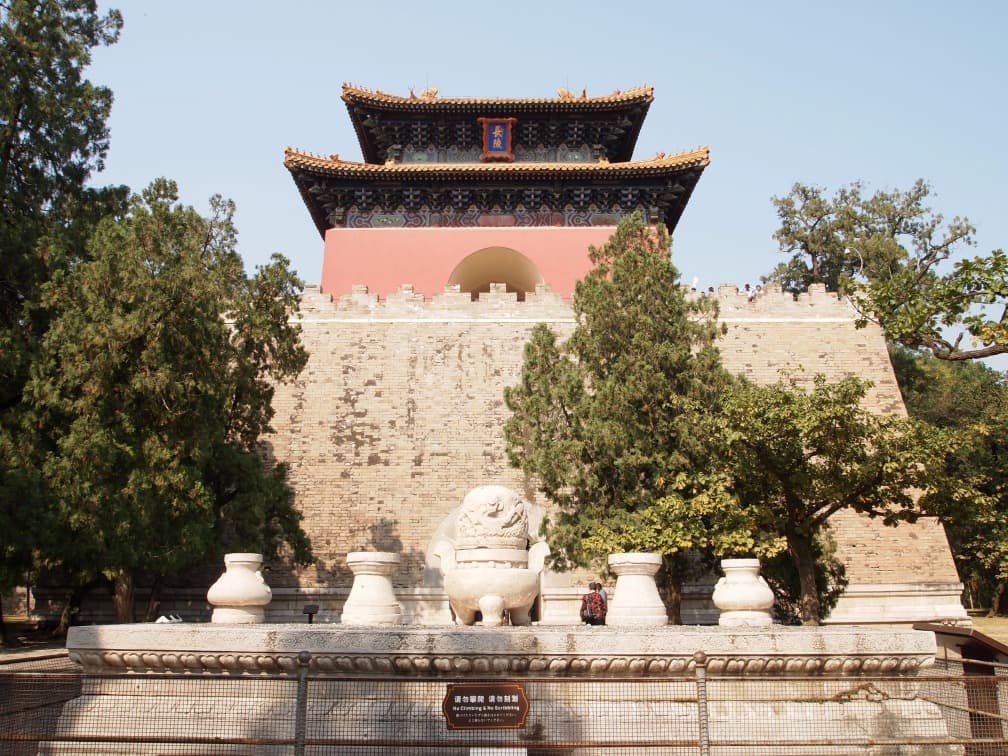
Construction began in 1409 under Emperor Yongle, the third Ming sovereign and founder of the site. He chose the location to build his own mausoleum, the Changling, which would serve as a model for subsequent tombs. For more than two centuries, his successors built their sepulchers there, until the dynasty's fall in 1644.
The Ming accorded particular importance to ancestor worship: the deceased retained a soul that was to be honored by subsequent generations. This belief explains the scale of the funerary arrangements and the richness of the furnishings placed in the tombs. A historical tradition documented among the early Ming held that concubines would accompany the emperor in death; sixteen concubines are cited as being bound to Yongle's sepulcher.
The site was placed under Chinese national protection for cultural relics and monuments in 1961, classified as a major national site in 1982, and then inscribed on UNESCO's World Cultural Heritage list in 2003. Only three mausoleums (Changling, Dingling, Zhaoling) are open to the public today; the others remain closed for conservation reasons.
What to see on-site
The Changling tomb
The sepulcher of Emperor Yongle, Changling is the largest of the thirteen mausoleums, covering approximately 120,000 m² at the foot of Mount Tianshou. Its architecture serves as a model for the other tombs. The Ling'en Hall, with its massive framework of precious wood, preserves ritual furnishings: imperial tablets intended for sacrifices, furnaces for burning silk offerings, incense and jade discs linked to ancestral ceremonies.
The Dingling tomb
Built for Emperor Zhu Yijun (Wanli), buried in 1620 with Empresses Xiaoduan and Xiaojing, Dingling is the only Ming mausoleum whose underground chamber has been entirely excavated, in the 1950s. The emperor's coffin, larger than those of the empresses, occupies the center of the chamber. Nearly 3,000 precious objects were found there: court robes, jewelry, golden crowns, red lacquered chests. A selection is now displayed in the galleries set up on-site.
The Zhaoling tomb
Built in 1567 for the 12th emperor Zhu Zaihou, Zhaoling is distinguished by its above-ground structure, which has aided its preservation. More modest than Changling, it provides a good example of the composition of a typical Ming mausoleum, with its ritual courtyard and burial mound.
The Sacred Way
Laid out in 1435, the Sacred Way stretches for approximately 7 km and constitutes the monumental entrance to the site. Successively, one passes through the Dahongmen Gate (Great Red Gate) and the Longfengmen Gate (Dragon and Phoenix Gate). The route is dotted with 24 monolithic statues: 12 mythical animals, symbolic guardians, and 12 military and civil officials. The Stele Pavilion, with its four pillars of white marble carved with clouds and dragons, marks a striking point along the way.
Practical information
Plan for half a day to a full day to visit the main mausoleums and the Sacred Way. The distances between sites are significant: transportation on-site or a private vehicle is recommended to visit Changling, Dingling, Zhaoling, and the Sacred Way in succession.
- Moderate admission fees, separate tickets for each mausoleum and the Sacred Way, with high and low seasons.
- Daytime opening hours, with wider hours in summer than in winter.
- A guided tour is strongly recommended to understand the historical context; certain areas can only be visited with a guide.
- Bring sturdy walking shoes, water, a hat in summer, and a windbreaker during the shoulder season.
When to go
The climate in the Beijing region is continental, with four distinct seasons. Spring (April-May) and autumn (September-October) are the most pleasant periods: mild temperatures, often clear skies, and favorable light for photography. Summer is hot and humid, sometimes rainy, with high attendance during Chinese school holidays. Winter is dry and cold, but offers a quieter atmosphere, with sites being far less crowded. Avoid the first week of October (Chinese National Day), a period of very high crowds at all tourist sites around Beijing.
How to get there
The site is located in the Changping District, north of Beijing. Several options are available from the city center:
- By public transport: combination of metro and bus from Beijing, with a connection in the northern suburbs. Expect approximately 1.5 to 2 hours of travel.
- By organized tour: the simplest option, often combined with a section of the Great Wall (Badaling or Juyongguan) located nearby.
- By taxi or ride-hailing: practical for optimizing time if traveling with others.
Verify current public transport routes before departure, as lines and terminals may change.
Nearby attractions
The northern Beijing region concentrates several major sites easily combinable with the Ming Tombs:
- The Great Wall at Juyongguan: accessible section located on the same route, ideal for a combined day trip.
- Beijing: Forbidden City, Temple of Heaven, hutongs, and Summer Palace, to explore over several days.
Frequently asked questions
Frequently asked questions
Of the thirteen mausoleums, only three are open to the public: Changling, Dingling, and Zhaoling. The others remain closed for preservation reasons.
Plan for half a day to visit one mausoleum and the Sacred Way, and a full day to visit the three public tombs together with the Sacred Way.
Yes, this combination is a classic. The Juyongguan or Badaling section is located on the same road north of Beijing and allows you to combine both visits in a single day.
Spring (April-May) and autumn (September-October) offer the most pleasant conditions. Avoid the first week of October, which is very crowded due to National Day celebrations.
It is strongly recommended. The site is vast, explanatory information on-site is limited, and certain areas can only be visited with a guide.
Plan your trip
The Thirteen Ming Tombs naturally integrate into a circuit around Beijing and northern China. To build a customized itinerary including this imperial necropolis, the Great Wall, and the Forbidden City, consult our trips to China.
Interested in this visit?
We can include it in your personalised itinerary.