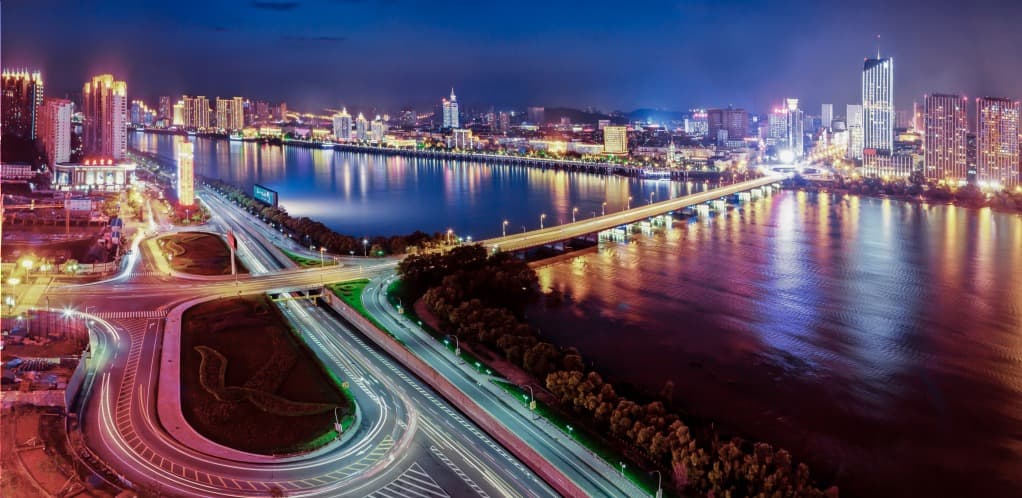
Jilin
Jilin
On the banks of the Songhua River, Jilin dons a magical coat of frost each winter. Manchu history, skiing and nature in northeast Chine.
Name: Jilin
Chinese name: 吉林
Province: Jilin
Status: Prefecture-level city
Population: 4,414,681 residents
Area: 27,100 km²
Jilin is considered the second-largest city in Jilin province. This industrial city, once the provincial capital, is situated on the banks of the Songhua River, which earned it the nickname "River City".
Jilin attracts tourists particularly in winter, when visitors come to admire the almost otherworldly landscape along the river's edge. Despite its growing urbanization, Jilin city boasts numerous charms to seduce its visitors.
History
Jilin is one of the oldest cities in northeast Chine. It was formerly Manchu territory.
During the reign of Ming Emperor Yongle (1360–1424) of the Ming Dynasty, Chinese forces attempted to extend their power over the entire Manchurian territory. Numerous fleets departed from Jilin to compel local tribes to pledge allegiance to the emperor.
In 1661, to counter Russian advances, a shipyard was established in Jilin. The city developed around this enterprise and became a fortified city in 1663 following the construction of its fort.
Following the loss of Manchuria, the city opened to Chinese settlement, and many Han Chinese moved there. When the Manchukuo established its capital in Changchun in 1930, Jilin lost much of its influence.
In 2007, the city hosted several events of the Asian Winter Games. In 2010, it was severely affected by floods that struck much of the country and claimed numerous lives.
Today
Although Jilin is today a major industrial city in northeast Chine, it retains its reputation as an agreeable city with enchanting landscapes, especially in winter.
The Songhua River that flows through it offers a splendid promenade lined with trees which, in winter, dress themselves in a beautiful coat of frost. This makes it one of the city's principal attractions, as the spectacle is so striking. Indeed, under the negative temperatures of January and February, the river resists freezing while its vapors settle on the pines and willows, covering them with frost. The sight is breathtaking, even enchanting, and will surely move you.
A few historical vestiges have survived urbanization. You can therefore discover, whether under snow or not, the lovely Wen Miao Temple, a Confucian temple erected in 1907. Its halls, converted into exhibition rooms and a museum, will reveal some secrets about Confucius and the Jilin region.
If you travel to Jilin in summer, make the most of the sunshine to relax with a drink on Century Square. This large plaza hosts several bars and restaurants and welcomes many visitors in summer who come to rollerblade or enjoy other activities. This square perfectly embodies the city's cheerful and relaxed atmosphere.
About twenty kilometers from the city stretches Songhua Lake, one of Chine's most famous artificial lakes. This vast lake promises a stroll through an environment populated by mountains and forests.
The city offers other attractions such as the Meteorite Museum, Beishan Park, perfect for enjoying lotus flowers in summer and frost-covered trees in winter, or the Longtan Mountain Park.
A stay of one or two days in this city will be perfect for you to rest before continuing on to the mountains or heading off to ski.
Climate
Nestled within four mountains and crossed by the Songhua River, Jilin enjoys a continental climate with warm, humid summers and cold, dry, windy winters.
The average annual temperature is 4.70°C, with an average January temperature of −17.3°C and an average July temperature of 22.8°C.
Summers can experience heavy rainfall due to monsoon influence. Despite the extreme cold that grips the city in winter, this season remains the best time to visit Jilin and enjoy its frozen landscapes.
Spring is also an excellent period to relax and bask in the sunshine that warms the city.
Airplane
Jilin has no airport, but Changchun's airport is located just 60 km to the west. This international airport offers around twenty domestic flights, including service to Beijing, Shanghai, Guangzhou, Shenzhen, Hangzhou, Fuzhou, and more.
International flights are also operated from Hong Kong, Bangkok, Seoul, and beyond.
Train
Jilin benefits from a railway station offering convenient connections to most major Chine cities, including Beijing, Tianjin, Dalian, Jinan, Hangzhou, as well as Harbin, Changchun, and Shenyang.
Long-Distance Bus
Jilin has two bus stations. Regular daily buses connect Jilin to Changchun. Other buses depart from Harbin and Shenyang to reach Jilin.
Buses and taxis are available throughout the city for easy transportation and visiting tourist attractions.
What to Do in Jilin?
- Witness the spectacular display of Frost-Covered Trees along the Songhua River.
- Try your hand at rollerblading on Century Square and stop for a drink on one of its terraces.
- Visit the Wen Miao Confucian Temple.
- Take a leisurely walk through Beishan Park.
- Venture on an excursion to Songhua Lake.
Want to discover this destination?
Our local advisors design your tailor-made trip.