Xinjiang
Name: Xinjiang
Chinese name: 新疆维吾尔自治区 (Xīnjiāng Wéiwú'ěr Zìzhìqū)
Status: Autonomous region
Capital: Urumqi
Population: 22,643,000 inhabitants (2013)
Area: 1,664,897 km²
Xinjiang is a Uyghur autonomous region situated at the far northwestern edge of Chine. Renowned for its distinctive traditions, evocative music and dance, you'll discover a region far removed from Chinese stereotypes. Xinjiang is equally a land of wonder, traversed by the legendary Silk Road and bordered by mountains, verdant forests and desert expanses. A journey through Xinjiang will make your travels in Chine truly unique and unforgettable.
History
Nomads and oasis dwellers
The key to Xinjiang's history lies in the existence of two distinct populations: nomadic pastoralists north of the Tian Shan massif and sedentary oasis dwellers along the edge of the Tarim basin. The earliest nomads were the Xiongnu; the settled inhabitants belonged to an Indo-European people, the Tocharians. Over millennia, these two groups saw their ethnic compositions evolve, yet they remain the foundation of the region's civilization to this day.
Buddhism
Languages and ideas traveled the same routes as merchandise, and by the 3rd century, Buddhism had taken root in the Tarim basin. Powerful Buddhist city-states emerged, such as Hotan, Kuqa and Turpan, where a magnificent art flourished, blending Kashmiri, Persian, Indian and even Greek styles.
In the 7th century, the Tang dynasty restored imperial authority that had disappeared after the fall of the Han, and Chinese influence once again penetrated Xinjiang.
The Uyghurs, Islam and the Mongols
Despite scarce historical sources, it is known that Tang dynasty control was never absolute. The Uyghurs maintained considerable independence throughout the 8th century, and the An Lushan rebellion (755-763) further undermined imperial authority.
Islam took hold in western Xinjiang under the Qarakhanides in the 11th and 12th centuries, but only reached the eastern regions in the 14th century.
In 1219, the Mongols conquered Yili, Hotan and Kashgar; this was the only period when the Silk Road routes were controlled by a single power. Timur, advancing from the West, sacked Kashgar again at the end of the 14th century. The region remained under the control of the Timurides or various Mongol tribes until the Manchu army entered Kashgar in 1755.
The struggle for control of the region
In the 1860s and 1870s, several Muslim uprisings shook western Chine. The withdrawal of Russian troops in 1881, after 10 years of occupying the Yili region, triggered the flight of thousands of Uyghurs, Chinese Muslims and Kazakhs toward Kazakhstan and Kyrgyzstan.
In 1865, a Kokand officer named Yaqub Beg seized Kashgaria, declared it an independent Turkestan and established diplomatic relations with Great Britain and Russia. Years later, the Manchu army returned, Yaqub Beg took his own life and Kashgaria was officially integrated into the new Chinese province of Xinjiang. After the fall of the Qing dynasty in 1911, Xinjiang was ruled by a succession of warlords, over whom the Guomindang (Nationalist Party) had little influence.
The only genuine attempt to establish an independent state occurred in the 1940s, when a Kazakh named Osman, leading a revolt of Uyghurs, Kazakhs and Mongols, took control of southwestern Xinjiang and proclaimed the East Turkestan Republic in January 1945. The Guomindang managed to convince him to dissolve the new republic in exchange for genuine autonomy.
Since 1949, the Beijing government has worked to suppress separatist movements by encouraging Han settlers to move to the region. Uyghurs, once comprising 90% of Xinjiang's population, now represent less than 50%. The "Western Development" campaign launched by Chinese authorities in 2000 continues, and Beijing has allocated nearly 100 billion dollars to build infrastructure, primarily for exploiting vast oil and gas reserves.
Uyghur Separatism and Chinese crackdown
Uyghurs have long regarded Han Chinese as invaders, and relations between the two peoples have never been good. However, tensions escalated significantly in the early 1950s, when communist Chine began expanding Xinjiang's population through Han settlement.
Although the central government has invested heavily in economic development and Xinjiang's infrastructure, Uyghurs claim that good jobs and profitable businesses are reserved almost exclusively for the Han. One easily observes that the two communities coexist without mixing, with few exceptions in Urumqi, the capital.
Long suppressed, Uyghur resentment sparked several clashes in the early 1990s. Tensions peaked in February 1997, when Muslim separatists violently protested in the northern city of Yining, triggering equally harsh Chinese police repression. These riots, the most severe to date according to Chinese media, resulted in at least 9 deaths and nearly 200 injured.
Hundreds of Muslims implicated in the unrest were arrested. Three were executed on their trial day, while others received life sentences. In response to these arrests, separatists detonated 3 buses in Urumqi, killing 9 passengers and injuring many others.
In April of the same year, violence erupted again in Yining when crowds attacked prison vans transporting some of February's rioters. Again, several people were killed or wounded.
In 2001, Chinese secret police raided several underground Uyghur mosques in Korla. A prominent leader and other officials were tried and executed.
Since then, the central government has exploited the climate of fear created by the September 11 attacks to repress Uyghur nationalism even more harshly, imprisoning or executing thousands of alleged "Islamic terrorists," with tacit American approval and deafening silence from the rest of the world.
Beijing maintains even tighter control over information regarding its relations with Uyghurs, presumably in the forlorn hope of transforming Xinjiang into a premier tourist destination and, more importantly, making it a major player in worldwide oil production.
Today
At the northwestern edge of Chine, Xinjiang has been coveted throughout the centuries by rival powers in the region. Its inhabitants, of fiercely independent character, have never enjoyed complete autonomy. After a long and tumultuous history with the Middle Kingdom, the province now "belongs" to the People's Republic of Chine, which exercises its sovereignty decisively.
Like another country within Chinese borders, Xinjiang shares nothing in common with Chine. Its language, entirely different, belongs to the Turkic language family. Its inhabitants resemble their Central Asian neighbors closely and, like them, favor a lamb-based cuisine.
Why is Chine interested in this desolate territory, thousands of kilometers from the capital? Bordering eight nations and encompassing roughly fifty ethnic minorities, Xinjiang occupies a crucial strategic position. Along the ancient Silk Road, it retains numerous vestiges and covers one-sixth of the country's area, alternating between merciless desert, taiga grasslands and dizzying mountains. Most importantly, its subsoil contains 30% of Chine's oil reserves!
Often overlooked by visitors flocking to Chine, Xinjiang is nonetheless changing rapidly thanks to the central government's efforts to modernize infrastructure and promote tourism. Beijing is undeniably working toward the renaissance of caravans on the Silk Road, this time composed of travelers.
Climate
Xinjiang experiences an extreme climate, reflecting its geography. Turpan is the hottest point in the country with temperatures reaching nearly 50°C from June to August; the Tarim and Junggar basins are similarly scorching in summer. Spring from April to May brings frequent sandstorms and dust clouds that obscure the landscape and complicate travel. Conversely, rain is virtually nonexistent except in the mountains and far north. In winter from December to February, temperatures plunge below freezing across the entire province.
Late May to June and September to mid-November are the most pleasant periods to visit the Xinjiang region.
How to get there?
Most Chinese cities offer flights to the capital Urumqi.
Urumqi can be reached via international flights from Almaty in Kazakhstan, Bishkek and Osh in Kyrgyzstan, Islamabad in Pakistan, Moscow and Novosibirsk in Russia, Baku in Azerbaijan and Tashkent in Uzbekistan. Seasonal flights may also operate from Seoul in South Korea.
Due to its location, several border crossings allow entry to the region by land: Pakistan (Khunjerab Pass), Kyrgyzstan (Irkeshtam and Torugart passes) and Kazakhstan (Korgas, Alashankou, Tacheng and Jimunai). With the exception of Alashankou, served by rail between Kazakhstan and Chine, these borders are crossed by bus.
Be aware that borders close depending on political circumstances and many open only if weather permits. Before traveling, it's advisable to thoroughly research these border crossings.
From Chine, there is a train that crosses Gansu to reach Xinjiang. The journey may be long but the landscapes you'll encounter easily make the wait worthwhile.
The Silk Road from Qinghai can also be an interesting itinerary by bus, though more chaotic than by train.
How to get around Xinjiang?
Once in Xinjiang, the most convenient way to travel will be by bus. From the Urumqi bus station, numerous buses depart daily to other major cities and tourist sites in the region.
Trains serve some major cities but are not the most practical solution.
For those short on time and wishing to avoid long bus journeys, there are domestic flights available, though be aware they can be cancelled due to weather or frequent sandstorms.
Language
Xinjiang Uyghur is part of the Turkic languages family and resembles other Central Asian languages.
You'll notice bilingual signs in Chinese and Arabic. Many Uyghurs do not speak or prefer not to speak Mandarin. Approximately 70% of Xinjiang's schools teach exclusively in Uyghur.
What to do in Xinjiang?
- Breathe the fresh air at Sayram Lake surrounded by mountains and verdant grasslands, and appreciate the wildlife thriving there with horses, ducks and swans.
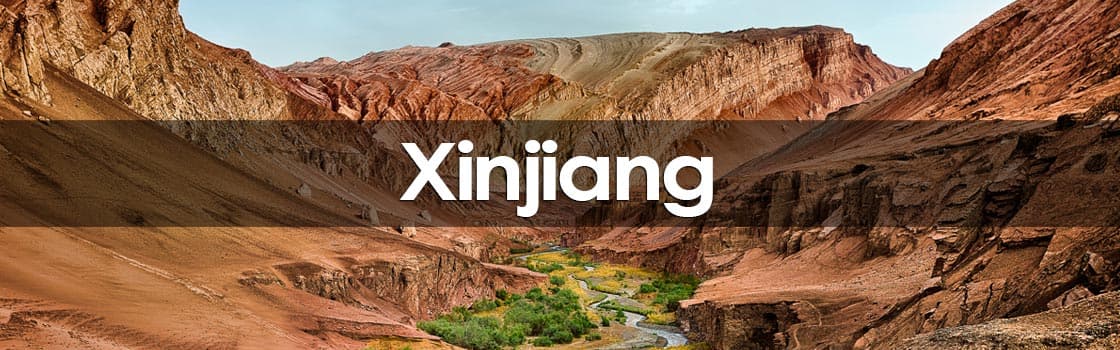
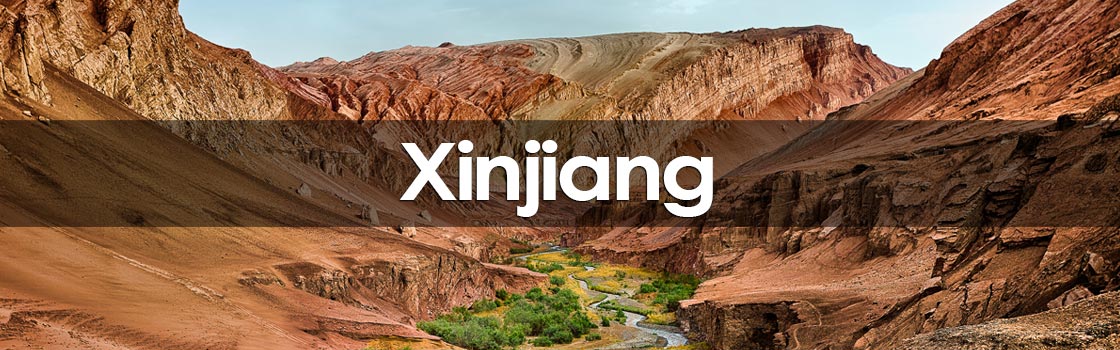
- Marvel at the spectacle of the "Flaming Mountains" in Turpan where temperatures can reach 50°C.
- Traverse a portion of the Silk Road and enjoy its mesmerizing natural landscapes.
- Observe the changing vistas of the Five-Color Bay in the heart of Xinjiang.
- Sleep in a Kazakh yurt at Tian Chi Lake.