Guia Fortress
Guia Fortress
Portuguese fortress from 1622 at the summit of Guia Hill in Macau: historic lighthouse, frescoed chapel and exhibition tunnel, UNESCO-listed.
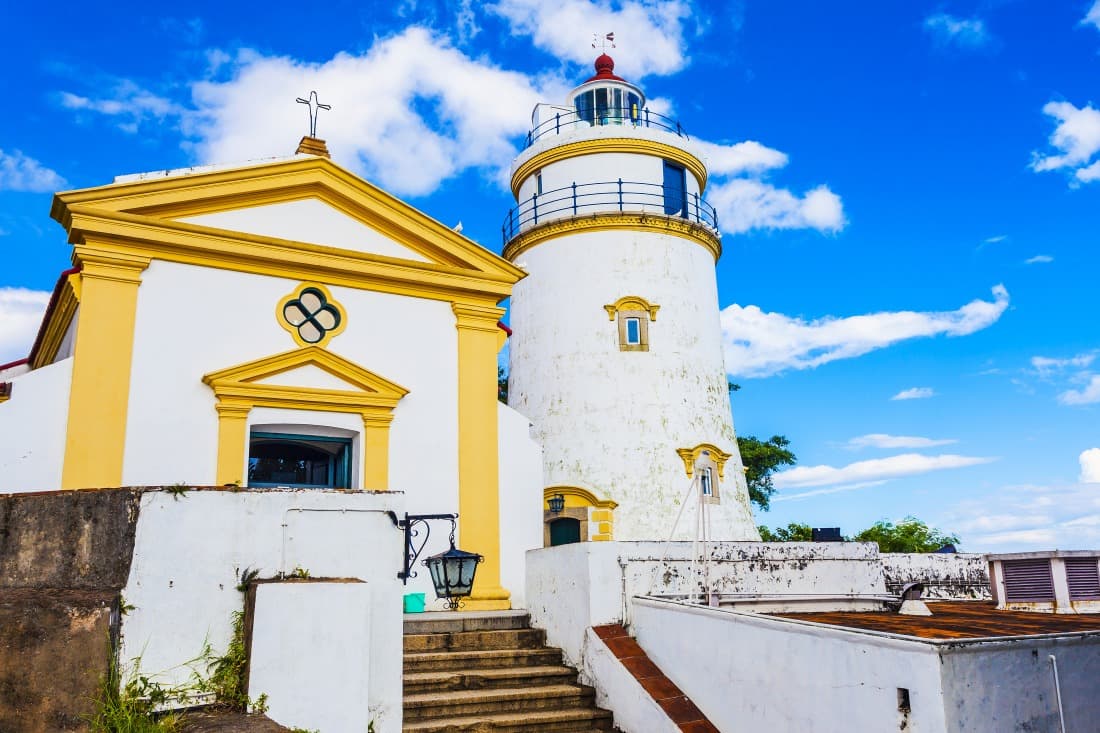
The Guia Fortress dominates Macau from the summit of the hill of the same name, at 91 metres altitude, the highest point of the peninsula. Built by the Portuguese between 1622 and 1638, this fortified complex brings together three rare elements in the region: a military fortress, a chapel decorated with frescoes and the first Western-style lighthouse erected on China's coast. The ensemble was inscribed in 2005 as a UNESCO World Heritage site within Macau's historic centre.
Why visit Guia Fortress?
- A UNESCO site that condenses four centuries of Portuguese presence in Macau.
- Three monuments in one: fortress, frescoed chapel and historic lighthouse, spread across 800 m².
- The highest point of the peninsula, with sweeping views over the city and neighbouring islands.
- A 456-metre anti-aircraft tunnel repurposed as an exhibition centre on the fort's military history.
History of the fortress
The fortress was erected between 1622 and 1638 on the summit of Guia Hill, also known as Wangyang Dong mountain. Its primary purpose was defensive: to spot and contain potential attacks from the sea, at a time when Macau was one of Portugal's principal trading posts in Asia.
The chapel inside also dates from 1622. During its renovation in 1998, previously hidden frescoes came to light: works by Franciscan nuns, they blend Christian iconography and mythological motifs, a rare testament to Macau's cultural syncretism.
In 1865, Portuguese authorities built the Guia Lighthouse at the summit, considered the first Western-style lighthouse on China's coast. Later, in 1931, a Portuguese officer had a 456-metre anti-aircraft shelter tunnel dug beneath the hill, designed to protect garrisons and munitions.
The departure of the Portuguese army in 1976 marked the end of the site's military function, which then gradually opened to the public. In 2003, the tunnel was refurbished as an exhibition centre. In 2005, Guia Hill joined UNESCO's World Heritage list as part of Macau's historic centre.
What to see on site
The fortress
The perimeter preserves Portuguese cannons, guard posts, watchtowers, old munitions stores and arsenals. The architecture, austere and functional, illustrates the military standards of 17th-century Portugal adapted to the sub-tropical climate of the region.
Guia Lighthouse
Standing 15 metres high, the lighthouse remains operational; its light reaches several dozens of kilometres. It also serves as a meteorological station. The tower itself is not accessible to the public, but its white silhouette and base can be viewed from the summit plateau.
The frescoed chapel
Of modest dimensions, the chapel houses the frescoes by the Franciscan nuns rediscovered in 1998, as well as portraits of the Virgin Mary and original elements linked to its 1622 construction. The decoration blends Western religious figures and Chinese-inspired motifs.
The exhibition tunnel
The 456-metre underground corridor presents the fort's military history: surveillance equipment, archive photographs, plans of Portuguese defences and explanations of garrison life.
Practical information
- Access: generally free and open for the fortress and chapel.
- Opening hours: daytime opening, with slightly more restricted hours for the chapel. Check official hours before your visit.
- Lighthouse: exterior only, the tower interior remains closed to the public.
- Duration of visit: allow 1 to 2 hours to explore the entire site.
- Best time: late afternoon offers favourable light for panoramic views. Avoid typhoon season (June to September).
How to get to the fortress
Guia Hill is located in the heart of Macau's peninsula, easily accessible from the historic centre. Several options are available to visitors:
- By bus: many urban routes serve the areas around the hill (notably lines 2, 6, 9, 12, 17, 18, 19, 22, 23, 28C, 32). Get off at the stop closest to Flora Park.
- By cable car: a free cable car connects Flora Park to the summit of the hill, the simplest option to avoid the walk uphill.
- On foot: a shaded path climbs from Flora Park to the plateau; allow approximately 20 to 30 minutes depending on your pace.
Nearby
Guia Fortress is part of Macau's UNESCO-listed historic centre. Combine it with the Ruins of St. Paul's, the A-Ma Temple and Senate Square, all accessible on foot or by bus from the hill.
To further explore China from a heritage perspective, also check out our pages on the Bell Tower and Drum Tower in Beijing, the Beishan Temple or the Baigongfang Crafts Museum.
Frequently asked questions
Frequently asked questions
Access to the site, fortress and chapel is generally free and open. It is advisable to check conditions with Macau's tourist services before your visit.
No. The Guia Lighthouse, built in 1865, remains operational and its interior is not open to the public. Only the exterior of the 15-metre-high tower can be visited.
Allow 1 to 2 hours to explore the fortress, frescoed chapel, exhibition tunnel and enjoy the panorama from the summit at 91 metres altitude.
Autumn and winter (October to March) offer a drier and more temperate climate. Avoid typhoon season, from June to September, when temporary closures may occur.
The path from Flora Park requires 20 to 30 minutes of moderate uphill walking. For easier access, a free cable car connects the park to the summit plateau.
Include the fortress in a China trip
Macau easily combines with Hong Kong and Guangzhou in a circuit dedicated to southern China, or as an urban and heritage stop within a wider itinerary. To plan your bespoke stay, consult our China trips.
Interested in this visit?
We can include it in your personalised itinerary.