Monastery of Gesar (Gompa Serti / Sertri Gompa)
Monastery of Gesar (Gompa Serti / Sertri Gompa)
Serti Gompa dominates the Tibetan village of Langmusi at over 3,500 meters altitude. Morning circumambulations, golden prayer halls and yak pastures: an authentic site far from the crowds.
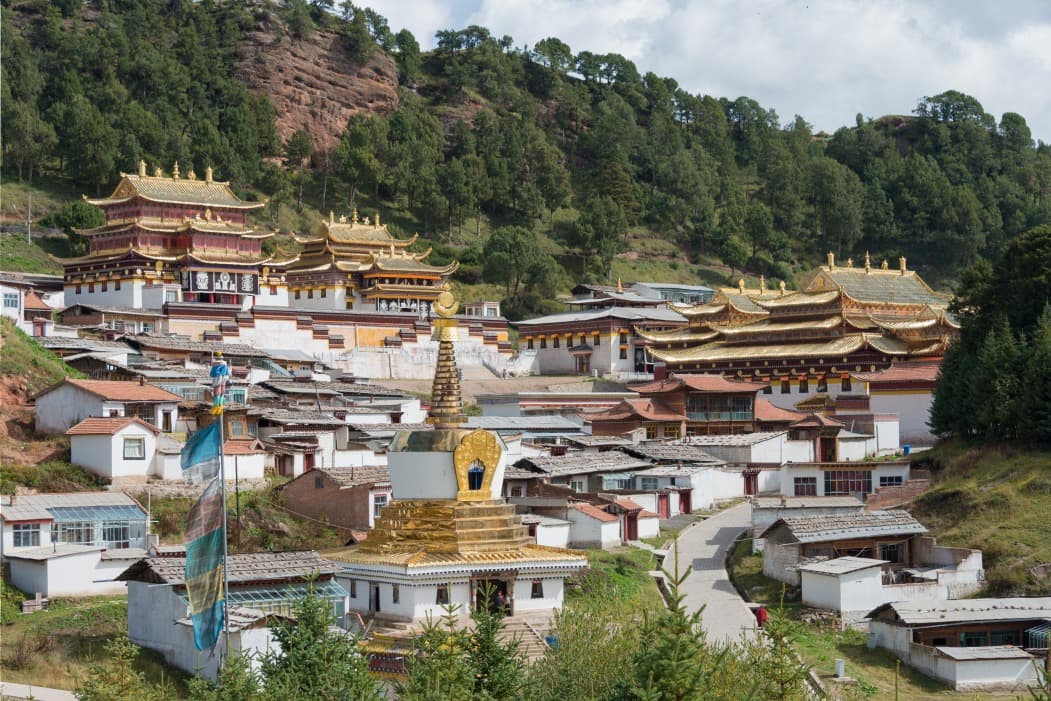
Perched on a hill overlooking the Tibetan village of Langmusi, Serti Gompa (also known as Sertri Gompa) is one of two major Tibetan Buddhist monasteries that define this settlement straddling the Gansu-Sichuan border. Founded by the Gelugpa school, it offers direct insight into Tibetan monastic life, away from mass tourism circuits. The surrounding pastures, prayer flags and maroon-robed monks compose a scene of rare cohesion.
Practical information at a glance
- Access: Langmusi is reachable by bus from Hezuo (Gansu) or Zoige (Sichuan); the monastery is a short walk from the village center.
- Dress code: Shoulders and knees must be covered; respectful behavior required in prayer halls.
- Recommended duration: 1 to 2 hours for the monastery alone; half a day combining the gorge and surrounding pastures.
- Admission: An entrance fee for the Langmusi site is generally required; check with your local agency for current rates.
What to see
The complex comprises several prayer halls adorned with thangkas, Buddha statues and yak butter lamps. The main hall houses a large golden statue surrounded by offerings. Golden roofs shine in the high-altitude sun. Rows of prayer wheels line the outer walls, turned by the faithful during their daily circumambulations.
History and context
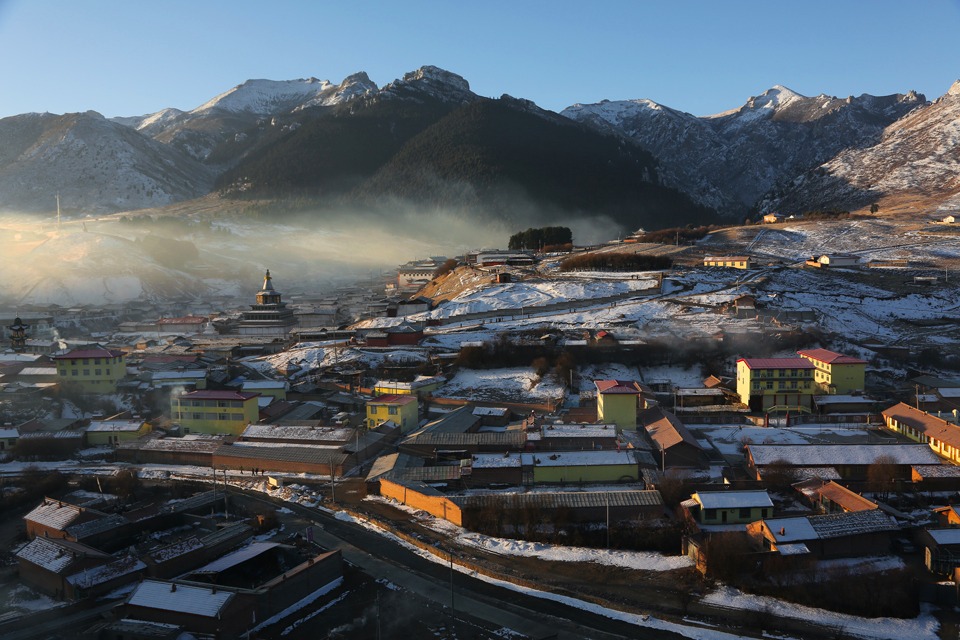
Langmusi is home to two distinct monasteries: Serti Gompa on the Gansu side and Kirti Gompa on the Sichuan side. Serti Gompa belongs to the Gelugpa school, the same as the Dalai Lama. The village itself is a historical crossroads between Tibetan and Hui cultures, giving it a particularly dense religious and ethnic identity. The altitude exceeds 3,500 meters, which has long protected the region from rapid urbanization.
Highlights of the visit
The morning circumambulation
Early in the morning, monks and pilgrims walk around the monastery while fingering their prayer beads and turning the prayer wheels. Witnessing this silent ritual is the most authentic experience the site offers.
The prayer halls
The interior of the temples is richly decorated: thangkas hanging from the ceiling, columns lacquered in red and gold, the scent of melted yak butter. Collective prayer ceremonies (puja) take place at fixed times; inquire on-site to attend discreetly.
The view over the pastures
From the monastery hill, the eye sweeps across the pastures of the White Dragon River valley, dotted with nomadic tents in summer. This panorama illustrates the continuity between monastic life and Tibetan pastoralism.
Etiquette and visitor rules
- Always walk clockwise around stupas and prayer wheels.
- Remove your shoes before entering prayer halls.
- Do not photograph monks without their explicit consent.
- Speak quietly inside temples; silence your phone.
- Do not touch statues or ritual objects.
Photography tips
The golden morning light (between 7 a.m. and 9 a.m.) is ideal for photographing the golden roofs and prayer flags. In late afternoon, raking light enhances the ochre and maroon facades. Inside temples, photography is often restricted or forbidden: always ask permission before raising your camera.
Location and access
Langmusi lies on the Gansu-Sichuan provincial border, on the eastern Tibetan plateau. The village is small and entirely walkable on foot. Serti Gompa is located in the Gansu section of the village. Buses connect Langmusi to Hezuo and Zoige. The high altitude may cause mild mountain sickness: allow a day for acclimatization if you are arriving from low elevation.
In the surrounding area
- Kirti Gompa — The other major monastery in Langmusi, on the Sichuan side, also Gelugpa, a short walk away.
- Langmusi Gorge — A narrow rocky fissure behind the village, ideal for a one-hour hike in dramatic scenery.
- Zoige Prairies (Ruoergai) — Vast wetlands and yak pastures, less than an hour's drive to the south.
Frequently asked questions
From May to October, the pastures are green and roads are passable. In winter, access can be difficult due to snow and very cold temperatures above 3,500 meters altitude.
Yes, the two monasteries are a short walk from each other. A morning is enough to visit both, reserving the afternoon for the gorge or surrounding pastures.
The region is accessible to foreigners without a Tibet Permit (TAP) since it lies in Gansu and Sichuan provinces, outside the Tibet Autonomous Region. Nevertheless, check current regulations at the time of your trip, as they may change.
Outside, yes. Inside the prayer halls, photography is often forbidden or requires permission. Always ask before taking photographs, and never photograph monks without their consent.
The village exceeds 3,500 meters. Plan at least one night for acclimatization, stay well hydrated, avoid alcohol for the first few days and reduce physical effort upon arrival.
Photos
Interested in this visit?
We can include it in your personalised itinerary.