Red Mountain (Hongshi Ya / Red Rock Cliff)
Red Mountain (Hongshi Ya / Red Rock Cliff)
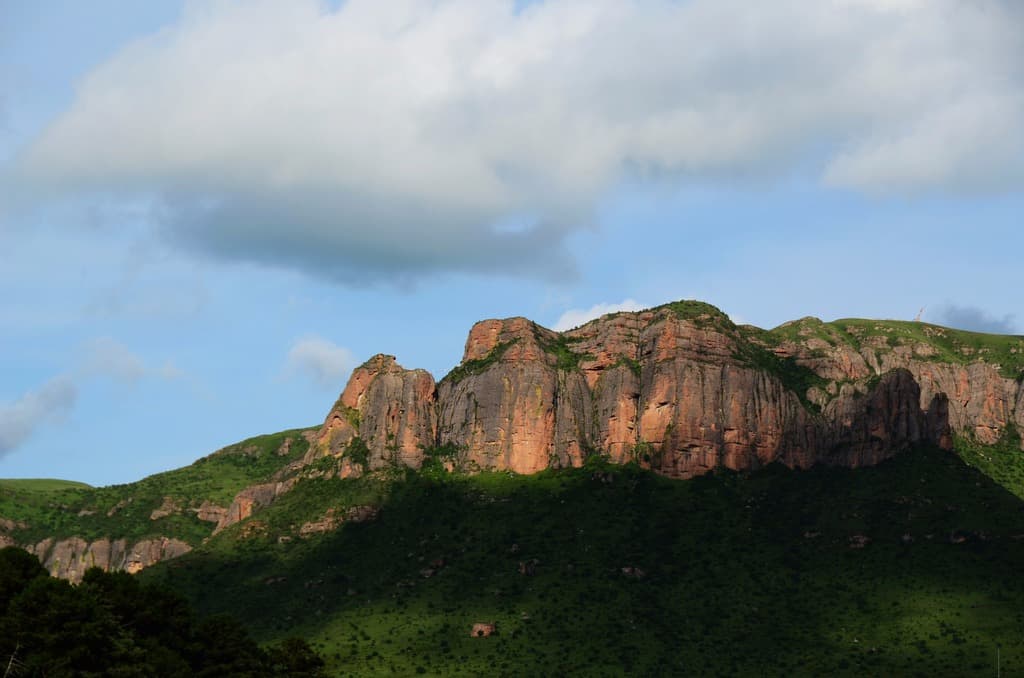
At Langmusi, the red sandstone cliff known as Hongshi Ya rises above the Tibetan gorge, dominating the monasteries below. An accessible trail from the town allows visitors to follow the torrent to the base of the cliff, passing prayer flags and high-altitude grasslands.
At the edge of Langmusi town, a blood-red sandstone cliff towers above the Tibetan plains. Known locally as Hongshi Ya (红石崖, "red rock cliff"), it stands in striking contrast to the gilded roofs of Buddhist monasteries nestled below. The site draws hikers and pilgrims who trace the gorge to its base, passing through coniferous forests and glacial streams.
What to See
The cliff face displays layers of red-orange sandstone sculpted by erosion over millennia. At its base flows a torrent fed by plateau snowmelt. Vegetation alternates between high-altitude meadows, dense forest, and exposed rocky outcrops. Tibetan prayer flags are strung across the heights, visible from the gorge floor below.
History and Context
Langmusi is a town straddling the Gansu-Sichuan border at over 3,400 meters elevation. Two Tibetan monasteries — Sertri Gompa on the Sichuan side and Kirti Gompa on the Gansu side — have structured local life for centuries. The red cliff is integral to the sacred landscape surrounding these monasteries; it features prominently in circumambulation circuits practiced by monks and pilgrims alike.
Highlights of Your Visit
The Gorge and Torrent
A trail climbs the gorge from the town center. The path follows a crystal-clear stream, winds through forested sections, and emerges at the cliff's base. The round-trip walk constitutes the heart of the experience.
Prayer Flags on the Heights
Garlands of colorful flags (lungta) are strung between rocky outcrops. Their presence underscores the spiritual significance of this place for the local Tibetan community.
Chromatic Contrast
The intense red of the rock stands out vividly against green meadows and the blue sky at this altitude. Late-afternoon light intensifies the ochre and vermillion tones of the cliff face.
Photography Tips
Late-afternoon light (around 4–6 p.m. in summer) strikes the cliff directly and brings out its red hues. From the gorge floor, a vertical composition frames the torrent in the foreground and the cliff wall beyond. Prayer flags visible from accessible heights along the trail offer a colorful foreground element.
Location and Access
The red cliff is within walking distance from Langmusi town center by following the main gorge northward. Langmusi is accessible by bus from Zoigê (Ruoergai) on the Sichuan side or from Hezuo on the Gansu side. The elevation exceeds 3,400 meters: allow time for acclimatization before undertaking strenuous walks. The gorge trail is not equipped for those with reduced mobility.
Nearby locations with internal links:
- Sertri Gompa Monastery — on the Sichuan side, a short walk away.
- Kirti Gompa Monastery — on the Gansu side, visible from town.
- Zoigê (Ruoergai) Grasslands — vast herbaceous plateau roughly two hours' drive away.
In the Surrounding Area
- Sertri Gompa Monastery — one of the two Tibetan monasteries that make Langmusi renowned; morning ceremonies are open to respectful visitors.
- Kirti Gompa Monastery — its counterpart on the Gansu side, featuring a richly decorated assembly hall.
- Zoigê Grasslands — a landscape of wetlands and meanders, habitat to deer and black-necked cranes.
Interested in this visit?
We can include it in your personalised itinerary.