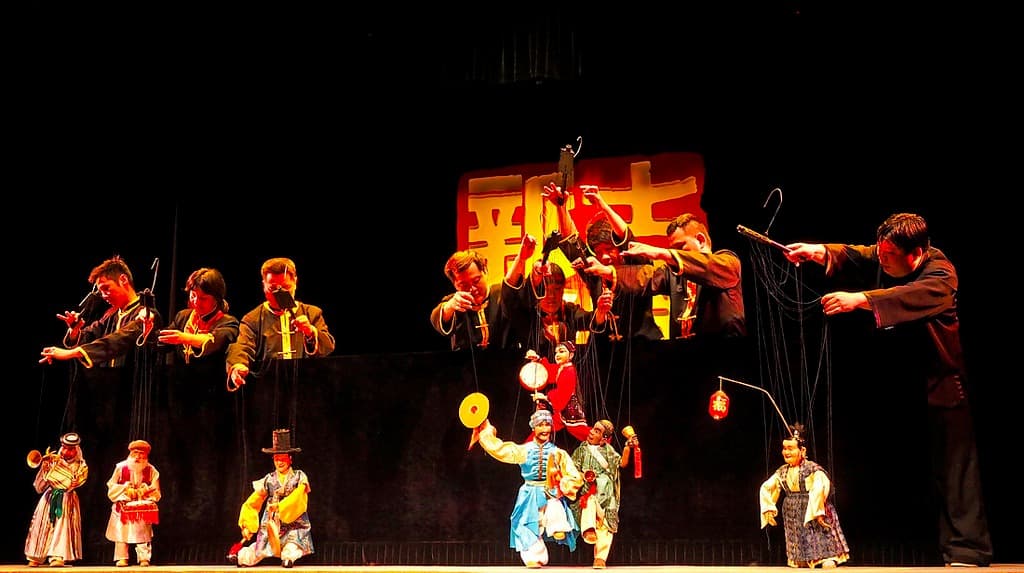
Quanzhou Puppet Museum (Jinxiu Zhuang)
Quanzhou Puppet Museum (Jinxiu Zhuang)
In the heart of Quanzhou, the Jinxiu Zhuang museum celebrates the ancient art of Fujian string puppet theatre, recognized by UNESCO, through historical collections, miniature costumes, and artisan workshops.
In the heart of Quanzhou, a port city in Fujian inscribed on the UNESCO World Heritage List, the Jinxiu Zhuang puppet museum is dedicated to the art of string puppet theatre — a living tradition in this region for more than a thousand years. It brings together historical collections, artisan demonstrations, and workshops, offering a rare window into a cultural heritage recognized by UNESCO.
What to See
The museum displays string puppets (kuileixi) from various periods and styles, hand-embroidered miniature costumes, stage accessories, and manufacturing tools. Panels trace the history of Fujian puppet theatre and its influence across Southeast Asia. Some rooms showcase antique pieces with complex mechanisms, capable of reproducing dozens of distinct movements.
History and Context
Fujian string puppet theatre (Fujian kuileixi) is documented from the Tang dynasty. Quanzhou, a maritime crossroads of the Silk Road, exported this art form to Taiwan, the Philippines, and Southeast Asia through waves of migration. In 2012, UNESCO inscribed this art on the list of intangible cultural heritage requiring urgent safeguarding, highlighting the scarcity of master puppet craftsmen.
Highlights of Your Visit
Master String Puppets
The most remarkable pieces are traditional stage puppets, some featuring more than thirty control strings. Their painted faces follow precise iconographic codes: colour, expression, and headdress indicate the rank and character of each figure.
The Fabrication Workshop
A dedicated section showcases the stages of carving puppet heads from camphor wood, painting, and assembly. Artisans sometimes work on-site, allowing you to observe the precision required for each piece.
Miniature Costumes
The puppets' garments faithfully reproduce the court dress of the Ming and Qing dynasties: gold-thread embroidery, dyed silks, and lacquered headdresses constitute an entire textile craft in themselves.
Photography Tips
Artificial lighting in the display cases can create reflections. Favour an angle slightly to the side to avoid glare on the glass. The details of embroidery and painted faces photograph well in close-up. Verify on-site whether photography is permitted in all rooms.
Location and Access
The museum is situated in Quanzhou's historic centre, near Zhongshan Road, a heritage thoroughfare in the city. Quanzhou is accessible from Xiamen (approximately one hour by high-speed train) and from Fuzhou. The city centre is easily explored on foot or by taxi.
Nearby
- Kaiyuan Temple — the largest Buddhist temple in Fujian, a few minutes' walk away, with its two iconic Song-dynasty pagodas.
- Qingjing Mosque — one of the oldest mosques in Chine, testament to the medieval Arab presence in Quanzhou.
- Quanzhou Maritime Museum — collections on the Maritime Silk Road and historic Fujian junks.
- Zhongshan Road — colonial avenue lined with arcades (qilou), ideal for a stroll between visits.
Frequently asked questions
For an individual visit, advance booking is generally not necessary. School groups or visits including demonstrations may require prior contact with the museum.
Demonstrations or workshops take place periodically, particularly during cultural festivals. Contact the museum or your local travel provider to check the programme during your visit.
Yes. The colourful puppets and artisan demonstrations typically captivate children. Some workshops allow you to manipulate puppets under the supervision of a craftsman.
Absolutely. Kaiyuan Temple, Qingjing Mosque, and Zhongshan Road are all within walking distance of the museum. Half a day is sufficient to visit the museum and one or two neighbouring sites.
Photography without flash is generally tolerated in exhibition spaces, though some rooms may prohibit it. Check the signage on-site before taking photographs.
Interested in this visit?
We can include it in your personalised itinerary.
