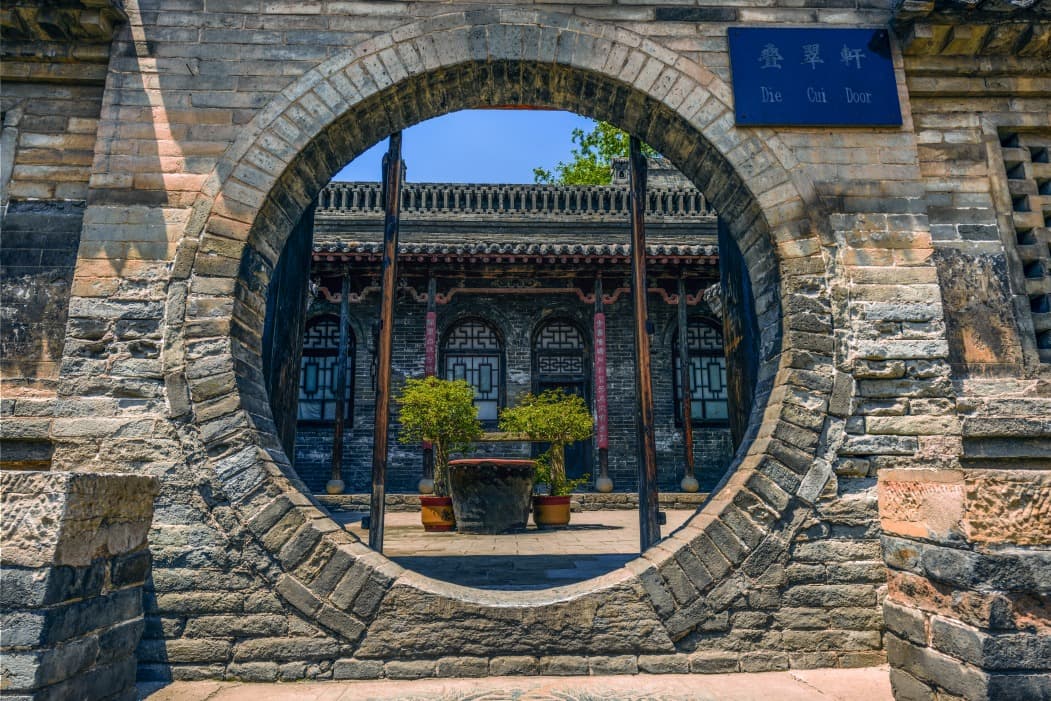
Wang Family Residence (王家大院)
Wang Family Residence (王家大院)
A grand merchant estate spanning the Ming and Qing dynasties, the Wang Family Residence in Lingshi impresses with its interlocking courtyards and decorative stonework, just an hour from Pingyao.
The Wang Family Residence — Wang Jia Da Yuan — ranks among the largest complexes of traditional residential architecture in Shanxi. Built by the Wang clan, a merchant family enriched during the Ming and Qing dynasties, it sprawls across tens of thousands of square meters in Lingshi, roughly an hour's drive from Pingyao. Its interlocking courtyards, stone sculptures, and wooden ornaments exemplify the splendor of northern China's merchant bourgeoisie.
Essentials at a glance
- Admission: Paid entry (rates to be confirmed on-site or with your local agency)
- Recommended duration: 2 to 3 hours to tour the main buildings
- Access: Lingshi County, Shanxi — reachable by bus or taxi from Pingyao or Taiyuan
- Dress code: No particular restrictions
What to see
The complex comprises several clusters of courtyards (yuan) linked by paved alleyways. Facades blend grey brick, sculpted stone framing, and the double-pitched roofs characteristic of Shanxi architecture. Lintels, brackets, and wooden panels bear symbolic motifs — bats, peonies, auspicious characters — carved with remarkable finesse.
Two main zones are open to visitors: the Gao Jia Ya complex and the Hong Men Bao complex, each organized around a succession of interior courtyards arranged according to the rank of their inhabitants.
History and context
The Wang clan amassed wealth through salt and grain trade under the Ming, then consolidated their fortune during the Qing. Construction of the estate unfolded over several generations, spanning the 17th to 19th centuries. At its height, the family ranked among Shanxi's most influential, the province then a hub of northern China's merchant networks.
The site is sometimes nicknamed "the Forbidden City of the people," a reference to its architectural scale, though this comparison remains largely rhetorical.
Highlights of your visit
Decorative sculptures
Shanxi craftsmen adorned doors, windows, and balustrades with stone and wooden bas-reliefs. Each motif carries meaning: the bat (fu) evokes good fortune, the pomegranate symbolizes progeny. Observing these details lengthens your visit — and that's precisely the point.
The hierarchy of courtyards
The arrangement of buildings reflects the family's social order: main courtyards hosted ceremonies, side courtyards housed servants and storage. Moving from one to another, you read the organization of a great Qing merchant household.
Views from the terraces
Certain buildings allow you to gain height and embrace the entire complex: cascading roofs, grey walls, and Shanxi's hills as backdrop.
Photography tips
Morning light, before tour groups arrive, is ideal for photographing courtyards without crowds. Sculpted door frames offer natural framing toward interior courtyards. Close-up details — glazed tiles, wooden reliefs — deserve as much attention as wide-angle views.
Location and access
The residence lies in Lingshi, Shanxi, roughly 70 km north of Pingyao. From Pingyao, a taxi or regional bus connects you to Lingshi. Some travelers combine it with Pingyao's old town in a full day, departing early.
Mandarin-language guided tours are typically available on-site; English-speaking guides are rarer — your local agency can arrange accompaniment.
Nearby
- Pingyao Old Town — a UNESCO-listed Ming-Qing merchant city, roughly an hour's drive away.
- Qiao Family Residence — another grand merchant estate in Shanxi, made famous by the film Raise the Red Lantern.
- Shuanglin Temple — near Pingyao, notable for its painted Buddhist statues.
Frequently asked questions
No. It is located in Lingshi, roughly 70 km north of Pingyao. Plan for an hour's drive. It's best visited as an excursion from Pingyao.
Two to three hours suffice to explore the two main complexes. Architecture enthusiasts or photographers can easily spend half a day here.
Yes, if you depart early from Pingyao. Visit the Wang Residence in the morning, then return to Pingyao for the afternoon. A private taxi simplifies logistics.
On-site guides operate primarily in Mandarin. For English-language accompaniment, it's best to arrange this through your local agency before your visit.
Spring (April–May) and autumn (September–October) offer pleasant temperatures and favorable light. Avoid major Chinese national holidays, when Shanxi sites draw large crowds.
Interested in this visit?
We can include it in your personalised itinerary.
