Ruins of Saint Paul's Church
Ruins of Saint Paul's Church
A remnant of a 17th-century Jesuit church, the façade of the Saint Paul's ruins is the symbol of Macau and a UNESCO World Heritage site since 2005.
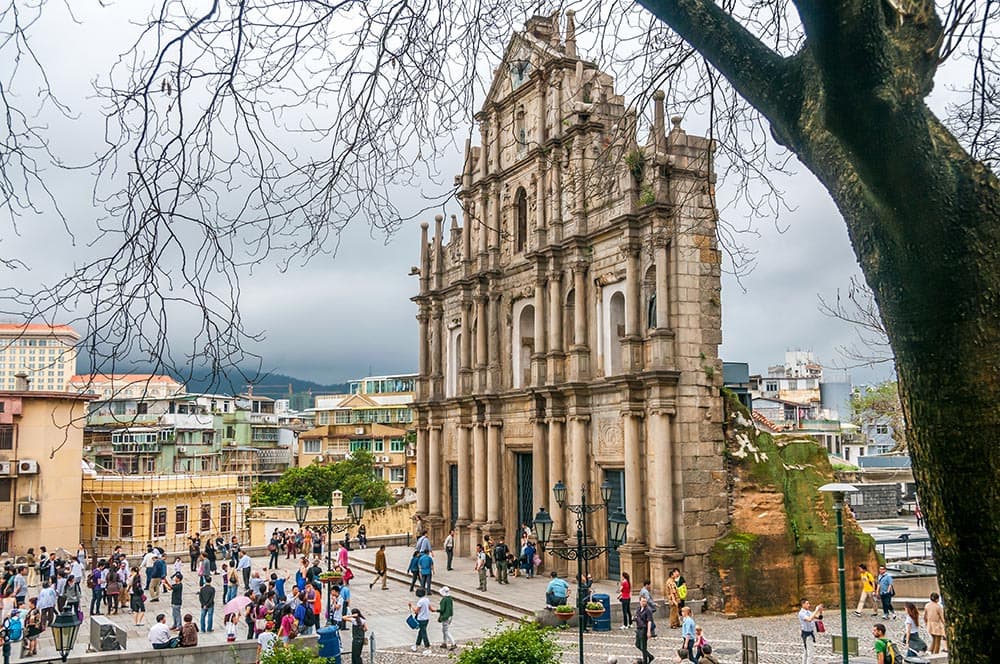
The ruins of Saint Paul's Church stand with their baroque façade above a monumental staircase, in the very heart of Macau. A remnant of a 17th-century religious building ravaged by fire in 1835, this sculpted wall panel is today the most recognizable symbol of the city and one of the major sites in its historic centre, listed as a UNESCO World Heritage site since 2005.
Why visit the ruins of Saint Paul's
- A unique façade standing 27 metres high, blending Portuguese, Chinese and Japanese influences, a rare testament to Jesuit evangelization in East Asia.
- Intricately detailed sculptures—Jesuit saints, the Virgin Mary, musical angels—still legible despite the centuries.
- A central location, just a few minutes' walk from Macau's historic centre and the Senate Square.
- Free admission, accessible at all hours for the exterior façade.
History of the site
Saint Paul's Church was built in 1565 by three Portuguese missionaries: Francisco Perez, Manuel Texeira and André Pinto. Adjoining the college of the same name, it became the largest Christian church in the Far East and a major hub for the spread of Catholicism throughout Asia.
A first fire destroyed it in 1595. Reconstruction, carried out between 1620 and 1627, resulted in a larger building, often referred to at the time as the Saint Paul's Cathedral. For two centuries, the complex was a beacon for the Christian community in the region.
In 1835, another fire devastated the entire complex: the church and college went up in smoke, leaving only the main façade standing. With no reconstruction undertaken, it gradually became the symbol of the city. In 2005, the ruins were inscribed on the UNESCO World Heritage list as part of Macau's historic centre.
What to see on site
The façade
Access is via a staircase of around 68 steps. Standing 27 metres high and organized across four levels, the façade ends with a triangular lintel topped by a cross. Sculptures, bronze statues and inscriptions in Chinese and Latin characters tell the story of the Jesuit mission in Asia. Notably visible is the inscription "the great virgin mother".
At the first level, bronze statues of four Jesuit saints—Louis of Gonzaga, Ignatius of Loyola, Francis Xavier and Francis Borgia—frame the main door. Higher up, the Virgin Mary surrounded by musical angels adorns the central niches, while a statue of Jesus accompanied by a dove with outstretched wings dominates the whole.
The rear of the façade
During the 1995 renovation, the façade was stabilized with concrete and steel pillars. An interior staircase leads to a platform at the rear of the wall, from where one can observe Macau's colonial alleyways.
The Saint Paul's Church Ruins Museum
Established in 1995 behind the monument, this small museum holds Catholic liturgical relics as well as remains of Japanese and Vietnamese martyrs unearthed during excavations. A visit usefully complements your reading of the façade.
Practical information
- Admission: free access to the façade and esplanade. The museum and crypt are also free.
- Opening hours: the façade is visible 24/7 outside; the museum and crypt open during the day, generally from morning until late afternoon (check current opening times on site).
- Duration of visit: allow 30 minutes to 1 hour for the façade, and 1 to 1.5 hours if you include the museum and surrounding alleyways.
- Accessibility: the entrance staircase makes wheelchair access difficult.
When to visit
The façade is oriented so as to be beautifully lit in the late afternoon, when the low sun accentuates the sculptures. Early morning offers the softest light and fewest crowds: from mid-morning onwards, tour groups arrive and the esplanade becomes crowded. Avoid weekends and Chinese public holidays if you wish to photograph the site without crowds.
What to see nearby
The ruins are part of Macau's historic centre, with most major sites within walking distance:
- Senate Square (Largo do Senado), a 10-minute walk away, with its Portuguese mosaic pavements.
- Fortaleza do Monte (Mount Fortress), just next door, offering panoramic views across the peninsula.
- Na Tcha Temple, a small Taoist shrine located behind the ruins.
- The shopping streets of Rua de São Paulo, perfect for sampling local specialities (egg tarts, almond biscuits).
To plan your stay, consult our dedicated guide to Macau.
How to get there
The site is easily accessible on foot from the heart of the Macau peninsula, heading up Rua de São Paulo. By public transport, several bus routes serve the area: 3, 4, 6A, 8A, 18A, 19, 26A, 33 and N1A. Taxis remain a practical option from more distant neighbourhoods or from Cotai.
Frequently asked questions
Frequently asked questions
Yes, access to the façade, esplanade and ruins museum is free.
Allow 30 minutes to 1 hour for the façade and rear platform, and up to 1.5 hours if you also visit the museum and surrounding alleyways.
Early morning for a quieter esplanade, and late afternoon for warm light that highlights the façade's sculptures.
A fire destroyed the entire Saint Paul's Church and college complex in 1835. Only the main façade survived, and it was never rebuilt.
Yes, the ruins are part of Macau's historic centre, inscribed on the UNESCO World Heritage list since 2005.
Plan your trip
The Saint Paul's ruins are an essential stop on any Macau itinerary, and easily fit into a broader circuit across China. Our advisors can help you build a custom journey combining Macau, Hong Kong and the major cities of the mainland.
Interested in this visit?
We can include it in your personalised itinerary.