Changbai Shan
Changbai Shan
Tianchi Lake, Paektu Volcano, boreal forests: everything you need to know to visit Changbai Shan, a jewel of northeastern Chine and Unesco Biosphere Reserve.
The Changbai Shan massif stretches from Jilin province in Chine to the North Korean border and is home to Chine's largest nature reserve.
History
The Changbai Shan Nature Reserve was established in 1960 and integrated into Unesco's "Man and the Biosphere" (MAB) program.
Mount Changbai, also known as Mount Paektu, experienced its last major eruption in 946. Since then, several minor eruptions have been recorded, notably in 1668, 1702, 1898 and 1903.
Since 1999, the volcano has been subject to intensive monitoring. In 2002 and 2006, significant seismic activity and microearthquakes were recorded.
Changbai Shan Nature Reserve
In the far north of Chine near the border with North Korea lies the Changbai Shan Nature Reserve. Like a solitary peak far removed from urban bustle, this not-quite-dormant volcano is now crowned by a lake of crystalline waters.
This landscape, as if plucked from your dreams, captivates every traveler who ventures here. The reserve spans more than 2,000 km², composed of dense forests, waterfalls, lakes and mountains. The highest point in the park is Mount Changbai (Paektu) at 2,744 meters above sea level.
302 animal species have been recorded within the reserve, including the snow leopard, Siberian tiger, Asian deer, black bear, Eurasian lynx and golden eagle. Some of these species are on the verge of extinction while others are flourishing, such as squirrels.
Mount Changbai
Changbai Shan, also called Mount Paektu in Korean, is a volcano straddling the border between Chine and North Korea.
The mountain is home to highly diverse fauna and flora. At lower elevations, vegetation is very dense, composed mainly of birch and pine trees, but above 2,000 meters, it begins to thin out, subject to capricious weather conditions. The animals inhabiting it have little difficulty hiding from visitors' view, as the park is immense, but some may be fortunate enough to capture images of a Leopard or lynx in search of food.
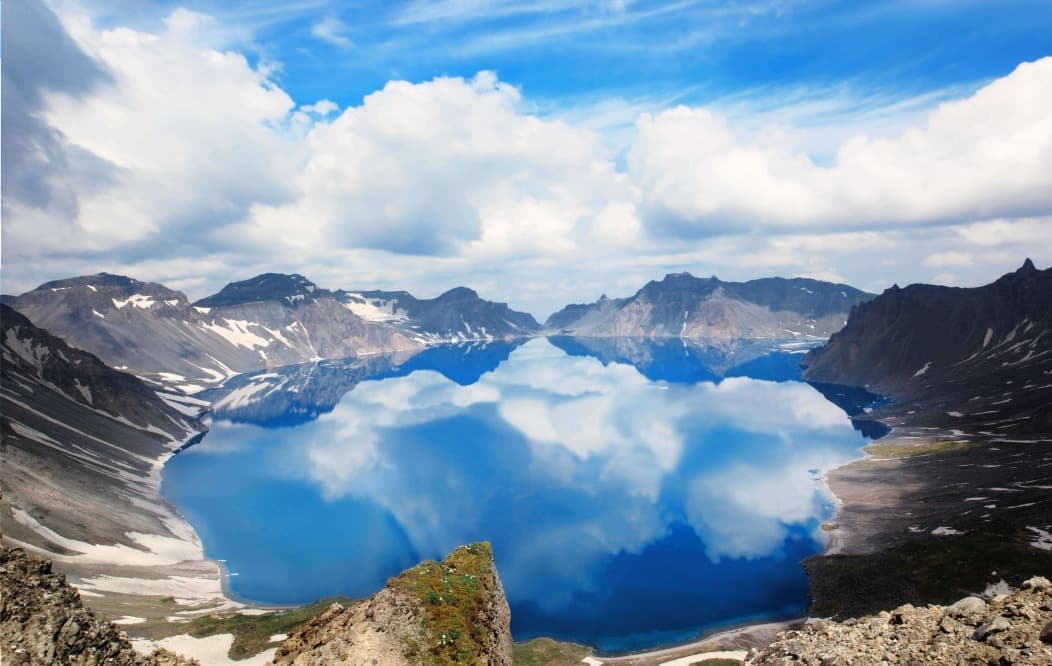
On the Chine side, the mountain is perfectly developed for tourists with observation platforms and a cable car to reach the Heavenly Lake. The view of the lake nestled in the heart of snow-capped mountains is astounding, almost unreal given the breathtaking beauty of the location. Its summit, which dominates the reserve at 2,744 meters above sea level, will also reveal a breathtaking panoramic view of neighboring peaks.
It is possible to reach it via the North entrance or the West entrance, separated by 100 km of enchanting nature.
Heavenly Lake
The Heavenly Lake sits at over 2,100 meters above sea level, nestled within the volcanic crater of Changbai Shan. Like an emerald, the lake with its deep blue waters has become the jewel of Changbai Shan. The lake extends 5 km in length and 3 km in width with an impressive maximum depth of 384 meters.
Frozen in winter, the lake feeds a massive waterfall when warmer weather returns. It thus becomes the direct source of the Erdaobai River.
Near these waterfalls are natural hot springs with medicinal properties. A thermal establishment is set up to take advantage of the pools.
North Slope
More frequently used, the north slope entrance allows easy access to the Heavenly Lake via waterfalls and hot springs. It is possible to make the first part by 4x4 and then ascend by cable car.
About ten kilometers from the entrance, the Underground Forest (Dixia Senlin) offers beautiful hikes through lush vegetation. The trail will lead you to a pleasant forested crater.
West Slope
Much less frequented than the north slope, it also allows access to the Heavenly Lake.
The interest in taking this route lies in discovering the Changbai Shan Canyon. Through lush forest, you can contemplate these impressive rock formations that extend for 70 km.
Climate
Regardless of season, the climate can change rapidly from one hour to the next, especially at altitude.
Even if the weather is suitable for hiking, violent winds or heavy rain can strike without warning and cause temperatures to drop by around ten degrees.
Regardless of season, it is always very cold at the summit with an annual average of -8.3°C. In summer the average reaches 10°C but in winter it drops sharply to around -24°C.
The Heavenly Lake is frozen from mid-October to mid-June.
The best time to visit the Changbai Shan Nature Park is from May to October.
The Changbai Shan Nature Reserve can be accessed from Erdao Baihe.
Air
An airport opened in 2008 to serve Baishan and the Changbai Shan Nature Reserve.
Changbaishan Airport is served by flights from Beijing, Guangzhou, Tianjin, Shanghai, Changchun, Chengdu, Dalian and Shenyang.
Train
There are several railway stations near Changbaishan.
Baihe Train Station: Located in the small town of Erdao Baihe, the station receives trains from Changchun, Shenyang, Jilin, Tonghua…
Antu Railway Station: Located 160 km from Erdao Baihe, it takes approximately 3 hours by road to reach Changbaishan. Antu Station is served by trains from Shenyang, Changchun, Jilin, Harbin, Dalian, Beijing and other cities in the province.
Long-Distance Bus
Long-distance buses arrive at Erdao Baihe from Changchun, Jilin, Antu, Yanji, Dunhua. From there you must take a second bus or car to the entrance of Changbai Shan.
Regular buses connect the town of Baihe to the North Slope entrance.
To reach the west slope entrance, it is advisable to take a taxi. In summer there is a bus connecting Erdao Baihe train station to the west entrance.
Once you have passed the entrances, you can use 4x4s, shuttles and cable cars to reach key points.
Fees
Park entrance fee: 125 RMB Bus fee: 85 RMB Bus fee to the mountain summit: 80 RMB
Want to discover this destination?
Our local advisors design your tailor-made trip.