Hotan
Hotan
An ancient Silk Road oasis in southwestern Xinjiang, Hotan captivates with its prized white jade, haunting Buddhist remains, and thriving Uyghur craftsmanship.
Name: Hotan
Chinese Name: 和田
Province: Xinjiang
Status: Prefecture
Population: 322,300 inhabitants (2010)
Area: 247,800 km²
Hotan is a city situated within the Tarim Basin, south of the Kunlun Mountains and facing the Taklamakan Desert in southwestern Xinjiang. Also known as Khotan and historically as Hetian, it serves as a vital crossroads. The western part of the city connects to Kashgar, while the east links to Bayinbgolin, an autonomous Mongolian prefecture.
Hotan is renowned above all as the world's foremost jade source, particularly celebrated for its luminous white jade. The prefecture is home to 19 ethnic nationalities, with Uyghurs, Han Chinese, Hui Muslims, and Kazakhs forming the largest communities.
History
Once a crucial military garrison along the Silk Road, this prefecture was a vital crossroads for commerce, philosophy, and religious exchange. Tocharian peoples inhabited the region roughly 2,000 years ago.
Archaeological excavations in local cemeteries have unearthed mummies of Caucasian type alongside those of mixed Eurasian descent, testament to centuries of cultural contact.
Hotan became recognized as Chinese territory under the Han Dynasty. During the 1937 Islamic rebellion, Hotan and the broader province fell under General Sheng Schicai. He was later displaced by the Kuomintang. In 1949, after communist victory in the civil war, the city was incorporated into the People's Republic of Chine. By 1984, the urban zone separated administratively from the county, with Hotan receiving direct government oversight.
Following the 2009 Urumqi unrest, ethnic tensions intensified throughout Xinjiang, including in Hotan. In 2011, the city launched its first railway service to Kashgar. Despite these challenges, Hotan has maintained its substantial economic and tourism appeal.
Today
Many regard Hotan as a jewel of the Silk Road. For two millennia, it has been celebrated for its advances in livestock herding and sericulture—the cultivation of silk-producing worms. Today, Hotan attracts travelers drawn to its ethnic diversity, layered history, and remarkable cultural heritage.
Uyghurs form the city's predominant population, bringing profound Islamic influence to its character.
During a journey through Xinjiang, a visit to the Hotan Museum reveals over 9,000 exceptional cultural artifacts. Exhibitions showcase traditional silk-weaving techniques, ceramics, paintings, and more.
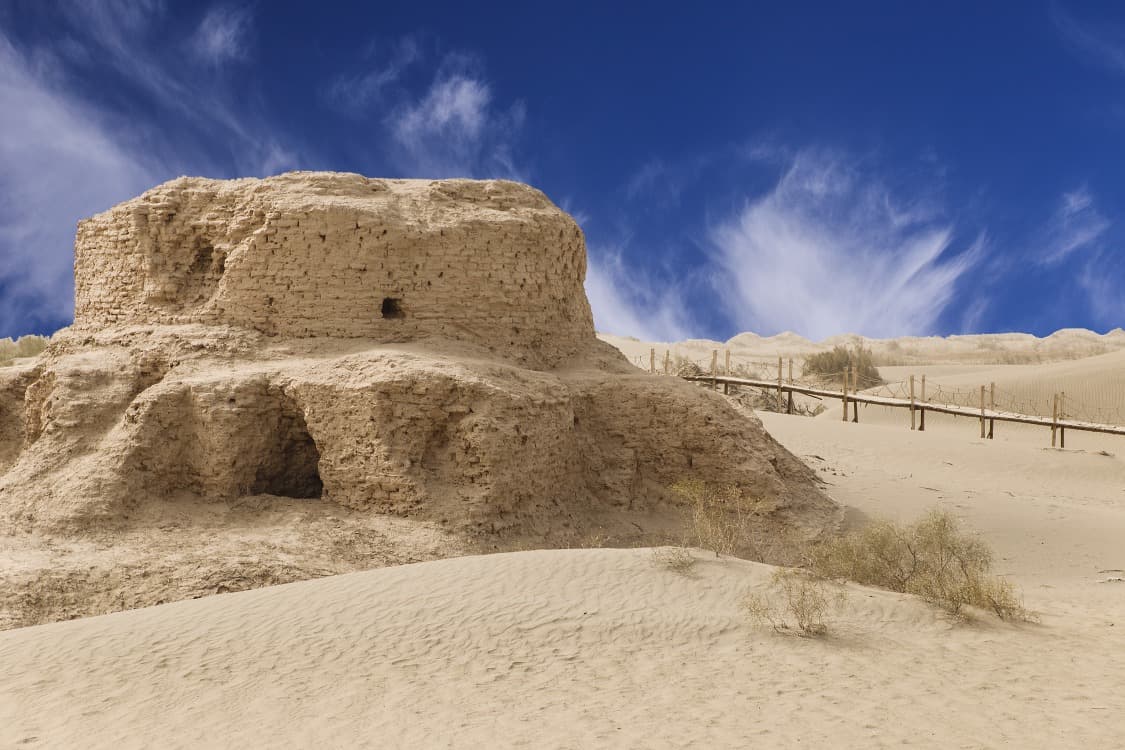
Do not miss the ruins and heritage sites scattered across the desert, bearing witness to the city's glorious past. The ancient city of Niya, Mallikurwatur, and the city of Yoktan stand as crucial testaments to the region's history. The remains of the Melikawat Buddhist monastery, 28 kilometers south of Hotan, are equally compelling. Beyond ancient ruins, nature enthusiasts will find solace in the nearby Muz Mountains and Kunlun Mountains, perfect for exploration.
With fortune, your visit to Hotan may coincide with traditional festivals and folk celebrations: Corban, Roza, the Jade Cultural Festival, or the Yutian dance.
The prefecture ranks among Xinjiang's celebrated commercial hubs. Gastronomically, savor diverse lamb dishes, yams, and fresh fruits—apricots, pomegranates, and beyond.
Climate
Situated in a hot-temperature zone, Hotan's region is dominated by a temperate arid continental climate. Summers are intensely hot; winters see minimal temperature drops. Rainfall is sparse, averaging 36.5 mm annually, with mean annual temperatures between 11–12°C and moderate sunshine. August and September offer the most pleasant visiting conditions.
Visitors reach Hotan by air, train, or bus.
Air
Hotan Airport, 12 kilometers south of the city center, connects travelers to regional and neighboring provincial cities. Six daily flights serve Urumqi, with flight times around 1 hour 50 minutes.
Train
Since recent expansion, Hotan connects via the Kashgar–Hotan railway line. However, passenger service remains limited: one daily train links Hotan to Kashgar.
Bus
Hotan benefits from China's National Highway 315, which traces the Tarim Basin, and the Taklamakan Desert Expressway. An express bus connects Urumqi, while regular services link Hotan to Kashgar.
Explore the city and historical sites by taxi. Fares start at 5 RMB daily and 7 RMB at night. Rental vehicles are available for excursions into the surrounding deserts.
The city operates roughly a dozen bus lines.
What to Do in Hotan?
- Explore the Hotan Museum with its rich collection of relics and exhibits.
- Discover the numerous archaeological sites surrounding the city, particularly the ruins of Melikawat Buddhist monastery.
- Visit the Silk Village to witness traditional weaving techniques firsthand.
- Trek Kunlun Mountain and immerse yourself in its breathtaking landscape.
Want to discover this destination?
Our local advisors design your tailor-made trip.