Guilin and Southern Karst
Limestone peaks of the Li River, terraced rice paddies of Longji at 1,100 metres, Zhuang and Yao villages: Guangxi concentrates the karst landscapes of southern China.
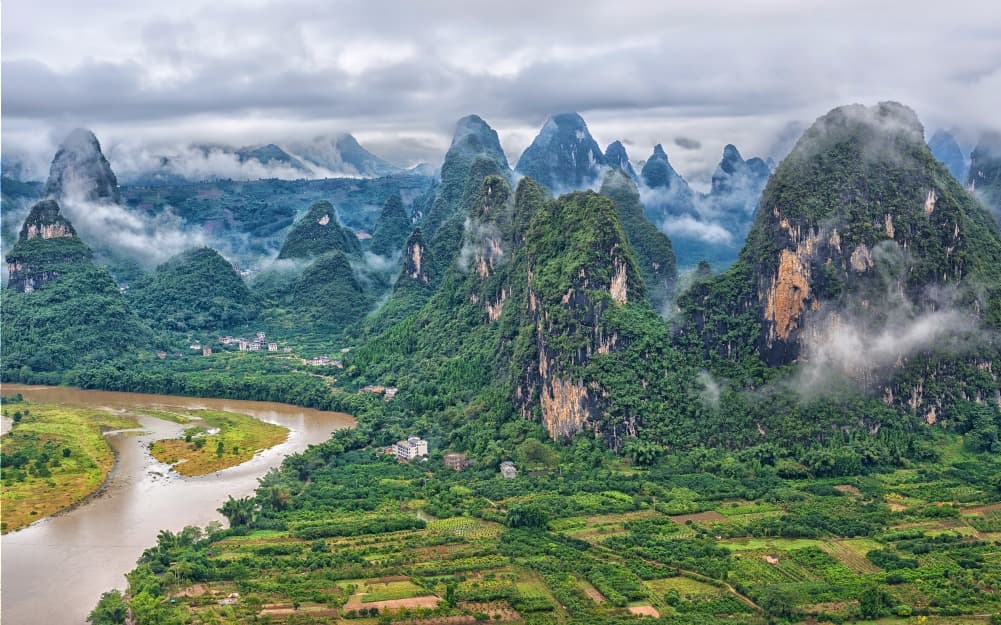
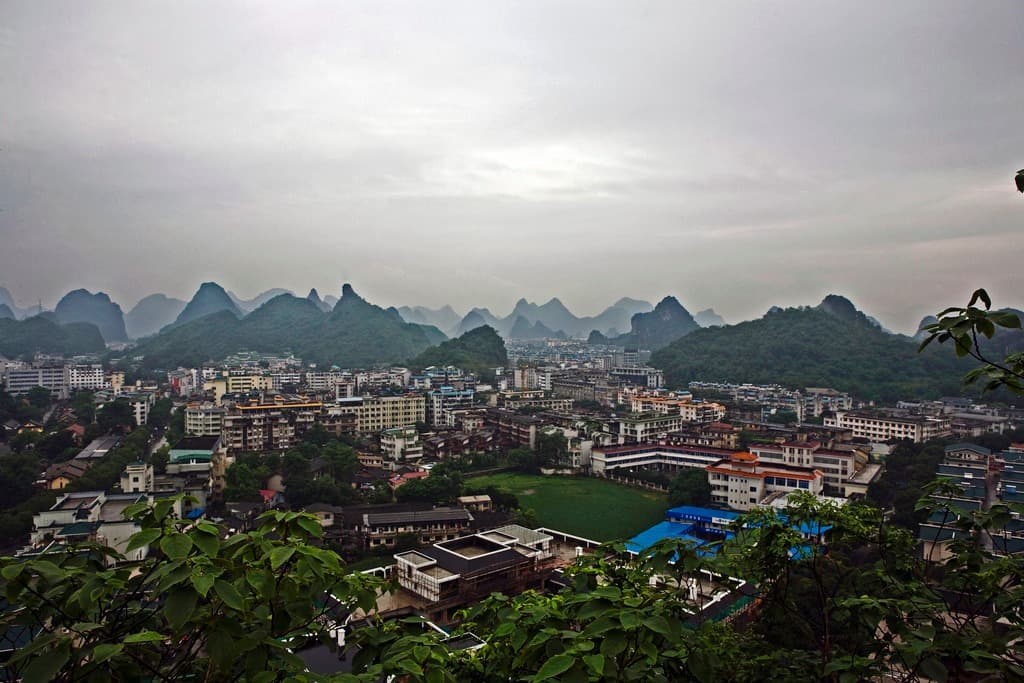
Guangxi occupies southern China, on the Vietnam border, and its karst terrain stretches nearly 200 kilometres between Guilin to the north and Yangshuo to the south. Our English-speaking team based in Guilin has known these landscapes for years: limestone peaks 100 to 200 metres high, underground rivers, caves adorned with formations like the Reed Flute Cave (Ludi Yan) at Guilin's northern edge. This distinctive geology stems from the erosion of an ancient coral plateau over tens of millions of years. The result appears in every vista: hundreds of isolated hills rise from rice paddies, and the Li River traces its course over 83 kilometres between Guilin and Yangshuo.
Yangshuo, a former farming town turned traveller's crossroads, retains a centre crossed by West Street and surrounding countryside best explored by bicycle. Within an hour's pedalling southward lies the Yulong River, gentler than the Li, where bamboo rafts drift at a leisurely pace. The villages of Fuli, Xingping and Daxu, still animated by markets every three days, preserve their grey-brick Ming and Qing houses. Xingping, founded 1,700 years ago, occupies precisely the meander depicted on the back of the 20-yuan note.
Northeast of Guilin, roughly two hours by road, the terraced rice paddies of Longji cascade between 300 and 1,100 metres altitude across the flanks of Dragon Mountain. Built during the Yuan dynasty seven centuries ago, they are maintained by two peoples: the Zhuang around Ping'an and the Red Yao around Dazhai and Huangluo. Huangluo village is renowned for its Yao women who grow their hair to 1.8 metres and cut it only once in their lifetime, at age sixteen. Treks between Ping'an, Zhongliu and Dazhai take three to six hours and pass through hamlets where rice cultivation remains the primary livelihood.
Guangxi's cuisine sets itself apart from neighbouring provinces. Guilin rice noodles (Guilin mifen), served at breakfast with braised pork, peanuts and coriander, are the daily staple. In Yangshuo, fish braised in beer (pijiu yu), caught from the Li and simmered with chillies and tomatoes, accompanies evening meals. The region also produces luohan guo, a dried fruit used as a traditional sweetener, and pomelo wine. The Zhuang, China's largest ethnic minority with 18 million people, celebrate the Song Festival on the third day of the third lunar month (typically April): days of call-and-response singing between men and women.
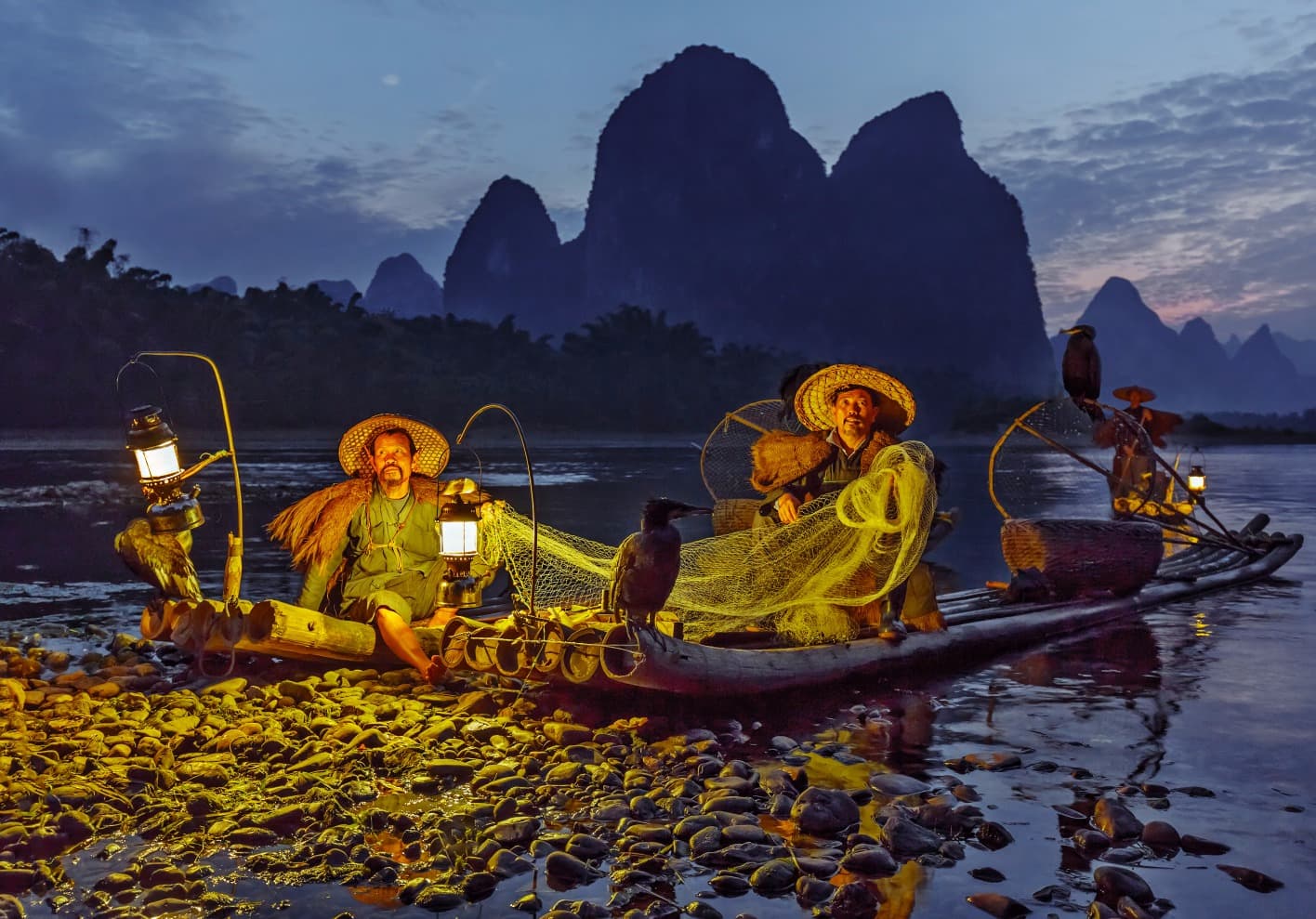
The local economy hinges on domestic tourism, which became massive following the opening of high-speed rail lines in 2014. Guilin welcomes over 100 million Chinese visitors annually, which explains why much of our work involves steering you away from congested spots at peak times. The classic Li descent departs from Zhujiang dock at 9:30 or 11:00: we often prefer the motorised bamboo raft version starting from Yangdi towards Xingping, slower-paced, or the riverside paths between Xingping and Nine Horses Hill, accessible on foot.
Highlights
Li River descent from Yangdi to Xingping. Four hours on a motorised bamboo raft across 20 kilometres, between 150-metre peaks dropping sheer into the water. The section includes Nine Horses Hill and the meander featured on the 20-yuan note.
Longji rice terraces at Ping'an and Dazhai. A three-to-five-hour trek through Zhuang and Red Yao villages at 800 metres altitude. Terraces shift colour with the seasons: mirror-like in May, vivid green in July, gold in October.
Yangshuo countryside by bicycle. A 25-kilometre loop around the Yulong River via Jiuxian and Liugong villages with their stone Ming houses. Paths traverse rice paddies and pomelo plantations.
Xingping market. On the third and sixth days of each lunar month, farmers from neighbouring hamlets descend to sell vegetables, medicinal herbs and poultry in the cobbled streets of this town founded under the Han.
Street food in Guilin. Mifen noodle stalls open from six in the morning around Zhengyang Street. Broth simmers overnight with star anise, cinnamon and pork bones.
When to go
The climate is subtropical and humid. The best windows are April through early June and September through mid-November. In spring, temperatures hover between 18 and 25 degrees and Longji's rice paddies fill for transplanting: from mid-April through early June, terraces mirror the sky. Autumn brings dry days around 20 to 26 degrees with sharp light; paddies turn gold from late September before the mid-October harvest.
Summer (June to August) remains manageable but challenging: 32 to 36 degrees in Guilin and Yangshuo, humidity above 80 per cent, afternoon storms daily. Conversely, the Li River runs at peak flow, guaranteeing full navigability of the route. Winter (December to February) drops to 8–12 degrees during the day, sometimes lower at Longji where snow can fall above 900 metres; landscapes take on a distinctive misty quality, but bamboo rafts cease operating on certain stretches due to low water.
Practical advice
Allow three to four full days for the region: one day for the Li descent and arrival in Yangshuo, one day for Yangshuo countryside cycling or the Yulong River, and two days for Longji with an overnight stay at a mountain village. Guilin Liangjiang Airport (KWL) receives direct flights from Beijing, Shanghai, Chengdu, Kunming and Hong Kong. Guilin North High-Speed Railway Station connects to Canton in 2.5 hours and Shanghai in 8 hours.
The smoothest combination pairs with Yunnan: a 1.5-hour flight to Kunming allows you to continue on to Dali and Lijiang. To Chengdu and Sichuan, expect 2 hours' flying, useful for those pursuing onwards to the Tibetan borderlands. The region suits families with children from age eight upwards thanks to gentle activities (cycling, rafting, short treks), contemplative travellers and regular walkers keen on Longji. Hotel comfort is good in Yangshuo (charming guesthouses in the countryside) and more rustic in Yao villages, where we work with several families renting traditional wooden rooms.