Introduction to Chinese Characters
In China's thriving traditional culture, writing holds a place of distinction. Fascinating because it differs from Western standards, it embodies within itself the history and much of Chinese thought. A brief introduction to what Chinese characters are, often called 'sinograms.'
In China's thriving traditional culture, writing holds a place of distinction. Fascinating because it differs from Western standards, it embodies within itself the history and much of Chinese thought. A brief introduction to what Chinese characters are, often called 'sinograms.'
In a nutshell
Chinese character, or sinogram, is called hànzì in Chinese (phonetic transcription in pinyin). This means the writing of the Han, the majority ethnic group in China.
- 漢字 Traditional Chinese
- 汉字 Simplified Chinese
- The term 'sinogram' was invented by Delphine Weulersse and Nicolas Lyssenko from the University of Paris VII—Not all Chinese characters are ideograms; there are certain phonetic components within many sinograms.
- Commonly, Cang Jie (around -2650 BC) is credited with creating Chinese characters through observation of nature. Legend presented him with four eyes. Another tradition attributes the creation of sinograms to the legendary Fuxi, a mythical figure seen as the father of Chinese civilization and the creator of the Yijing, the Classic of Changes.
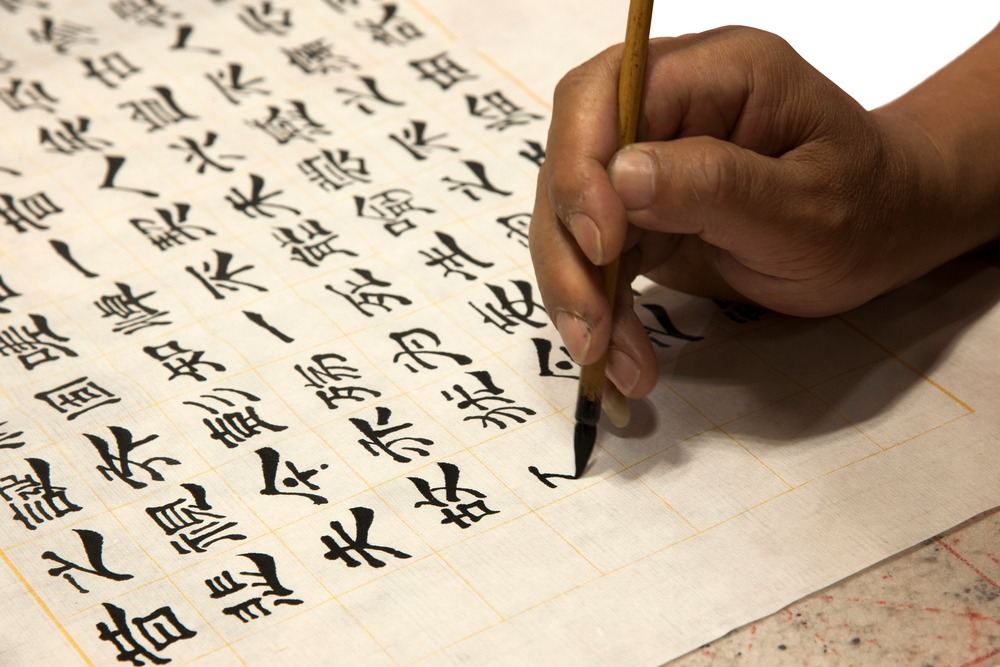
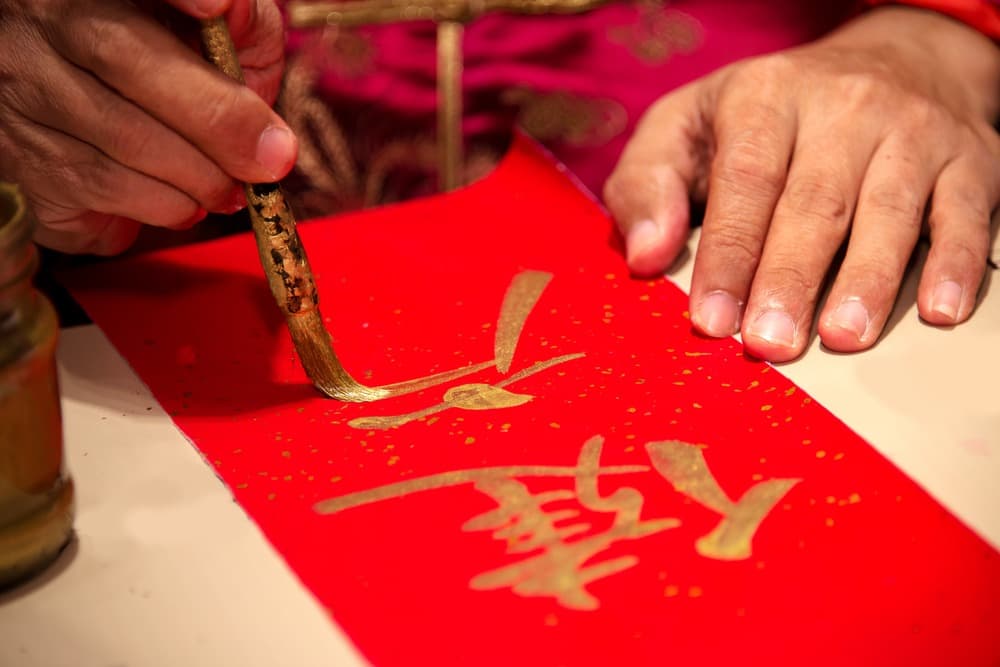
- With calligraphy, an art considered the equal of painting in China, the writing of Chinese characters can take on an artistic or even meditative quality. This discipline is credited with numerous benefits for health and notably the development of cognitive abilities.
A central place in Chinese heritage
Perhaps more than for any other civilization, writing occupies a central place in China's historical and cultural heritage. However, its origins are difficult to explain—too ancient and shrouded in legend.
The only certainty is that this system, composed of characters (or sinograms), is both one of the oldest (if not the oldest) to have emerged, and it remains unique in the world today.
Sinograms: distant origins and a unifying role
Since their primitive forms, Chinese characters have evolved considerably. When do the earliest versions of these signs date back to?
The most ancient traces take us back 6,000 years. The marks left on animal bones and tortoise shells remain the most celebrated archaic version of sinograms. Over time, the form of characters evolved in a purely practical direction, leading to simplification, with the final stage being Mao Zedong's reform adopted in 1958. It should be noted that this reform was not applied everywhere; Macau, Taïwan, and Hong Kong retained what is known as traditional writing.
Throughout Chinese history, writing has occupied a place of prominence that likely ensured its survival to the present day: thanks to the absence of connection between writing and pronunciation, sinograms became a perfect means of linguistic unification across the vast Chinese territory.
It was the First Emperor of the Qin, Qin Shihuangdi, who, after conquering the other kingdoms and thus unifying the country, decided to do the same with writing: the objective was clearly to consolidate central power. Significant administrative measures were employed to this end.
The result remains visible in China today: despite great differences in spoken languages, the entire Chinese people share the same writing system, which facilitates communication in many ways.
Ideas rather than sounds
Indeed, based primarily on pictograms and ideograms, Chinese characters evoke meanings and ideas (sometimes with an associated phonetic element), whereas writing systems in other languages transcribe sounds. Even Japanese writing, which one might think equivalent to its Chinese neighbor, borrows sinograms while giving significant space to phonetic signs, the kanas.
Other similar writing systems, such as Egyptian hieroglyphics, did not survive the test of time and gave way to phonetic alphabets, where writing and pronunciation go hand in hand.
Internationally famous yet often misunderstood
Undoubtedly, characters are one of the most fascinating and renowned aspects of Chinese culture. Yet paradoxically, they are also one of its most misunderstood characteristics by the uninitiated.
There is a tendency to think that sinograms are one of the most difficult aspects to master when learning the language of Confucius. However, according to experts, learning characters (hanzi in Mandarin) is not as complicated a step in studying this language as mastering the four tones can be.
While effort is needed to memorize as many as possible, Chinese characters are constructed in a logical manner. Understanding this logic increases one's capacity for learning.
There are more than 50,000 sinograms, which means that the vast majority of Chinese speakers know only an infinitesimal portion of them. It is even unlikely that an expert of the Chinese language, however learned, would know approximately all of them.
Which is not really a significant problem, since only 3,000 are considered 'common': knowing these allows one to understand 99% of the content of the press and literature in China...