Lao Zi, the Immortal Master
Presumed father of Taoist philosophy and the Dao De Jing, Lao Zi is an important figure in Chinese cultural heritage. He is said to have met the sage Confucius, who is reported to have been left speechless after their conversation...
Presumed father of Taoist philosophy and the Dao De Jing, Lao Zi is an important figure in Chinese cultural heritage. He is said to have met the sage Confucius, who is reported to have been left speechless after their encounter...
Lǎo Zi (or Laojun) in pinyin
Alternative transcription: Lao Tzu
Chinese characters: 老子 or 老聃
The birth of Laozi remains unclear, however historians who believe in his existence think he was born between 600 and 200 BCE. Note: his Chinese name, Lǎo Zi, means "Master Lao" (old master) or "old child". His true name is said to have been Li Er or Lao Tan.
Did you know?
A legend grew around Laozi's birth. The ancients believed that Lao Zi's mother carried him in her womb for either eight or eighty years. Thus, he would have been born wise, possessing all the attributes of men of distinction.
Another legend speaks of a comet that appeared in the sky on the day of his birth, accompanied by nine dragons that emerged from the earth to wash him. Some believe he died at the age of 200, or that he still lives somewhere in a remote part of Chine.
Laozi, mythical or real figure?
Did Lao Zi truly exist? Although the sage is particularly famous and described as the father of Taoist philosophy, the truth of his existence has never been proven. This could be a consequence of the solitary life he is generally said to have lived, removed from the social world.
Extensive research has been conducted on his life, but none can determine exactly where he was born. However, one author, Bian Shao, places the sage's birthplace in the Guizhou region, in Guiyang.
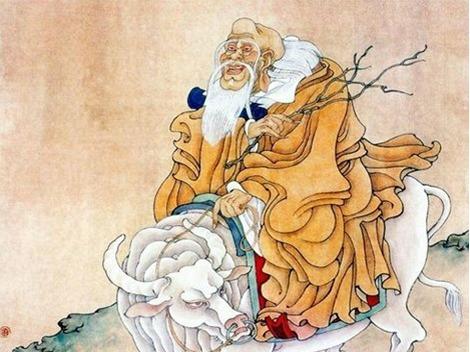
Laozi is believed to have served as an archivist and astrologer for the emperors of the Zhou dynasty (690 to 705 BCE) for several years. But faced with the power struggles of the Zhou dynasty, Laozi left the present-day Shaanxi province to head west. Rich iconography illustrates Laozi's journey on the back of a black ox traveling across the Empire.
Before crossing the Han Gu Pass (also called Hien Kou), a border guard named Yin Xi is said to have asked him to write a philosophical testament. The text that Laozi composed would become the famous "Dao de jing" (Tao-Te-Ching) or "the sacred book of the way and virtue," composed of more than 5,000 Chinese characters and the origin of Taoism.
However, according to historians, the work probably dates only to the Han dynasty (206 BCE to 220 CE). This raises doubts about the authorship of the book attributed to Laozi, or whether he wrote it with his own hand...
Due to lack of information and questionable dating, some historians believe that Lao Zi did not exist. However, the classical work "The Book of Rites" by the disciples of Confucius mentions a conversation between "Master Lao" and Confucius himself regarding funeral rites. It even states that the father of Confucianism was particularly impressed by his "Taoist counterpart."
Our first mention of Laozi comes from the second most important Taoist work, the Zhuangzi, written by the sage of that name and his disciples. The father of Taoism is there called Lao Dan (老聃), and spends his time criticizing the efforts of Confucius, which he judges to be futile and against nature.
Taoism, a philosophy 哲学 that became a religion 教
The wisdom and teachings of Lao Zi, particularly the Dao De Jing, would give birth to Taoism. This is the teaching of the Way, the "dào jiào." This philosophy spread from the period of the Warring States through the early Han dynasty. However, a religious form later emerged when Confucianism became the official philosophy of the state.
This religious evolution of Taoism occurred in parallel with that of Huanglao (named after Laozi and Huangdi), another current that was both political and philosophical but was eclipsed by the teachings of Kongzi. During the Eastern Han period, the scholar Bian Shao presented Master Lao as an immortal, and increasingly important figures, including Emperor Huandi, paid him cult reverence.
For the sect of the Five Pecks of Rice, he is one of the four great gods, and one of the Three Pure Ones for modern religious Taoist schools. In the 3rd century, as Buddhism grew in power in Chine, followers of the Way attempted to portray him as Buddha or his teacher in order to preserve the predominance of their religion. This itself is proof that the figure of Laozi could be used for propaganda...
Marcel Granet, in his 1922 work "The Religion of the Chinese," defines Taoism as "a religion of salvation that aims to lead the faithful to Eternal Life." He specifies that the Taoists conceived this religion as a material immortality of the body itself rather than a spiritual immortality.
Taoists believe it is pointless to date the teachings of Laozi. According to them, this is a detail that Westerners favor and which serves them no purpose whatsoever. The knowledge of wisdom is beyond time for Taoists. These arguments could also be a way of filling in the gaps about the life of the Master who initiated the teaching...
道德經 Dàodé Jīng
The famous works Hanfeizi and Huainanzi were the first to attribute the Book of the Way and Virtue to Laozi. This book has various names including Daode zhenjing (道德真經), the authentic classic of the Way and Virtue, Wuqian yan (五千言), five thousand characters, or Taishang Xuanyuan Daodejing (太上玄元道德經).
The book is composed of 81 chapters meant to present and explain, using poetic aphorisms, the basic concepts of philosophical Taoism: the Way, non-action (wuwei), virtue... According to some experts, Laozi wrote only the first ten chapters.
The apparent lack of coherence between the different chapters leads some to believe it is a compilation of texts written by different authors. Others see in it a subtle and profound coherence. Like sacred books such as the Bible or the Quran, it can be read in different ways depending on the person consulting it. It has inspired many fields such as medicine, strategy, politics, martial arts, or even sexuality.
The famous words of Laozi
Living as a recluse, the natural life and wisdom of Lao Zi led him to be venerated by the religious branch of Taoism as a God, and each of his words took on a sacred character. This is one of the reasons why works have cataloged the sayings of the "old master." There are hundreds of Lao Zi quotes. A few examples among many others:
Knowing others is wisdom. Knowing oneself is true wisdom.
Imposing one's will on others is force. Imposing it on oneself is true force.
The more the sage gives to others, the more he has for himself.
He who boasts of his glory loses all its merit. He who celebrates himself will not be recognized.
Words of truth often lack elegance. Elegant words are rarely truth.
Did Laozi truly exist? The debate will seemingly never be closed. The many sources do not agree on making the sage a figure of history in its own right, and others give him a character too sacred to be true. The only concrete thing we have today is the symbolic impact the figure has taken on. Elevated to the status of divinity in religious Taoism, he is considered one of the immortals that Chine has produced, and symbolizes ancient wisdom.