The Lunar New Year
China's most important traditional festival, the Spring Festival, or Chunjie, marks the entry into the new lunar year. It is also a significant time for family reunions and an opportunity to celebrate China's traditional values.
China's most important traditional festival, the Spring Festival, or Chunjie, marks the entry into the new lunar year. It is also a significant time for family reunions and an opportunity to celebrate China's traditional values.
| Lexicon | |
| The Spring Festival | 春节 Chūnjié (traditional Chinese: 春節) |
| (Alternative name) | 过年 guò nián |
| Lunar calendar new year | 农历新年 Nónglì xīnnián |
| The first month of the lunar year | 正月 zhēng yuè |
| The eve of the new year | 除夕 Chúxī or 年除夕 Niánchúxī |
| Wishing a happy new year in Chinese | 新年好 ! Xīnnián hǎo ! |
Duration: From the 1st to the 15th day of the first month of the lunar calendar. The New Year celebrations conclude with the Lantern Festival (元宵节 yuán xiāo jié)
China's greatest traditional festival
The Spring Festival is China's most important festival and the first major traditional celebration of the civil year. It marks the entry into the new lunar year, a calendar system used in Chine until the establishment of the Republic in 1912.
This festival is celebrated throughout the Chinese world and its diaspora, though younger generations appear to be paying less attention to it in comparison with their interest in Western holidays such as Christmas.
The Spring Festival, or Chunjie, resembles Christmas for its family-centered nature. Indeed, family members must reunite in their hometown, even if some have left to pursue careers elsewhere.
This tradition explains why the periods preceding the Spring Festival are marked by record crowds at train stations, bus terminals, and airports. This period is called 春运 Chunyun, the movements of spring.
The name Chunjie
The festival traces back far into the past to the Shang Dynasty period (17th to 11th century BCE). Its origins lie in the rural world, when farmers celebrated a good harvest. Initially, it consisted of offering sacrifices to deities and ancestors at the beginning of the year. Over time and through successive dynasties, the name changed repeatedly.
In 1911, when the lunar calendar was replaced by the Gregorian calendar in Chine, Chinese New Year took its current name of "Spring Festival" (Chunjie), as it not only marked the beginning of the new lunar year but also celebrated the imminent arrival of spring.
Chinese New Year dates
Chinese New Year falls between the last week of January and mid-February. The festival itself lasts 16 days from the eve of the new year until the Lantern Festival on the 15th day of the first lunar month. New Year's Eve and the first three days of the first lunar month are the most important.
Seven days of official holidays, including the weekend, are granted during the first week of the first lunar month by the Chinese government.
The myth of the Nian monster
The Spring Festival, or Chinese New Year, is also called Guo Nian (过年 guò nián), which means to pass the new year. This name is linked to the myth of the Nian monster, from which part of the festival's folklore originates.
The Nian monster lived in the mountains, feeding on small animals. In winter, lacking prey in its habitat, it would move closer to villages to capture domestic animals and even humans.
Later, people discovered that the monster feared three things: the color red, bright fire, and deafening noise. This gave rise to the customs of red lanterns and decorations, as well as the use of firecrackers. Today, these traditions remain a symbol for inviting happiness and driving away demons...
Customs associated with the Spring Festival
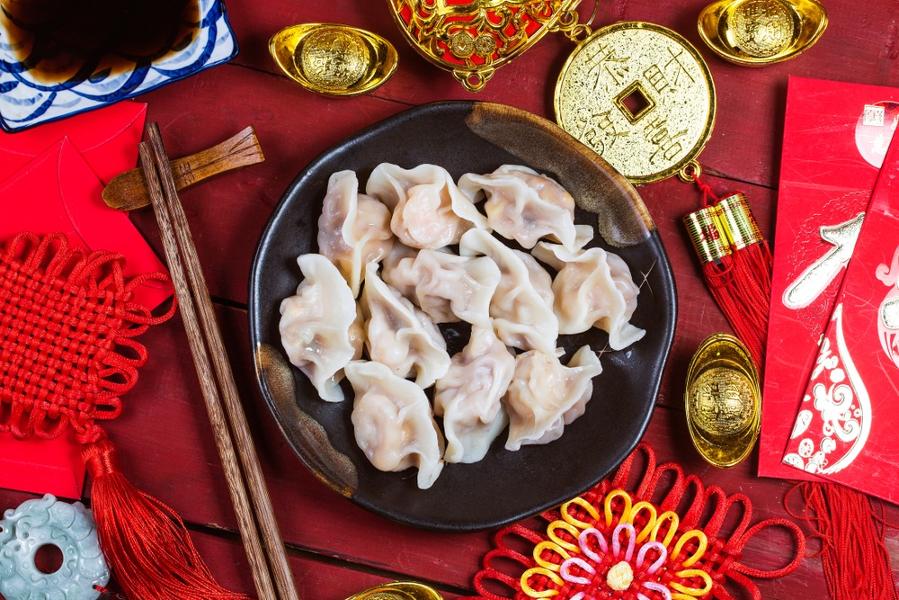
Several customs are linked to Chunjie. Some persist while others have already disappeared. The most significant tradition in the north is making jiaozi (crescent-shaped dumplings) at home on New Year's Eve. In the south, other foods dominate today such as noodles, Niangao (glutinous rice cake), and Tangyuan (glutinous rice balls with filling).
The meal is of course much richer and more varied than usual, and all family members (except in cases of serious obligation) must be together for this special moment.
Nowadays, most Chinese watch the special gala broadcast on the national CCTV channel that evening, particularly anticipating the show (usually late in the evening) of the famous comedian Zhao Benshan.
More traditional performances include the lion dance, the dragon lantern dance, the boat dance, and stilt walking. However, these aspects are better preserved in rural areas than in major cities, where the wealthier sometimes prefer to travel during this holiday period.
Another important aspect of the festival, for at least two weeks, is the use of extremely loud firecrackers. Their purpose is to chase away demons and misfortune, but due to fire hazards and pollution risks, this custom is now forbidden or restricted in many places.
It is also customary to give money in red envelopes to children. And like what Westerners do, Chinese people spend the first 5 days of the year visiting family and friends to convey their wishes for the new year. The tradition is inspired by mandarins who had to visit the imperial court to offer their wishes to the emperor.
Today, the Chinese New Year Festival is increasingly attracting foreigners, intrigued by the richness of Chinese traditions.