China's Great Green Wall Against Desertification
To counter desertification as the Gobi Desert advances across Chinese territory, China has launched an extensive reforestation project
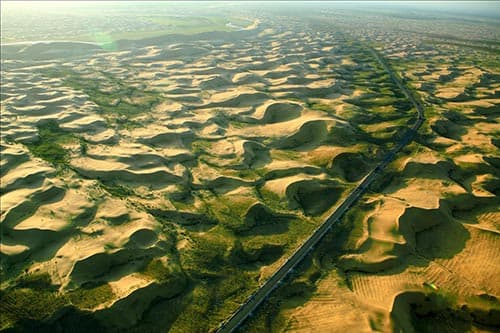
To counter desertification as the Gobi Desert advances across Chinese territory, China has launched an extensive reforestation project known as the Great Green Wall. Each year, nearly 3,600 km² of grassland disappears beneath the sands and transforms into arid zones. To halt the advance of the Gobi Desert and combat global climate change, China has embarked on creating a Great Green Wall in the country's north. This project aims to plant approximately 35.6 million hectares of trees across a 4,500 km stretch running east to west by 2074. While the country is considered the world's largest polluter, China is finally demonstrating a commitment to fighting climate change.
The urgency for China
Desertification is today a genuine scourge for China, losing arable land each year to arid zones and deserts. The famous Gobi Desert is gradually encroaching on Chinese territory and significantly reducing the surface area of cultivable lands. This phenomenon also generates severe sandstorms that carry dust as far as Beijing, and even to Korea and Japan. These storms greatly accelerate pollution and trigger more or less serious disasters. The flooding of the Yellow River in 1988 is one of the major consequences of this desertification.
The world's largest reforestation project
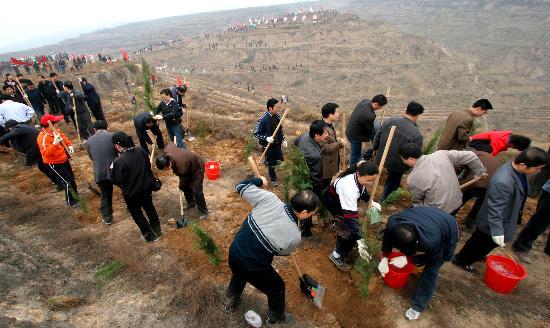
Following the model of the Great Wall and the Grand Canal connecting Hangzhou to Beijing, China has launched a massive reforestation project. This forest spanning thousands of hectares should stretch 4,500 km from the autonomous region of Xinjiang to the province of Heilongjiang.
To date, of the 100 billion trees planned, roughly half are said to have already been planted. China is one of the few countries in the world to be increasing its forest cover since the plan's launch. "China plants 2.5 times more trees every year than the rest of the world combined," stated Nobel Peace Prize recipient Al Gore, known for his commitment to combating climate change. The majority of trees have been planted by local farmers supported financially by the Chinese government. Environmental organizations and millions of Chinese citizens work each year on planting efforts. Each spring, millions of Communist Party members travel across the country to plant trees and participate in the country's reforestation. The project is proving successful, as Africa recently launched its own great green wall along the Sahel border modeled on the Chinese plan and developed in collaboration with China's expertise.
Notable ecological challenges persist
However, other studies point to soil degradation along the Green Wall. Indeed, among the planted trees, many require large quantities of water and draw from groundwater, thus destroying certain soil nutrients. Some farmers have seen their land become impoverished or disappear beneath forest plantations. Moreover, despite the quantity of trees planted, it remains uncertain whether this will impact China's pollution, which continues to rise annually. As young trees absorb far less carbon dioxide than mature forests, it will take many years to observe any tangible changes in this regard. Nevertheless, early positive signs concerning desertification have been noted, with a slowdown in the desert's advance across China.
Frequently asked questions
China's Great Green Wall is a massive reforestation project launched by the Chinese government to counter the advance of the Gobi Desert. It aims to plant 35.6 million hectares of trees across a 4,500 km band running east to west, from Xinjiang to Heilongjiang province, by 2074.
Each year, approximately 3,600 km² of Chinese grassland disappears beneath the Gobi Desert sands, reducing arable land and causing severe sandstorms that sometimes reach Beijing, Korea, and Japan. Faced with increasing desertification and climate change, China decided to create this vegetative barrier.
Early positive signs have emerged, with a slowdown in the Gobi Desert's advance. Roughly half of the planned trees are said to have already been planted. China is now one of the few countries worldwide increasing its forest coverage. According to Al Gore, China plants 2.5 times more trees annually than the rest of the world combined.
Despite its ambitions, the project faces criticism. Some planted trees require large volumes of water, depleting groundwater and impoverishing soils. Agricultural land has occasionally been sacrificed for plantations. Additionally, young trees absorb little CO2, making the climate impact difficult to measure in the short term.
Yes, the Chinese project inspired the creation of an African Great Green Wall, stretching along the southern border of the Sahara (Sahel region) for over 8,000 km, from Dakar to Djibouti. This pan-African initiative was developed in collaboration with Chinese expertise and supported by international organizations such as the African Union.