Longxing Temple
Longxing Temple
Buddhist monastery founded in 586 in Zhengding (Hebei), Longxing Temple preserves Song architecture and a bronze Guanyin statue over 22 meters tall.
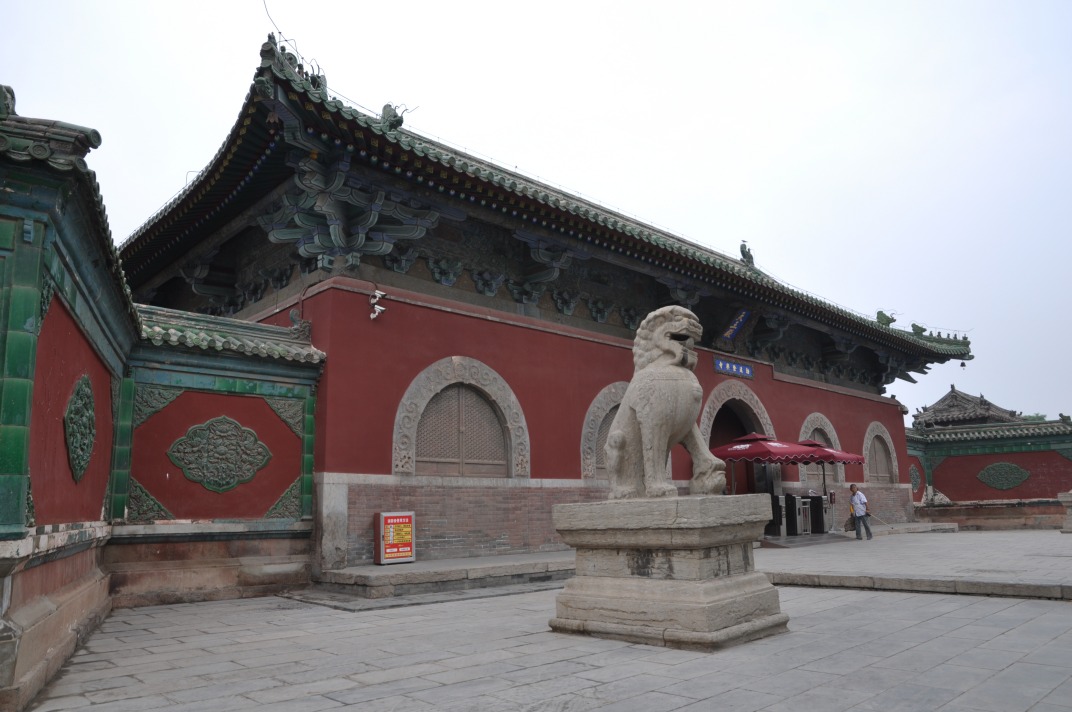
Longxing Temple is a Buddhist monastery in Hebei province, located on Menli Avenue, east of Zhengding, approximately 15 km north of Shijiazhuang. Founded during the Sui dynasty in the late 6th century, it encompasses nearly 50,000 m² of exceptional Song architecture, Buddhist statuary, and ancient calligraphy, now open to the public as a museum.
Why visit Longxing Temple
Longxing is one of China's rare major monasteries where Song architecture from the 10th-12th centuries has been preserved in its original layout. The site stands out for three major elements:
- a bronze Guanyin statue over 22 meters tall, among the highest ancient bronze Buddhist statues preserved in Chine;
- a Hall of Great Mercy 33 meters high, a monumental example of Song carpentry;
- the Longchang Stele, a reference for understanding Chinese calligraphy history from the Wei to Tang dynasties.
The site draws fewer visitors than Beijing's major attractions, allowing for a peaceful visit focused on religious art and architectural history.
History of the monastery
The temple was built in 586 by Kaihang, under Emperor Wendi, founder of the Sui dynasty (581-618). It was originally called the Longcang Monastery.
During the Kaibao period (dynasty Song, 960-1279), Emperor Taizu (Zhao Kuangyin) had it enlarged and renamed it Longxing (龙兴), a term evoking the "rise of the dragon," the imperial symbol of prosperity. The monastery was subsequently expanded and restored under Qing emperors Kangxi and Qianlong, who added several buildings and funded restoration of the statues.
Over the centuries, the site acquired two nicknames still used today: "temple of enduring prosperity" and "great buddha temple," the latter referring to the colossal Guanyin statue. Now desacralized, the temple is today managed as a public museum dedicated to Chinese Buddhist art.
What to see on site
The buildings are aligned on a north-south axis, all facing south according to tradition. Following this central axis allows you to see the principal halls in succession.
Hall of the Deva King and Vinaya Altar
Entry is through the Hall of the Deva King, which houses the celestial guardians. Further along, the Vinaya Altar was used for monastic ordination ceremonies.
Hall of Mahamuni
Built during the Northern Song, the Hall of Mahamuni preserves Ming dynasty frescoes, clay sculptures, a Song-era representation of Kassapa, as well as the Mount Sumeru sculpture, the Buddhist cosmic mountain created to illustrate Ming ritual practice.
Hall of Great Mercy
Built during the Kaibao reign (968-976), the Hall of Great Mercy is the monastery's main building. It rises three stories to approximately 33 meters, topped by a diamond-shaped gable and glazed green tiles. It houses the bronze Guanyin statue: over 22 meters tall, with 42 arms, seated on a lotus, holding the sun, the moon, the sword of victory, and various musical instruments. It is one of China's highest ancient bronze Buddhist statues.
Hall of Vairocana
At the end of the axis, the Hall of Vairocana houses approximately 1,000 small buddhas and 12 Vairocana statues, arranged to symbolize the infinite diffusion of the Dharma.
Rotating library and Longchang Stele
The Song pavilion houses a rotating library containing sutras and archives from the 12th century, a concrete illustration of Song technical ingenuity. Nearby, the Longchang Stele, conceived during the Sui, is a reference document for studying Wei and Tang calligraphic styles.
Practical information
- Visit duration: allow 2 to 3 hours to explore the central axis and main halls.
- Admission: reasonable entrance fee, payable on site.
- Hours: daytime opening, with reduced hours in winter. Verify with your accommodation the day before.
- To note: dim lighting in some halls; photography often restricted near the statues.
When to visit
Hebei has a continental climate: hot, humid summers and cold, dry winters. The most pleasant periods are mid-April to late June and mid-September to late October. Avoid Labor Day week (early May) and National Day week (early October), when visitor numbers peak.
How to get there
Zhengding is connected to Shijiazhuang, Hebei's capital, by urban transport:
- from Shijiazhuang, take bus 31 or 201 to Zhengding bus station;
- from there, bus 1 serves the temple;
- a taxi or ride-share from Shijiazhuang remains a quick, affordable alternative.
Shijiazhuang itself is connected to Beijing by high-speed rail in approximately 1 hour 15 minutes, allowing for a day trip from the capital.
Nearby attractions
Zhengding is known for its density of ancient monuments: several Tang and Song pagodas (Xumi Pagoda, Lingxiao Pagoda, Hua Pagoda) are located within walking distance of Longxing Temple. A full day allows you to combine Longxing with two or three of these pagodas.
To extend your itinerary through northern Chine, you may consult our guides on the Yungang Grottoes and the sacred mountain Hengshan in Shanxi, or near Beijing Tian'anmen Square and Beihai Park.
Frequently asked questions
Frequently asked questions
It is located on Menli Avenue, in the east of Zhengding city, in Hebei province, approximately 15 km north of Shijiazhuang.
Its foundation dates to 586, under Emperor Wendi of the Sui. It was originally called the Longcang Monastery and was renamed Longxing under the Song, then enlarged under Kangxi and Qianlong during the Qing period.
The bronze Guanyin statue over 22 meters tall in the Hall of Great Mercy, the Ming frescoes in the Hall of Mahamuni, the 1,000 buddhas in the Hall of Vairocana, and the Longchang Stele for ancient calligraphy.
Allow 2 to 3 hours to explore the entire site following the central axis. Buddhist art enthusiasts can easily spend a half-day here.
No, it is today managed as a public museum dedicated to the art and history of Chinese Buddhism, though some halls retain their religious atmosphere.
Include Zhengding in your journey
Longxing Temple naturally fits into an itinerary combining Beijing, Hebei, and Shanxi. To build a tailor-made circuit incorporating Zhengding and other major northern sites, consult our Chine travel ideas.
Interested in this visit?
We can include it in your personalised itinerary.