Mao Zedong's Birthplace
Mao Zedong's Birthplace
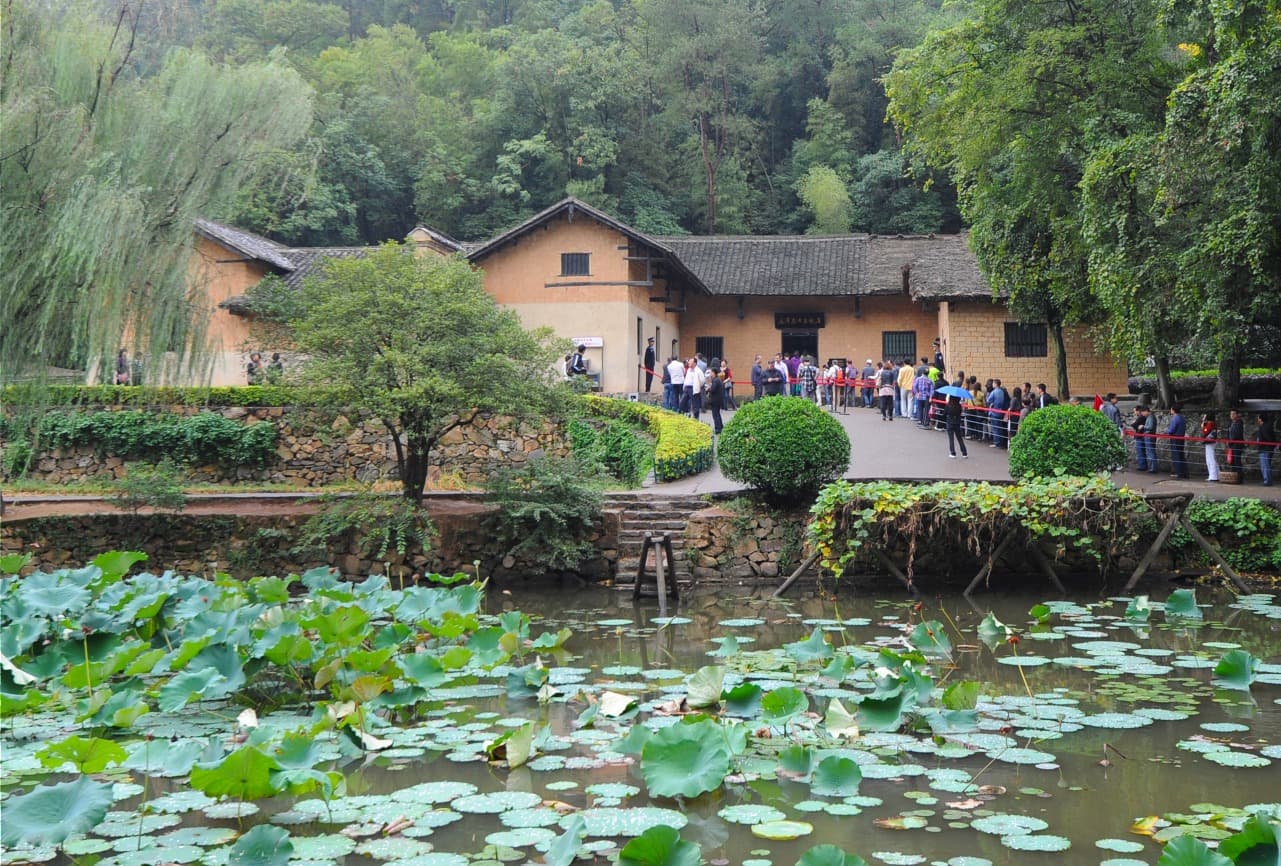
Peasant rammed earth dwelling in Hunan where Mao Zedong was born in 1893, designated a protected site in 1961 and central landmark of red tourism in Shaoshan.
Mao Zedong's birthplace stands 90 kilometers from Changsha, in the town of Shaoshan, northwest of Xiangtan district, in Hunan Province. This peasant rammed earth dwelling, where China's future leader was born in 1893, is the central site of "red tourism" in the country and one of Hunan's major heritage landmarks.
Why Visit Mao Zedong's Birthplace
The site's appeal rests on three elements. First, it is a rural residence from late 19th-century southern Chine, preserved in its original architecture: rammed earth walls, thatched roof, layout centered around a courtyard. Second, the furnishings and kitchen utensils on display offer insight into daily life in an affluent rural Hunan family. Finally, the place is a powerful marker of contemporary Chinese political memory: it attracts millions of visitors each year from across Chine, and the pilgrimage atmosphere that characterizes the visit is part of the experience itself.
Site History
The house was built by Mao Zedong's father, a prosperous peasant descended from a relatively wealthy Shaoshan family. Mao Zedong was born here in 1893 and spent his childhood before leaving the village to pursue his studies. According to local tradition, he made it his headquarters in 1927, at a pivotal moment in organizing the peasant movement in Hunan.
In the 1950s, following the founding of the People's Republic of Chine, authorities and the local population regarded the place as a memorial site for Mao Zedong. The house was then opened to the public, first to Chinese visitors and gradually to foreigners. The Chinese State Council inscribed it as a protected site in March 1961, which formalized its restoration and museography. The site today forms part of a larger memorial complex that includes a museum, a bronze statue, and several buildings associated with the Mao family.
What to See On Site
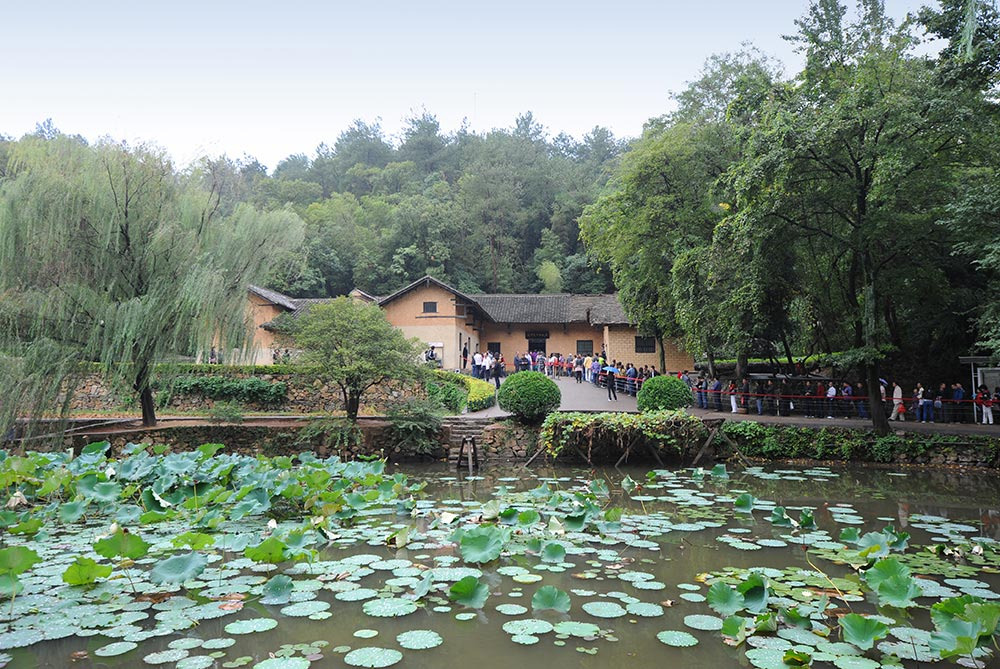
The residence is built of rammed earth with a thatched roof, in the style of Hunan farmhouses. Its surface area of 472.9 square meters reflects the family's social standing at the time, superior to that of most village peasants. Situated before a pond and surrounded by wooded hills, it sits within a preserved rural setting.
The visit follows a marked route through the main rooms:
- the chamber where Mao was reportedly born, with its wooden bed;
- the rooms of his parents and siblings;
- the kitchen and common room, with their period furniture and kitchen utensils;
- agricultural annexes: stable, granary, grain storage space;
- the inner courtyard opening onto the pond.
Family photographs are displayed in several rooms. At the exit, souvenir stalls feature items bearing Mao Zedong's image: badges, portraits, red books.
Practical Information
- Visit duration: allow 30 to 45 minutes for the house alone, 2 to 3 hours if combining with the museum and bronze statue.
- Admission: entry to the birthplace is free or nominal, on presentation of an identity document (passport for foreigners). Check current conditions before your visit.
- Hours: open daily from morning through late afternoon. Very crowded on weekends, Chinese public holidays, and around dates commemorating Mao.
- Rules: photography is prohibited inside the house. Appropriate dress is requested; the site is treated with near-religious respect by some visitors.
How to Get There
Shaoshan is accessible from Changsha (Hunan's capital) by high-speed train, then by bus or taxi to the village. Once there:
- By bus: routes 402, 411, 452, 578, or 701, stop at Provincial Museum. Local routes may change; confirm with your accommodation.
- By taxi or ride-hailing app: short journey from the station or Shaoshan's center.
- On foot: the house, museum, and bronze statue are linked by shaded pedestrian paths.
Nearby
Shaoshan is more than just the birthplace. The village concentrates several sites related to Mao Zedong's memory: the memorial museum, the bronze statue plaza, the former school where he studied, and the exhibition hall for his personal objects. To extend your time in the region, consult our Shaoshan guide. More broadly, Chine has other major heritage sites such as the Great Wild Goose Pagoda in Xi'an, the Great Wall at Juyongguan near Beijing, or the Thousand Buddha Caves at Bezeklik in Xinjiang.
Frequently Asked Questions
Frequently asked questions
Yes, provided you place it in its rural context. The house is a fine example of Hunan peasant architecture, and the setting alone—pond, hills, surrounding rice fields—justifies spending half a day in Shaoshan.
The site typically operates with tickets purchased on-site upon presenting your passport. During peak season and commemorative dates linked to Mao, expect queues; advance online booking through Chinese platforms can ease access.
Photography is permitted outdoors (facade, pond, courtyard) but forbidden inside the house. This rule is strictly enforced by staff.
Spring (April–May) and autumn (September–October) offer the most pleasant conditions. Avoid the "Golden Week" around October 1st and December 26th (Mao's birthday), when crowds are extreme.
Half a day suffices for the birthplace alone. Allow a full day to also visit the museum, bronze statue, and other memorial sites in the village.
Plan Your Trip
Shaoshan fits naturally into a Hunan itinerary, between Changsha, Zhangjiajie, and Fenghuang. To build a coherent circuit integrating heritage, landscapes, and historic cities, see our Chine travel ideas.
Interested in this visit?
We can include it in your personalised itinerary.