White Horse Pagoda
White Horse Pagoda
Located 2 km from Dunhuang, the White Horse Pagoda has commemorated since the 4th century the horse of monk Kumarajiva, on the ancient Silk Road.
Two kilometers southwest of Dunhuang, in the small town of Baima, the White Horse Pagoda has stood for more than sixteen centuries at the edge of an ancient section of the Silk Road. Modest in size yet singular in its history, it commemorates the death of a white horse named Tianliu, the mount of Buddhist monk Kumarajiva.
Why visit the White Horse Pagoda
The pagoda presents three main points of interest for travelers passing through Dunhuang:
- A compelling legend tied to Kumarajiva, one of the greatest translators of the Buddhist canon into Chinese.
- Distinctive architecture spanning nine stories, each treated in a different style.
- A short and accessible walk from downtown, easy to incorporate into a visit to Dunhuang's major sites.
The visit is quick (allow 30 to 45 minutes on-site), making it a natural complement to the Buddhist caves in the region.
History: Kumarajiva and the horse Tianliu
The pagoda is believed to have been erected between 382 and 386 by the monk Kumarajiva, a Buddhist master of Kushan origin invited to China to teach Buddhist arts. Historical sources place this episode during the Earlier Qin period (351-394), a small northwestern dynasty that controlled the Hexi Corridor at the time.
According to tradition, Kumarajiva crossed the desert with his white horse, Tianliu, reaching Dunhuang. Upon arrival, the animal collapsed from illness and died without recovering. The monk, deeply moved by this loss, had a pagoda built in honor of his traveling companion. The structure was restored multiple times over successive dynasties, explaining the layering of styles visible today.
Kumarajiva continued eastward and became one of the principal architects of Buddhism's spread through China, translating several fundamental Sanskrit texts into Chinese.
What to see on-site
The nine-story architecture
The pagoda stands approximately 12 meters high and rests on a base roughly 7 meters in diameter. It comprises nine stories, each treated with distinct geometry: square, octagonal, cylindrical according to the levels. This stacking creates an overall tiered silhouette that is both stocky and soaring.
The overall plan is orthogonal, following an ancient architectural tradition that successive restorations, notably during the Ming dynasty, helped to establish.
The summit bells
The pagoda's crown is adorned with bells that chime in the desert wind. On calm days, the sound carries far across the surrounding park—one of the elements that captivated ancient travelers along the Silk Road.
The park and surroundings
The pagoda is surrounded by a small park decorated with sculptures and relics arranged along the access path. The short walk to the structure, shaded in places, makes for a pleasant extension of your visit.
Practical information
- Visit duration: 30 to 45 minutes, including the park.
- Admission fee: modest entrance fee, payable on-site.
- Hours: open during daytime, from morning until late afternoon. Exact hours vary by season.
- Best time to visit: May through October, when Dunhuang's desert climate is more pleasant. Avoid midsummer midday (high temperatures) and winter, when wind makes the walk less enjoyable.
How to get there
The pagoda is located approximately 2 km from Dunhuang's city center.
- On foot: you can reach the site by following the riverbanks that flow through town. Allow 30 to 40 minutes of walking, pleasant outside the hottest hours.
- By taxi: a ride from downtown is quick and inexpensive; most drivers know the site by its local name (Baima Ta).
- By bicycle: a practical option to complement visits to other Dunhuang sites on the outskirts.
Nearby attractions
The White Horse Pagoda fits naturally into a broader exploration of the region. To extend your visit:
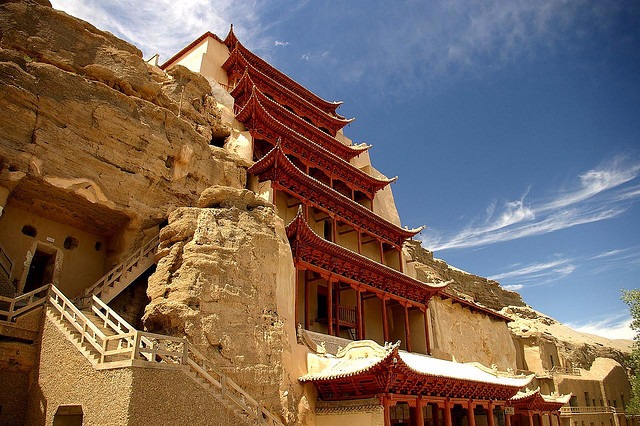
- Dunhuang and its major sites (Mogao Caves, Mingsha Dunes, Crescent Moon Lake).
- The Thousand Buddha Caves of Bezeklik, another Buddhist stop on the Silk Road.
- The Great Wild Goose Pagoda in Xi'an, to put into perspective Kumarajiva's work, whose translations were later extended there.
Planning your trip
The White Horse Pagoda fits naturally into an itinerary along China's Silk Road. To build a journey combining Dunhuang, the Hexi Corridor, and the great Buddhist sites, explore our China travel ideas.
Interested in this visit?
We can include it in your personalised itinerary.