Singing Sand Dunes
Five kilometers south of Dunhuang, the dunes of Mingsha Shan rumble beneath the wind and visitors' footsteps. Nestled within the massif, the Yueyaquan oasis offers a striking contrast between water and ochre sand.
A few kilometers south of Dunhuang, the dunes of Mingsha Shan rise up to 250 meters above the Gobi Desert. Their distinctive feature: the sand, set in motion by wind or visitors' footsteps, emits a low, continuous rumbling. This rare acoustic phenomenon, documented since antiquity, earned the site its name—"singing sand mountain." Hidden within the dunes lies the Yueyaquan oasis, a crescent of moon settled in the sand for centuries.
Quick Practical Guide
- Admission: Paid entry (combined ticket for Mingsha Shan + Yueyaquan)
- Recommended duration: 3 to 4 hours minimum to climb the dunes and reach the oasis
- Clothing: Closed-toe shoes recommended; fabric shoe covers are rented at the entrance to protect from sand
- Access: Taxi or bus from central Dunhuang, site approximately 5 km south of the city
- Activities on-site: Camel rental, sandboarding, paragliding
- Best time to visit: May–June and September–October to avoid extreme summer heat
What You'll See
The dunes form an arc spanning several kilometers, with sharp crests sculpted by prevailing winds. The sand's color shifts from golden ochre in daylight to deep orange at sunset. At the site's heart, Yueyaquan—the crescent moon oasis—shelters a freshwater spring surrounded by reeds and poplars, with a traditional pavilion reflected in its waters.
History and Context
Dunhuang was a major junction on the Silk Road. Caravans crossing the Gobi would stop at Yueyaquan before facing the desert or after crossing it. Written accounts of the dunes' acoustic phenomenon date back to the Han Dynasty. The site is classified as a national protected area in China and ranks among Central Asia's most photographed desert landscapes.
Highlights of Your Visit
Climbing the Dunes at Sunset
Ascending on foot or by camel to the main ridge takes between 30 and 60 minutes depending on your pace. From the summit, the view encompasses the entire dune massif and, on clear days, the foothills of the Tibetan Plateau on the horizon. It's at this moment that the sand "sings" most distinctly, carried by the evening breeze.
The Yueyaquan Oasis
Nestled in a natural depression sheltered from sand by surrounding dunes, this spring has never run dry for millennia despite the desert's advance. The contrast between green water, reeds, and ochre sand crests is striking. A small Taoist temple borders the northern shore.
Sandboarding Down the Slopes
Wooden boards are available for rent at the site's entrance. Descending the steep slopes is fast and spectacular; it's also one of the moments when the sand's rumbling is most audible.
Photography Tips
- Golden hour: An hour before sunset, the dune crests are etched with maximum clarity and shadows structure the landscape.
- Yueyaquan: Photograph the oasis from the overlooking ridge to capture both water and dunes in frame.
- Camel caravans: Lines of camels backlit against the crests are the site's iconic shot—position yourself downhill, facing the setting sun.
- Protect your gear: Fine sand infiltrates everything; a waterproof bag or plastic sleeve for your lens is recommended.
Location and Access
Mingsha Shan is located approximately 5 km south of central Dunhuang. Regular taxis and tourist buses connect the city to the site. Dunhuang is accessible by air from Xi'an, Lanzhou, and Urumqi, or by train (Dunhuang Station on the Liuyuan Line). The Mogao Caves, another major site in the region, lie about twenty kilometers to the southeast. Access to the dunes themselves is difficult for people with reduced mobility due to the soft sand.
Nearby Attractions
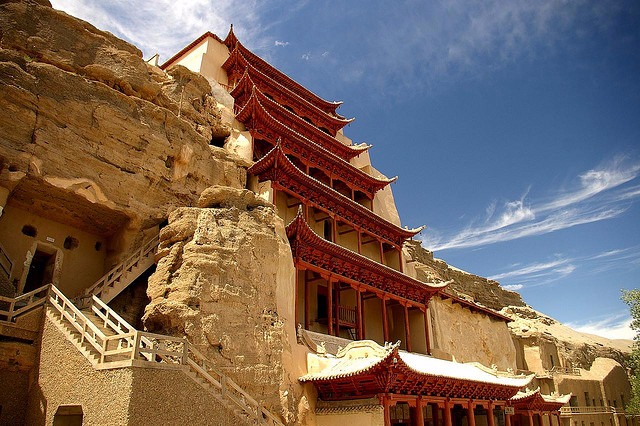
- Mogao Caves — UNESCO-listed Buddhist rock complex, with over 400 caves adorned with frescoes and sculptures dating from the 4th to 14th centuries.
- Dunhuang Museum — Archaeological collections from Silk Road excavations, including manuscripts and artifacts from the Tang period.
- Yumen Guan (Jade Gate Pass) — Ancient Great Wall frontier post, approximately 90 km northwest, a vestige of the western Silk Road.
Frequently asked questions
May–June and September–October offer comfortable temperatures. Summer (July–August) can exceed 40°C on the sand; winter is cold and windy. Sunset remains the ideal time regardless of season.
The phenomenon is most pronounced in moderate wind or during rapid slope descents. In calm conditions, the sound is subtle. Sandboarding down the slopes is one of the most reliable ways to trigger it.
Closed-toe shoes are essential. At the entrance, fabric shoe covers are available for rent to prevent sand from filling your shoes during the climb.
Yes, but the Mogao Caves require advance reservation and a guided tour of at least 2 hours. It's advisable to visit Mogao in the morning and Mingsha Shan in the afternoon to enjoy the sunset over the dunes.
Photos are permitted on the dunes and around Yueyaquan. No particular restrictions are posted on the outdoor site, unlike the Mogao Caves where photography is prohibited inside the grottoes.
Access to the dunes themselves is difficult due to soft sand and slopes. The entrance perimeter and facilities around Yueyaquan are partially accessible, but much of the site remains challenging for visitors with reduced mobility.
Interested in this visit?
We can include it in your personalised itinerary.