White Pagoda Hill
White Pagoda Hill
On the north bank of the Yellow River opposite Lanzhou, White Pagoda Hill brings together an octagonal pagoda from the 18th century, three temples and a viewpoint over the city.
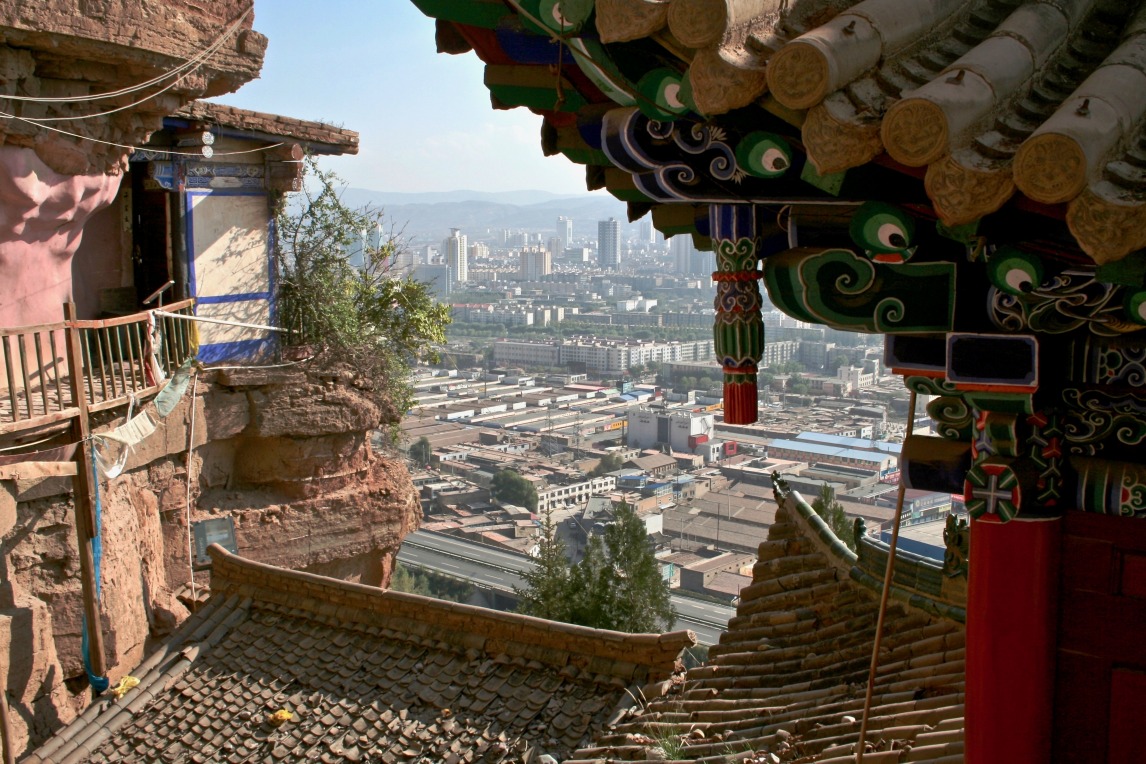
White Pagoda Hill (Bai Ta Shan) rises above the north bank of the Yellow River (Huang He), facing the heart of Lanzhou. This urban park, perched on a wooded hillside, shelters a seven-tiered white pagoda, several ancient temples and pathways offering sweeping views over the city and China's second-longest river.
Why visit White Pagoda Hill
The site combines three attractions rarely found together in a single Chinese urban park: Buddhist heritage centered around a Ming-Qing pagoda, a natural viewpoint over the Yellow River valley, and a gateway to the culture of Gansu's ethnic minorities, including a traditional tent of the Yugu people set up within the park. The trails crisscrossing the hill also make it a popular walking destination for Lanzhou residents, just a short distance from the city center.
History of the hill and pagoda
Under the Yuan dynasty (1271–1368), the hill lay within the territory of the Xixia empire (Tangut). Tradition recalls a diplomatic episode: Genghis Khan allegedly proposed to the king of Tibet that they unify their two nations. The Tibetan ruler sent a lama to carry his reply, but the emissary died on the journey, near Lanzhou, before completing his mission. When the Yuan Empire conquered the Xixia and incorporated Lanzhou into its territory, a temple was built on the hill in memory of this monk. The site gradually became an important place of worship for the region.
The current pagoda is the result of several construction campaigns. It was renovated by Lou Yongcheng during the reign of Emperor Jingtai (Ming dynasty, 1368–1644), then enlarged around 1715 by Chuo Qi, governor of Lanzhou, under Emperor Kangxi (Qing dynasty). In 1958, the entire site was designated a municipal park by the city of Lanzhou, a status that enabled its preservation and development as a public space.
What to see on site
The park spreads across the slopes of a hill reaching approximately 1,700 meters in elevation—Lanzhou itself lying at around 1,500 meters. Several pathways lead to the summit on foot via a moderate climb.
The white pagoda
The pagoda has an octagonal plan and rises seven stories to a height of approximately 17 meters. Its ivory-colored tower is adorned with eight Buddha statues. At each corner of the eaves, iron bells chime in the wind, a characteristic soundscape of the place.
Temples and park features
Three temple halls, connected by covered corridors, structure the upper part of the park:
- the Hall of Arhats,
- the Hall of Sangon,
- the Hall of Three Stars.
The site also preserves three objects regularly presented as the hill's "three treasures": a drum made from elephant hide, an ancient bronze bell and an old tree known as "redbud" (Chinese Judas tree). Set slightly apart, a traditional tent of the Yugu people, a Turkic-speaking minority of Gansu, offers insight into the region's pastoral way of life.
The cable car
A cable car connects White Pagoda Hill to the hill facing it across the river. The journey offers a comprehensive view of the Yellow River valley and Lanzhou's urban landscape.
Practical information
The park is open daily with extended hours from morning to evening. The admission fee is modest, with an additional ticket required for the cable car. Allow approximately 2 to 3 hours to explore the park on foot, longer if you combine temple visits with a cable car ride.
When to visit
Lanzhou experiences a dry continental climate marked by cold winters and hot summers. May–June and September–October offer the most pleasant conditions for walking: moderate temperatures, low rainfall and better visibility across the valley. Winter remains accessible but windy, and summers can be oppressive in mid-afternoon.
How to get there
The hill is easily accessible from central Lanzhou by bus. Several lines serve the Bai Ta Shan Gong Yuan (White Pagoda Hill Park) stop: lines 11, 20, 35, 53, 108, 131 and 136. A taxi ride from the station or city center is quick and inexpensive.
Nearby attractions
Your visit naturally extends to other sites in Lanzhou and Gansu:
- The Baigongfang Handicraft Museum, to understand regional craftsmanship.
- The Beishan Temple, another major Buddhist site.
- The Bell and Drum Towers, witnesses to Chinese imperial urbanism.
Frequently asked questions
Frequently asked questions
Allow 2 to 3 hours to walk through the park, climb to the pagoda and visit the three temples. Add around one hour if you take the cable car to the hill across the river.
No. The paths are well-maintained and the elevation gain is modest. The hill remains accessible to anyone in reasonable walking condition, at a leisurely pace.
Morning offers favorable light and a quieter local atmosphere. Late afternoon, meanwhile, allows you to enjoy warmer lighting across the Yellow River valley.
Yes. Park admission and the cable car ticket are separate. Both remain modestly priced, payable on site.
Prepare your trip
White Pagoda Hill naturally fits into an itinerary through Gansu and along the Silk Road. To build a custom trip, explore our travel ideas in China.
Interested in this visit?
We can include it in your personalised itinerary.