Wuyishan Water Curtain Cave
Wuyishan Water Curtain Cave
In the Luban Gorges (Gansu), the Water Curtain Cave combines two 100-meter waterfalls, monumental Buddhist statues and thousand-year-old murals.
The Water Curtain Cave (Shuilian Dong, 水帘洞) is located in the Luban Gorges, on the cliff face of Mount Huaguo, in Wushan County (Gansu province, Tianshui prefecture). Despite the phonetic similarity, this site has no connection to Mount Wuyi in Fujian: it forms part of a network of 72 caves documented around Mount Wushan and ranks as one of the most significant Buddhist rock-cut complexes in Gansu after the Maiji caverns.
Why visit the Water Curtain Cave
The site brings together three rarely combined features within a single area: a monumental natural cavern hidden behind two 100-meter waterfalls, an ensemble of Buddhist statuary carved over nearly sixteen centuries, and a concentration of inscriptions, murals and stupas that trace Buddhism's spread along the Hexi Corridor. The cliff shelters five main cavities—Xiangsheng Pond, Lashao Temple, the Thousand Buddhas Cave, the Water Curtain Cave and Sanqing Cave—which locals collectively call the Zhoulou Mountain Valley.
History of the site
The earliest excavations date to the period of the Five Hu and Sixteen Kingdoms (304-439), when Buddhism took root in northwestern China following trade routes. Lashao Temple, one of the complex's oldest structures, may have been founded during the Western Jin (265-316).
Through subsequent dynasties—Northern Wei, Sui, Tang, Yuan—Buddhist monks, Taoist priests and Confucian scholars came in succession and left their mark on the site. The Buddha statues and murals bordering Xiangsheng Pond date from the Northern Zhou (557-581), while portions of still-visible buildings, including Sisheng Palace, Guanyin Temple and Laoju Chamber, trace back to the Sui dynasty. Under the Qing, General Yu Hongliang, originally from Zhejiang, carved two calligraphic inscriptions featuring a style attested since the Song era.
What to see on site
The Water Curtain Cave
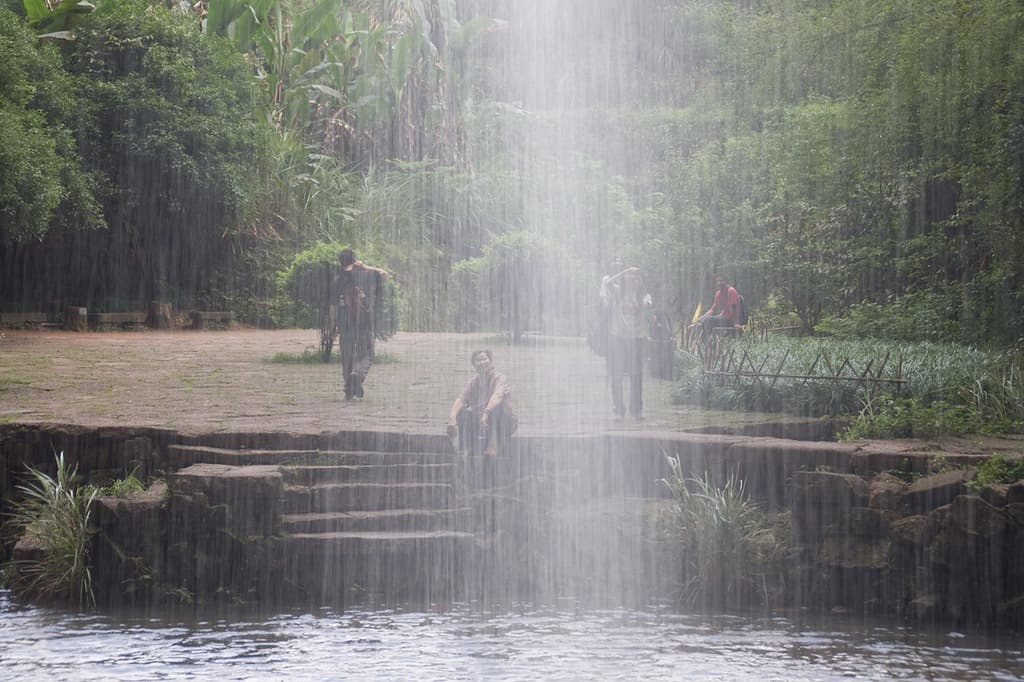
The main cavity is a shallow natural grotto in the shape of an inverted eaves, measuring roughly 30 meters wide, 50 meters high and 30 meters deep. Two waterfalls cascade from the cliff summit nearly 100 meters down, masking the entrance behind a sheet of water that gave the site its name. Inside, ten small Sui-era buildings have been constructed; some compartments, once sacred spaces, now house tea houses visited by local guests.
Xiangsheng Pond
This is where the waterfalls plunge. Along the surrounding walls stand rows of Buddha statues and murals attributed to the Northern Zhou. Local tradition holds it to be a sacred place where immortals are said to appear.
Lashao Temple
Built into the cliff face, Lashao Temple marks the summit of the route. It is renowned for its three colossal Buddha statues (roughly 40 meters each), flanked by two Bodhisattvas. The main statue is crowned by a canopy adorned with bronze bells, carved clouds and animal figures in Hinayana style.
The Thousand Buddhas Cave (Qianfo)
West of Lashao Temple, the Thousand Buddhas Cave houses numerous statues, including a representation of Sakyamuni Buddha standing 31 meters tall. The statues are positioned away from direct light to preserve their pigments.
Inscriptions, murals and stupas
Along the path leading to the cavity, several rock carvings punctuate the walk, including calligraphic works by General Yu Hongliang. The entire site contains eight stupas (Buddhist funerary structures) and more than 2,000 square meters of murals, making it one of Gansu's largest pictorial collections after Maiji and Mogao.
Practical information
- Plan a half-day to leisurely explore all five cavities.
- The access path is winding and carved into the cliff: wear good footwear and bring water.
- Entry fees are modest, with a possible supplement for internal shuttle service. Check hours and prices on the day itself, as they change regularly.
- Photography is permitted outdoors; inside chapels, flash is generally prohibited.
When to visit
The visit is most spectacular during the rainy season (typically June through September), when the waterfalls reach peak flow and form a true curtain above the cavity. In the dry season, the falls reduce to two thin white ribbons windswept and wispy; the site remains worthwhile for its statuary and murals, but loses its most striking effect. In winter, Gansu's dry cold and icy conditions on the path make hiking less pleasant.
How to get there
The logical starting point is Tianshui, a city served by rail from Lanzhou and Xi'an. From Tianshui, reach Wushan County's seat via regional bus (approximately 1.5 to 2 hours depending on service). From Wushan's bus station, local coaches serve the site entrance; the final approach is on foot via a path carved into the cliff.
Nearby attractions
If you are exploring rock-cut Buddhism in Gansu and western China, several sites extend your visit:
- The Maiji Caverns, roughly one hundred kilometers east near Tianshui, the premier cave complex in Gansu.
- The Beishan Temple, another landmark of Chinese Buddhist sculpture.
- The Hexigten Geopark, to understand western China's landscapes.
- The Aiding Lake, in the Turpan basin, for geographic contrast with Gansu's highlands.
Frequently asked questions
Frequently asked questions
Plan your trip
The Water Curtain Cave fits naturally into an itinerary combining the Hexi Corridor, Tianshui and the Maiji caves. To build a customized route through the region, consult our Chine journeys.
Interested in this visit?
We can include it in your personalised itinerary.