Yumbulagang Palace
Yumbulagang Palace
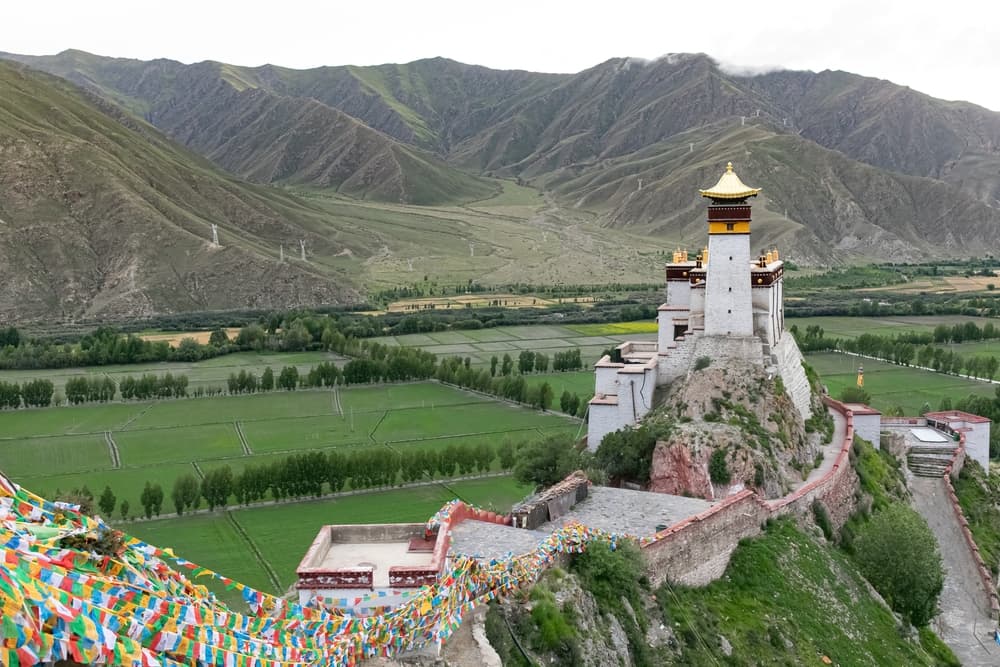
Perched on a rocky spur in the Yarlung Valley, Yumbulagang Palace stands as Tibet's oldest known structure. The legendary residence of Tibet's first king, it now houses active Buddhist chapels and commands stunning panoramic vistas across the plains below.
Yumbulagang Palace rises from a rocky outcrop dominating the Yarlung Valley, roughly twenty kilometres south of Tsetang. Considered Tibet's oldest structure, it is believed to have been built for Nyatri Tsenpo, the first Tibetan king. Transformed into a Buddhist monastery over the centuries, it remains a powerful symbol of Tibetan identity, blending royal legend with living spirituality.
Practical information at a glance
- Admission: paid (ticket required, rates vary—check on site)
- Recommended duration: 1 to 2 hours, including the climb
- Access: paved road to the base of the rock, then on foot via a steep path
- Dress code: modest clothing required; shoulders and knees must be covered inside the monastery
- Altitude: approximately 3,700 metres — allow time for acclimatisation
What to see
The main tower, narrow and soaring, dominates the landscape for kilometres around. Inside, stacked chapels house Buddha statues, thangkas, and representations of Tibet's earliest kings. The summit terrace offers an unobstructed view across the barley fields of the Yarlung Valley and the distant Yarlung Tsangpo river.
History and context
Tibetan tradition dates Yumbulagang's founding to the 2nd century BCE, identifying it as the residence of King Nyatri Tsenpo, the first sovereign of the Tibetan royal lineage. The current building is largely a reconstruction: the original palace suffered severe damage during the Cultural Revolution. Restoration work, begun in the 1980s, restored its characteristic profile.
Highlights of your visit
The climb to the tower
The path ascending from the car park winds past prayer flags and votive prayer wheels. The slope is steep; allow about fifteen minutes of steady climbing. The view gradually opens onto the agricultural plain below.
The interior chapels
Each level houses a distinct chapel. The ground floor is dedicated to protective deities; upper storeys honour ancient Tibetan kings and major Buddhist figures. Monks conduct regular ceremonies here: you may witness prayers or incense offerings.
The terrace and panorama
From the tower's summit, the Yarlung Valley unfolds in its full expanse. On clear days, snow-capped peaks define the horizon to the south. This is one of central Tibet's most sweeping, unobstructed panoramas.
Etiquette and visiting rules
- Remove your shoes before entering each chapel.
- Circumambulate altars and stupas clockwise (the Buddhist direction).
- Speak quietly indoors; ongoing ceremonies deserve silence.
- Ask permission before photographing monks or worshippers.
Photography tips
Early morning light is ideal: the rising sun illuminates the tower's eastern façade and gilds the fields below. Late afternoon brings raking light that accentuates the valley's relief. From the terrace, a wide-angle lens captures both the tower and the landscape. Photography is generally permitted outdoors; indoors, check for prohibition signs in the chapels.
Location and access
Yumbulagang lies in the Yarlung Valley, approximately 25 kilometres south of Tsetang. Most visitors reach it by private vehicle from Tsetang, often as part of a combined excursion with other valley sites. No regular bus service serves the site directly. Disabled access is limited: the final climb is entirely on foot via an unimproved path.
From Lhassa, allow 3 to 4 hours driving time via the main highway. A Tibet Travel Permit is mandatory for all foreign visitors.
Nearby
- Samye Monastery — Tibet's first Buddhist monastery, founded in the 8th century, accessible from Tsetang.
- Royal Tombs of Chongye — necropolis of ancient Tibetan kings, in the same Yarlung Valley.
- Trandruk Monastery — one of Tibet's oldest temples, a few kilometres from Yumbulagang.
Frequently asked questions
Yes. All foreign visitors to Tibet must hold a Tibet Travel Permit, obtained through an authorised agency. This permit is checked at several checkpoints between Lhassa and Tsetang.
April to October offers the best weather. Summer (July–August) can be rainy but the valley is lush. In winter, temperatures are intense and some access routes may be difficult.
Yes, that's the standard itinerary. One day from Tsetang allows unhurried visits to Yumbulagang, Trandruk Monastery and the Chongye tombs.
The path is short but steep, at over 3,700 metres altitude. Visitors not yet acclimatised may feel breathless. Climb slowly and stay hydrated.
Rules vary by chapel. Some display explicit prohibition signs. Outdoors, photography is unrestricted. If in doubt, ask a monk on site.
Interested in this visit?
We can include it in your personalised itinerary.