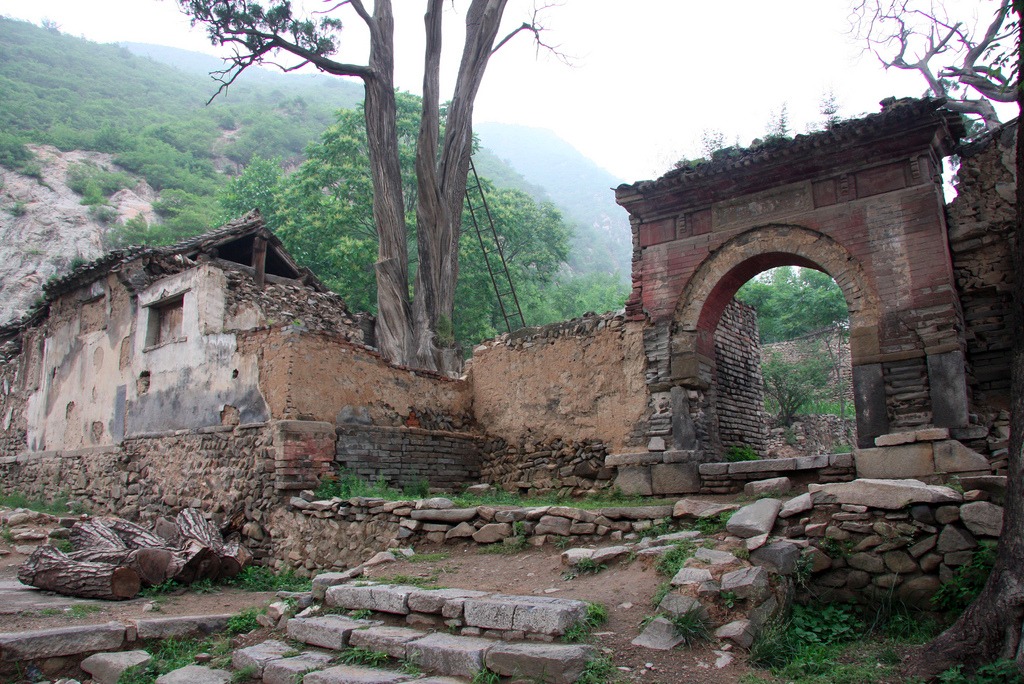
Zhujiayu
A fortified village in Zhangqiu district (Shandong), Zhujiayu preserves a remarkable ensemble of defensive walls, stone-paved alleyways, and stone houses from the Ming and Qing dynasties, far removed from the usual tourist circuits.
Zhujiayu is a fortified village in Shandong province, in eastern China, perched in the foothills of Zhangqiu district. Built primarily during the Ming dynasty, it preserves a cohesive collection of stone-paved alleyways, stone houses, and defensive walls. Little frequented by foreign travelers, it offers a rare glimpse of traditional rural architecture in northern China, virtually untouched by time.
What to See
The village is organized around a network of narrow alleyways lined with gray stone houses topped with tile roofs. The encircling walls, watchtowers, and fortified gates structure the space. Interior courtyards (siheyuan adapted to the mountainous terrain) bear witness to sober and functional domestic architecture. A few inscriptions and stelae recall the history of the families who inhabited this place for centuries.
History and Context
Zhujiayu was founded and developed primarily during the Ming and Qing dynasties (14th–19th centuries). The village takes its name from the Zhu clan that settled here. Its elevated position and fortifications responded to the security imperatives of the era. Listed among China's historic and cultural villages, it is subject to heritage preservation measures.
Highlights of Your Visit
The Walls and Fortified Gates
The stone enclosure, still largely standing, clearly delineates the village. The massive entrance gates, well preserved, set the tone: Zhujiayu was designed to resist, not merely to shelter.
The Stone-Paved Alleyways
The network of stone lanes forms the backbone of the village. Some climb in staircases along the terrain. The patina of the flagstones and the absence of motorized traffic reinforce the atmosphere of a place that has remained apart from modern times.
Domestic Architecture
Gray stone houses, with sober facades and enclosed courtyards, illustrate the adaptation of traditional northern Chinese housing to mountainous terrain. Several residences are open to visitors.
Photography Tips
Morning light, before any influx of local visitors on weekends, works well for the narrow alleyways where direct sunlight is rare. The fortified gates offer clean framing with the village in the background. Architectural details—sculpted lintels, worn thresholds, moss-covered tiles—deserve particular attention.
Location and Access
Zhujiayu is located in Zhangqiu district, itself part of Jinan municipality, the capital of Shandong province. Jinan is accessible by high-speed train from Beijing, Shanghai, or Qingdao. From Jinan or Zhangqiu, the village is accessible by car or taxi; direct public transportation is limited. Plan on a private vehicle or taxi for the final stretch of the journey.
Nearby Attractions
- Jinan — Shandong's provincial capital, renowned for its natural springs, notably the famous Baotu Spring.
- Zhangqiu — district city housing other historical sites and the local market.
- Mount Tai (Taishan) — sacred Taoist and Buddhist mountain, UNESCO World Heritage site, accessible from Jinan.
Frequently asked questions
Spring (April–May) and autumn (September–October) offer pleasant temperatures and vegetation that contrasts with the gray stone of the village. Summer can be hot and humid in Shandong; winter is cold but the village is then very peaceful.
No special attire is required. Comfortable shoes with slip-resistant soles are recommended for the stone-paved alleyways and stair passages.
Half a day is sufficient to walk through the village and appreciate its architectural details. A full day allows you to combine the visit with the surrounding area of Zhangqiu.
Yes. Jinan and its springs, as well as Mount Tai (Taishan), are natural complements to a stay in the region. A two to three-day itinerary allows you to cover these sites without rushing.
Photography is generally free in the public spaces of the village. For the interiors of houses that may be open to visitors, it is courteous to ask permission from residents or caretakers.
Interested in this visit?
We can include it in your personalised itinerary.