Tianluokeng Tulou Ensemble
Tianluokeng Tulou Ensemble
Five UNESCO-listed Hakka earthen tulou nestled on Hudong mountain in southern Fujian: architecture, history and practical advice.
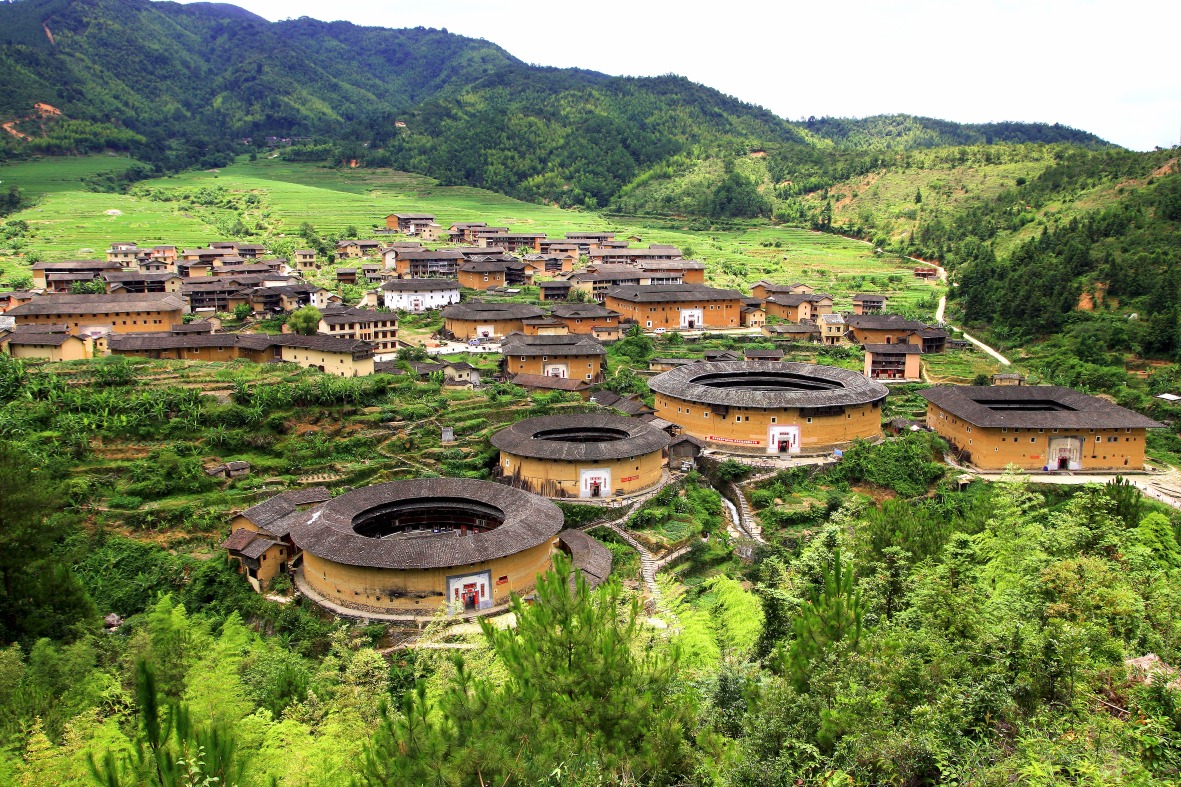
The Tianluokeng Tulou Ensemble is located approximately 60 km from the county seat of Nanjing, in the southeastern province of Fujian. This grouping of five fortified earthen dwellings, built by the Hakka people on the slopes of Hudong mountain, is among the 46 Fujian tulou sites inscribed in 2008 on the UNESCO World Heritage list. Its characteristic silhouette—a central square building surrounded by three round structures and one oval building—has earned it a local nickname evoking the Olympic rings.
Why Visit Tianluokeng
The site captures at a glance several major characteristics of tulou architecture: variety of forms (square, round, oval), placement deep in the mountains, and a backdrop of bamboo groves and terraced rice paddies. From the viewpoint perched above, the composition of the five buildings forms one of rural Fujian's most photographed panoramas. Inside, the courtyards, wooden staircases and central wells offer glimpses of a communal lifestyle still partially inhabited today.
Site History
The word tulou literally means "earth construction." These multi-family buildings are the work of the Hakka, populations originating from the Han people of northern Chine who migrated southward from the Middle Ages onward. Settling in the mountainous regions of Fujian and Guangdong, they built these domestic fortresses to protect themselves from conflicts with local populations and bandits.
At Tianluokeng, the Buyunlou is the oldest building: it dates to the late 18th century. The other structures span the Ming and Qing dynasties and the 20th century. The Hechang, Zhenchang and Ruiyun tulou date from the 1930s. The Wenchang, the only oval-shaped construction, is the most recent: it was completed in 1966. The main square building, destroyed by a bandit-set fire in 1936, was renovated in 1953.
The lineage's founding is attributed to Wong Baisanlang (sometimes transcribed Wong Baisalang), ancestor of the Wong family during the Qing dynasty. His commemorative plaque is found in the ancestral hall, where his descendants organize annual prayer ceremonies in his memory.
What to See
Tulou Architecture
The Tianluokeng tulou are built of rammed earth mixed with stone and bamboo shoots, a material that gives them their strength and ochre hue. Each building has a single entrance door, whose thickness can exceed one meter, and small windows facing outward only on the upper stories. Inside, there are typically around thirty rooms spread across three or four floors, accessed by external wooden staircases. Roofs are covered with black clay tiles, and a well occupies the center of the courtyard. A single tulou could house over 80 people, all related by family ties.
The Five Buildings
- Buyunlou (square, late 18th century): central building, the oldest in the group.
- Hechang, Zhenchang, Ruiyun (round, 1930s): arranged around the central square.
- Wenchang (oval, completed 1966): a unique form on the site.
The Wong Ancestral Hall
Located in the main building, it preserves the commemorative plaque of Wong Baisanlang. It is the ceremonial heart of the village and a living testament to Hakka clan culture.
The Viewpoint
Moving slightly toward the slope of Hudong mountain, you reach a vantage point that encompasses all five tulou. From here, the "Olympic rings" composition truly comes into its own, with bamboo forests and terraced rice paddies stretching across the background.
Practical Information
The site is accessible throughout the day, usually from morning until late afternoon. Entry is fee-based (modest rate), with a combined ticket often covering a visit to Yuchanglou and the neighboring village of Taxia. Allow 2 to 3 hours to explore the site and climb to the viewpoint. Since the terrain is steep, wear sturdy hiking shoes.
When to Visit
Tianluokeng can be visited in any season, but two periods stand out:
- Spring (April-May): flooded rice paddies and bamboo forests in brilliant green.
- Late summer and early autumn (August-October): golden harvest, when the terraces take on their most photogenic hue.
Summer can be hot and humid, winter cool and misty—morning mists over black-tiled roofs create particularly atmospheric scenes.
How to Get There
Xiamen is the most convenient starting point. Daily long-distance buses connect the Xiamen Hubin Bus Station to Nanjing County and then to Tianluokeng, with morning departures. Plan for 4 to 5 hours of travel. An alternative is to reach Nanjing by train from Xiamen, then take a local bus or shared taxi to the site. Many agencies also offer full-day or two-day excursions combining multiple tulou ensembles.
Nearby Attractions
The entrance ticket often includes access to Yuchanglou, famous for its floors with a slight tilt, and the Taxia village, crossed by a river and bordered by more modest tulou. An hour's drive away, the Hekeng and Chuxi ensembles round out a broader picture of Fujian's Hakka architecture.
Frequently Asked Questions
Frequently asked questions
Allow 2 to 3 hours to tour the five buildings, reach the viewpoint and enjoy the landscape. To combine Tianluokeng, Yuchanglou and Taxia, plan for a full day.
Yes, several Hakka families still live in some buildings on the site. The Wong family ancestral hall continues to host annual ceremonies.
The round form, most common, optimizes defense (no blind corners), earthquake resistance and fair distribution of housing among families. The square shape is older, the oval form rarer.
Yes, the interior courtyards are accessible. Some upper floors are reserved for residents, but it is generally possible to climb to the first level to observe the structure.
The harvest takes place in late summer and early autumn, typically between August and October depending on the year.
Planning Your Trip
Tianluokeng fits naturally into an itinerary through rural Fujian or a loop from Xiamen. To build your itinerary, check our suggestions for travel in Chine and our other attraction guides for the country.
Interested in this visit?
We can include it in your personalised itinerary.