Qian Mausoleum
Qian Mausoleum
Located 85 km from Xi'an, the Qian Mausoleum (684) is the largest Tang imperial tomb. It is home to Gaozong and Wu Zetian, China's only reigning empress.
The Qian Mausoleum, or Qianling, is the largest and oldest of the Tang dynasty imperial tombs. Built in 684, it stands 85 km northwest of Xi'an, in Qian County (Shaanxi Province). The site contains the burials of Emperor Gaozong and Empress Wu Zetian, the only woman to have ruled in her own right in Chinese history.
Why visit the Qian Mausoleum
- A Tang imperial funeral complex over 1,300 years old, set open-air on Liangshan Hill.
- The Sacred Way lined with monumental stone statues, including the famous 61 beheaded figures.
- The tomb of Wu Zetian, a unique figure in ancient Chinese political power.
- A quieter visit than Xi'an's major sites, in the heart of the Guanzhong plain.
History of the site
The mausoleum was built in 684 to receive the remains of Emperor Gaozong, the third sovereign of the Tang dynasty, whose personal name was Li Zhi. His widow, Wu Zetian, was buried there upon her death in 705. Entering the court as a concubine, she rose through the ranks to become empress consort, then regent, before deposing her own sons Zhongzong and Ruizong and briefly founding the Zhou dynasty. She remains to this day the only reigning empress in Chinese history.
Around the imperial couple, seventeen subsidiary tombs hold members of the royal family, high officials, and military commanders. Five of them have been excavated: among the finds were identified three royal family members, a chancellor, and a guard general.
What to see on site
The Sacred Way and Liangshan Hill
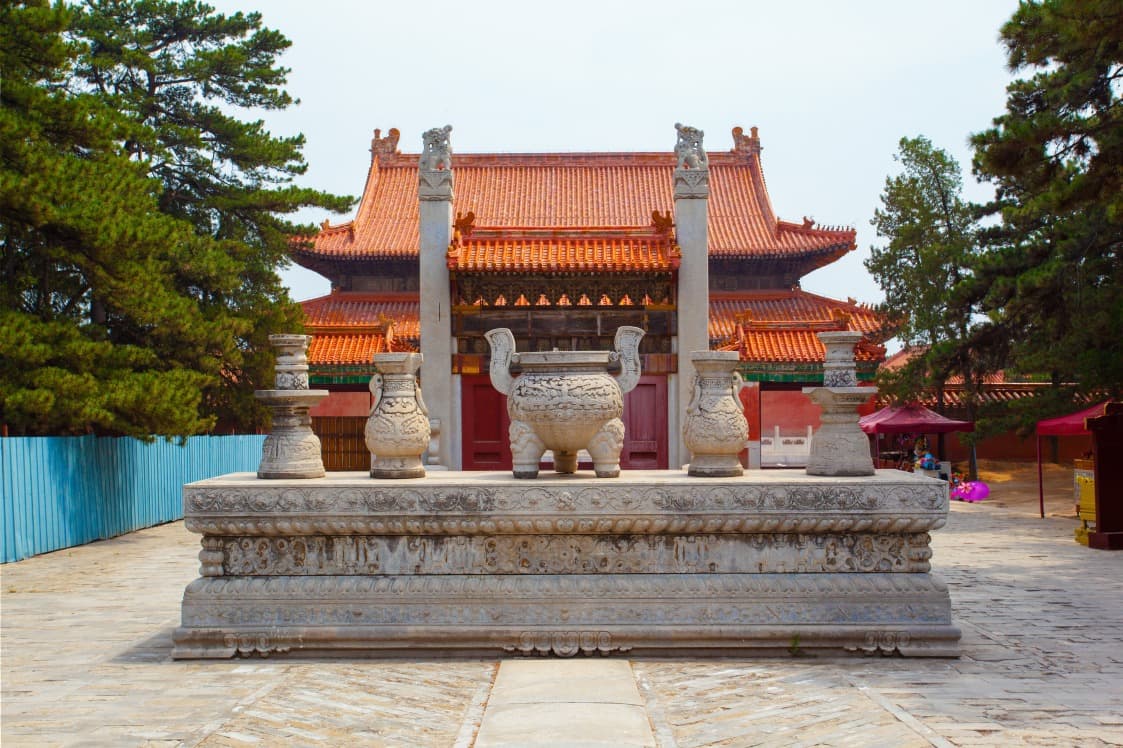
A long sacred way leads to the summit of Liangshan Hill, where the main mausoleum stands. It is bordered by stone statues and sculptures dating back over 1,200 years: winged horses, birds, lions, officials in armor. The entire complex originally comprised nearly 380 buildings—sacrifice halls, pavilions, tombs—of which only the foundations and a few restored elements remain.
The 61 headless statues
Along the Spirit Way stand 61 stone statues representing foreign emissaries and chiefs of minority peoples who came to attend Gaozong's funeral. All were beheaded, primarily during the Cultural Revolution. Inscriptions carved on their backs still allow the identification of several figures' origins.
Stelae and murals
Two large white stone stelae frame the entrance to the imperial tomb: one pays tribute to Gaozong's military and administrative achievements, the other, left blank of inscription, is traditionally associated with Wu Zetian. In the subsidiary tombs open to the public, underground murals depict court activities, hunts, and processions of the Tang dynasty.
The subsidiary tombs
The excavated burials of princes Zhanghuai and Yide, as well as that of Princess Yongtai, rank among the most interesting for their well-preserved frescoes and funerary objects.
Practical information
- Duration of visit: allow 2 to 3 hours to walk the Sacred Way, the main tomb, and one or two subsidiary tombs.
- Period: open year-round, with extended hours from spring to autumn. Admission is higher during peak season; consider a combined ticket if you wish to visit the satellite tombs.
- What to bring: walking shoes, water, sunscreen, or an umbrella. The site is extensive and largely open-air.
- Best time: spring and autumn offer the most pleasant conditions; winter is still feasible but windy on the hill.
How to get there
The simplest way from Xi'an is tourist bus no. 3, which departs from the railway station square and goes directly to the Qianling Mausoleum, typically with a morning departure and early afternoon return. Verify schedules the day before at your location, as they vary by season.
Minibuses and taxis also operate from Xi'an, sometimes as part of an excursion combining Qianling with other Tang tombs. Allow approximately 1.5 hours of travel time each way.
What to combine nearby
The Qian Mausoleum is part of a vast network of imperial tombs in the Guanzhong plain. Nearby, the Zhao Tomb (Zhaoling, dedicated to Emperor Taizong) and the Mao Tomb (Maoling, dedicated to Emperor Wu of the Han) complement the visit logically over a day.
Back in Xi'an, continue exploring Tang art at the Great Wild Goose Pagoda. For other landmarks of Chinese heritage, see the Great Wall at Juyongguan or the Bezeklik Thousand Buddha Caves.
Plan your trip
The Qian Mausoleum naturally integrates into a stay around Xi'an and Shaanxi, between the Terracotta Army, city walls, and ancient imperial capitals. Discover our bespoke itineraries for a trip to Chine that blends major sites with more hidden-gem stops.

Interested in this visit?
We can include it in your personalised itinerary.