Chengyang Wind and Rain Bridge
Chengyang Wind and Rain Bridge
In Sanjiang, Guangxi province, the Chengyang Wind and Rain Bridge exemplifies the nail-free wooden architecture of the Dong ethnic group, nestled amid rice paddies.
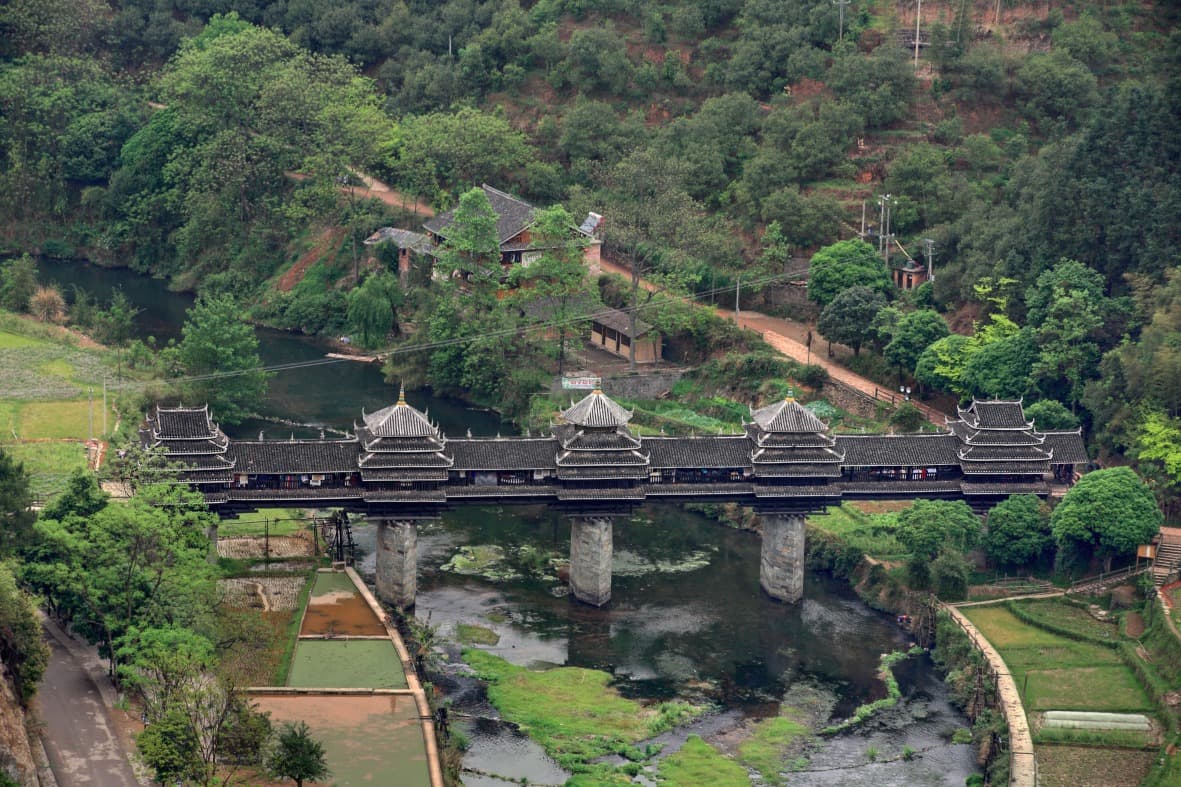
Twenty kilometers north of Guyi, in Sanjiang district (Guangxi province), the Chengyang Wind and Rain Bridge spans the Linxi River at the entrance to villages of the same name. Also called Yongji Bridge, it stands as one of the finest examples of wooden architecture among the Dong ethnic group, constructed entirely without nails through interlocking joinery.
Why visit the Wind and Rain Bridge
The bridge brings together several points of interest in one location. Its wood and stone architecture, assembled without nails, showcases craftsmanship passed down through generations of the Dong people. It still serves as a daily passage for residents of Chengyang's eight villages, making it a living site rather than a frozen monument. Surrounding it, terraced rice paddies, hills, and tea plantations compose the agricultural landscape characteristic of northern Guangxi. The bridge ranks among China's best-known wooden structures and benefits from national heritage protection status.
History and legend
The structure was built in 1916 by Dong inhabitants of the valley. Its foundation is tied to a local legend: a dragon, master of wind and rain, is said to have plunged into the Linxi River to save a young girl swept away by the waters, then became the village's protective spirit. The bridge was erected as a tribute to this guardian entity.
Since its construction, it has served as the village's sole gateway facing the Linxi River. Today it ranks among China's four great covered bridges, alongside comparable structures preserved in other provinces.
What to see on-site
The bridge's architecture
The bridge measures approximately 70 meters long, 3.4 meters wide, and 10 meters high. It rests on 5 stone pillars, features 3 passageways, 19 covered verandas, and 5 pavilions. The three central pavilions adopt a four-story pagoda style; the two end pavilions display roofs stacked across five levels. The entire structure is assembled entirely in wood using interlocking joinery, without nails or adhesive.
The sculptures
On the pillars and beams, Dong artisans carved phoenixes, longevity cranes, and small floral dragons. These motifs echo the founding legend of the protective dragon and the symbolic repertoire unique to Dong culture.
The surrounding setting
The bridge sits within a landscape of rice paddies, forested hills, and tea plantations. Benches positioned along the verandas invite visitors to sit, sheltered from sun or rain—hence its name—to watch the daily movement of villagers and the river's flow.
The villages of Chengyang
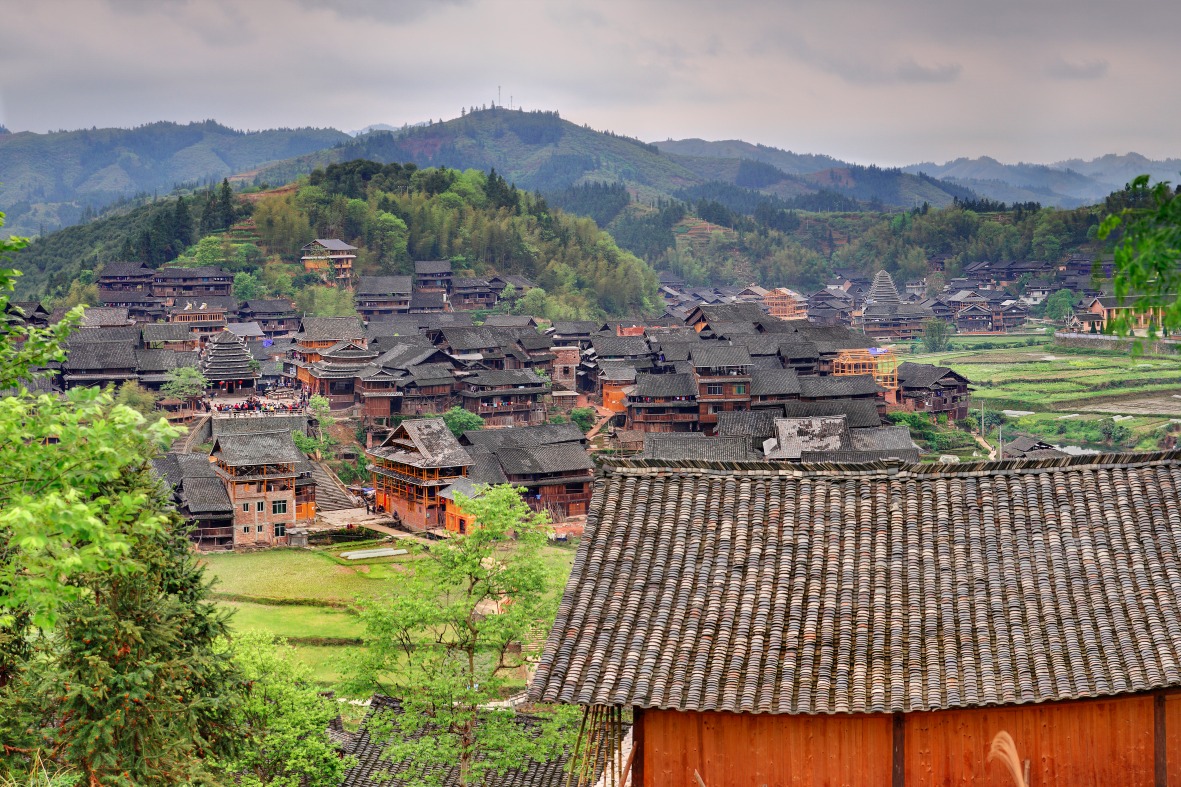
The bridge serves an agricultural cluster of eight hamlets: Ma'an, Pingzhai, Yanzhai, Dazhai, Pingpu, Pingtan, Jichang, and Dongzhai. The population is predominantly Dong. Several family-run guesthouses welcome visitors wishing to extend their stay and experience the local rural rhythm.
Practical information
- Duration: allow 1 to 2 hours for the bridge alone, half a day to a full day if you also explore the surrounding villages.
- Admission: paid entry at moderate rates, valid for the bridge and the entire Chengyang site.
- Hours: open during daylight hours, generally from morning to early evening.
- On-site: Dong guesthouses, small restaurants, trails to rice paddies and tea plantations.
When to visit
The region can be visited year-round, but the landscape changes dramatically with the seasons. In spring, flooded rice paddies mirror the sky and hills turn green again. Summer is hot and humid, ideal for seeing terraces in full green. Autumn brings golden rice paddies before harvest, often considered the most photogenic season. Winter is quieter, with cool, misty weather that highlights the bridge's architecture.
How to get there
The simplest access combines train and bus. From Guilin, high-speed rail reaches Sanjiang in less than an hour. At Sanjiang's bus station, take the Sanjiang–Linxi line and get off at the Chengyang stop, a few minutes' walk from the bridge. Taxis and ride-sharing services round out options from Sanjiang's town center.
What to see nearby
Sanjiang district allows you to extend your discovery of Dong architecture: Mapang's drum tower, other covered bridges in the valley, and rural markets dot the itineraries. To broaden your travels to other regions of Chine, several sites complement this overview:
- Sanjiang and its Dong villages
- The Great Wall at Juyongguan
- Great Wild Goose Pagoda
- Longgong Cave
Frequently asked questions
Frequently asked questions
No. Contrary to claims sometimes made, the Chengyang Wind and Rain Bridge does not appear on the UNESCO World Heritage List. It does, however, benefit from protection status under China's national heritage designation.
This name designates a typology of covered bridges unique to the Dong ethnic group: their verandas and pavilions shelter pedestrians from wind and rain, and offer benches where visitors can rest or take shelter.
One hour is enough to cross the bridge and observe the sculptures. To explore Chengyang's eight villages, rice paddies, and tea plantations, plan for a full day, or even an overnight stay.
Yes. It remains the main gateway to Chengyang village from the opposite bank and is part of daily life, a distinction that sets this site apart from a mere tourist monument.
Several family-run guesthouses operated by Dong residents offer accommodations in Chengyang's hamlets. This is a worthwhile option to enjoy the bridge in morning or evening light, outside peak tourist hours.
Preparing your trip
The Chengyang Bridge fits naturally into an itinerary through Guangxi, between Guilin, Longsheng, and Dong and Miao villages. To build a journey around this region and beyond across Chine, consult our suggestions for travel to Chine.
Interested in this visit?
We can include it in your personalised itinerary.