Nine Bends River
Nine Bends River
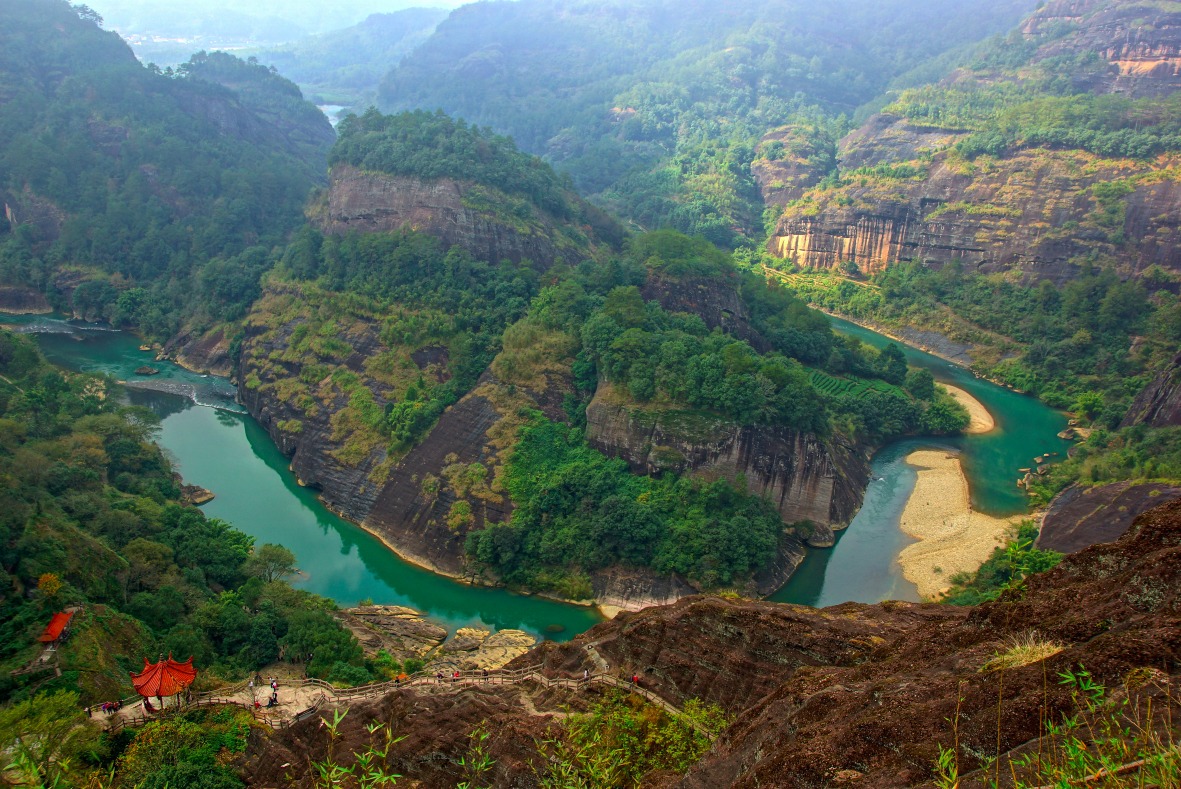
At the foot of Mount Wuyi, 9.5 km of river and nine meanders traveled by bamboo raft, amid karst peaks, hanging coffins and carved calligraphy.
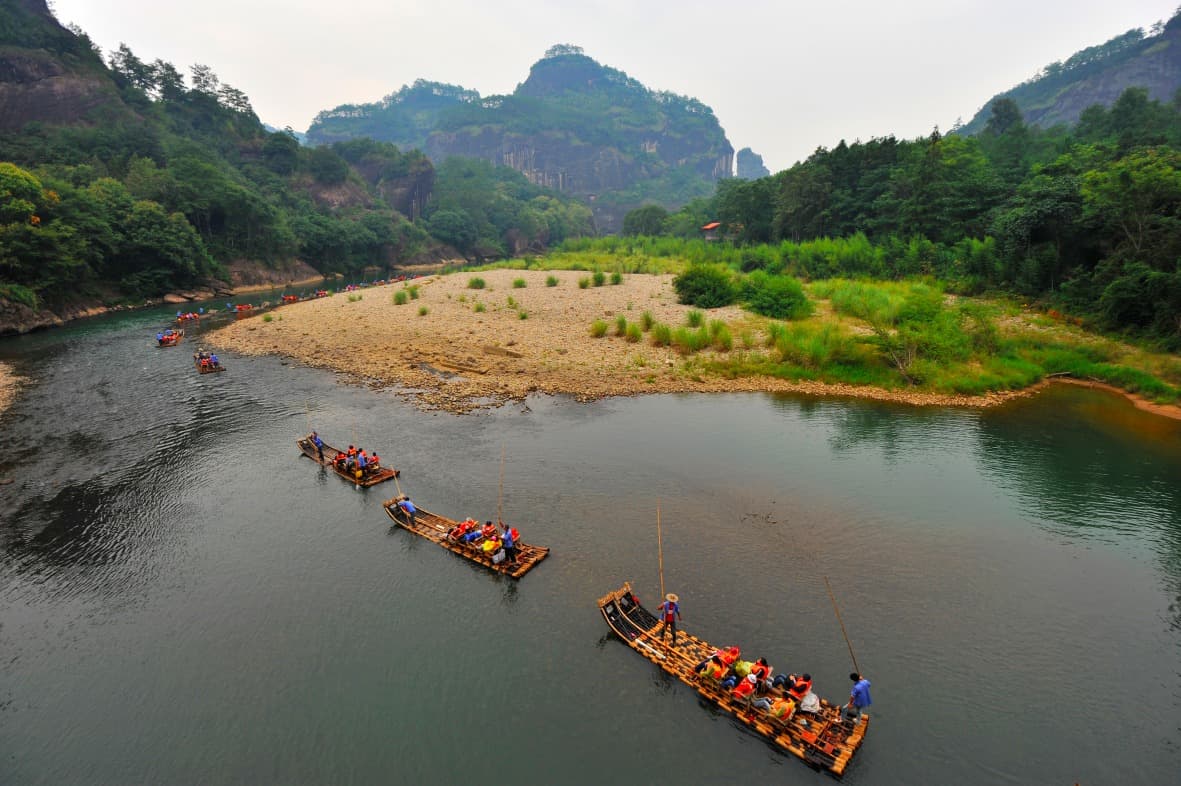
Located 8 km from Mount Wuyi, near the village of Xincun in Fujian province (southeastern Chine), the Nine Bends River (Jiuqu Xi in pinyin) winds for 9.5 km at the foot of UNESCO-listed karst peaks. The bamboo raft descent, lasting 1.5 to 2 hours, passes through nine successive curves and beneath 36 summits and 99 rock formations, in a landscape that has inspired Chinese painting and poetry for over a thousand years.
Why visit the Nine Bends River
The site combines three rarely found attractions. First, a natural setting: a slow-moving waterway that winds around nine bends in the heart of the Wuyi massif, whose summits exceed 400 m in altitude. Second, a rich cultural heritage: 18 hanging coffins clinging to the cliffs, 35 academic relics left by celebrated scholars including philosopher Zhu Xi, and nearly 450 m² of engravings and calligraphy carved into stone. Finally, an accessible experience: navigation takes place on stable bamboo rafts, limited to six passengers, requiring no physical exertion.
The inscription of Mount Wuyi on the UNESCO World Heritage list in 1999, under both natural and cultural criteria, confirms this singularity. Few Chinese landscapes combine such a dense concentration of historical testimonies over just a few kilometers of river.
History and cultural heritage
The Nine Bends valley holds a special place in Chinese intellectual history. In the 12th century, under the Southern Song dynasty, philosopher Zhu Xi (1130-1200), a major figure of neo-Confucianism, founded an academy on its banks. For centuries, scholars, painters and poets came to meditate, paint and carve their impressions directly into the rock. The calligraphy visible today on the cliff faces are direct traces of these visits.
Even older, the funerary use of the cliffs dates back to the Minyue culture, over 3,000 years ago. The hanging coffins in wood, hoisted dozens of meters above the river, constitute one of the archaeological mysteries of the region: lifting techniques, ritual significance and the identity of the deceased remain subjects of debate.
The descent ends near the Wuyi Palace, an ancient temple from the Song dynasty built to honor the Lord Wuyi, the tutelary deity of the place. The building, restored several times, houses today the administrative offices of the site.
What to see along the nine bends
Rafts depart from the Xingcun landing and travel downstream in reverse numerical order: you thus begin at the ninth curve to end at the first, near Wuyi Palace. Here are the highlights in order of appearance.
First bend: Dawang Peak and Lion Peak
At the entrance, Dawang Peak ("Great King"), Manting Peak and Lion Peak frame the river's exit. The Dawang, recognizable by its massive form, is one of the emblematic summits of the massif.
Second and third bends: Yunu Summit
Yunu Summit ("Jade Maiden"), slender and solitary, is considered the symbol of Mount Wuyi. Its silhouette reflects in the water when skies are clear.
Fourth bend: Zang Peak and West Fishing platform
Zang Peak overlooks a rock platform called West Fishing, where tradition places a fishing scene evoked in classical poetry.
Fifth bend: the widest section
This is the widest and longest section of the river. The current slows, the valley opens, and you can see the remains of the academy founded by Zhu Xi on the northern bank.
Sixth bend: engraved calligraphy
Rock walls here bear numerous Chinese calligraphy characters engraved by scholars throughout the dynasties. Some inscriptions reach several meters in height.
Seventh bend: the highest peaks
The raft passes beneath the highest peaks of this section of the valley. This is also the area where the hanging coffins in cavities carved into the cliff face are best observed.
Eighth bend: the lion's mouth
A rock formation shaped like an open lion's mouth gives its name to this bend. Boatmen typically slow down to allow passengers to observe it.
Ninth bend: departure from Xingcun
The starting point of the descent, the ninth bend is located in a more enclosed area, closest to the river's source in the western forest of the massif.
Practical information
- Journey duration: 1.5 to 2 hours depending on water flow.
- Capacity: maximum six people per raft, life jackets and bamboo seats provided.
- Price: expect a moderate budget, tickets purchased at the landing or via local agencies; advance booking is recommended during peak season.
- What to bring: sun protection, light waterproof clothing, water; umbrellas are sold at the landing.
- Accessibility: easy boarding and disembarking, but transfers involve sitting on low benches.
When to go
The climate is subtropical and humid, with average annual precipitation of 2,200 mm and temperatures averaging between 12 and 18 °C. The best periods for the descent are spring through autumn, avoiding heavy rain episodes in June and July which can suspend navigation. Autumn offers optimal visibility of the summits and pleasant temperatures. Winter remains navigable but cool on the water.
How to get there
The site is reached from the city of Wuyishan, accessible by high-speed train from Fuzhou or Xiamen, and by plane via Wuyishan Airport. From downtown, take the public bus line 6 to the entrance of the scenic zone, then an internal shuttle serves the Xingcun landing, the starting point of the descent.
What to see nearby
Mount Wuyi lends itself to several days of exploration. Beyond the river, the massif features hiking trails to the main peaks and tea plantations producing the famous Wuyi oolong teas (Da Hong Pao). To extend your Chine journey, other major sites deserve a visit:
- The Great Wall at Juyongguan, one of the best-preserved passes north of Beijing.
- The Great Wild Goose Pagoda in Xi'an, a Buddhist monument from the Tang dynasty.
- The Hexigten Geopark in Inner Mongolia, for its volcanic landscapes and steppes.
- The Bezeklik Thousand Buddha Caves, on the ancient Silk Road.
Frequently asked questions
Frequently asked questions
The complete journey through the nine bends takes 1.5 to 2 hours depending on the river's flow.
Yes, the river is calm and rafts are equipped with life jackets. Capacity is limited to six people per raft for safety.
During peak season (spring, autumn, Chinese holidays), advance booking through an agency or online is highly recommended as daily ticket quotas are capped.
These are 18 wooden coffins dating back over 3,000 years, attributed to the Minyue culture, hoisted and placed in cavities of the cliff face for ritual reasons still not fully understood.
The descent operates almost year-round, except during heavy rainfall (especially June-July) which may result in temporary suspension for safety reasons.
Preparing your trip
The Nine Bends River fits naturally into a journey devoted to southeastern Chine or a grand cultural and natural tour of the country. To build a custom itinerary combining UNESCO heritage, karst landscapes and tea plantations, consult our Chine travel suggestions.
Interested in this visit?
We can include it in your personalised itinerary.