Jinsha Ruins
Jinsha Ruins
In Chengdu, the Jinsha Ruins reveal the 3,000-year-old capital of the Shu kingdom. Museum, excavations and over 5,000 exhumed objects.
A major archaeological site in Sichuan province, the Jinsha Ruins are located in the suburbs of Chengdu, 50 km from the Sanxingdui site. Discovered by chance in February 2001 during road construction, this deposit over 3,000 years old constitutes the first major archaeological discovery of 21st-century Chine. It reveals the remains of the ancient capital of the Shu kingdom, contemporary with the Shang and Zhou dynasties.
Why visit the Jinsha Ruins
The site offers a tangible reading of a civilization that long remained mysterious: the ancient Shu. Over 5,000 objects in gold, bronze, ivory, jade, stone and lacquered wood have been unearthed here, drawing the portrait of a sophisticated ritual society. The visit combines two dimensions rarely brought together: an open-air archaeological park where excavations continue, and a modern museum that contextualizes the pieces. For travelers interested in archaeology, Jinsha forms a logical pairing with Sanxingdui and completes understanding of the Sichuan basin before Chinese unification.
History of the site
In February 2001, workers building a road northwest of Chengdu uncover fragments of ivory and jade. The excavations that follow reveal the scale of the deposit: Jinsha was, between the 12th and 7th centuries BCE, the political and religious center of the Shu kingdom, following the decline of Sanxingdui. The site documents the emergence, development and rapid disappearance of this culture.
Faced with the richness of the discoveries, authorities launched an ambitious museum project in 2004. The buildings were completed in 2006 and the museum officially opened on April 16, 2007. Excavation campaigns continue to this day.
What to see on site
The site covers a vast area divided by the Modi River. The museum buildings span 38,000 m² and are divided into several distinct sections.
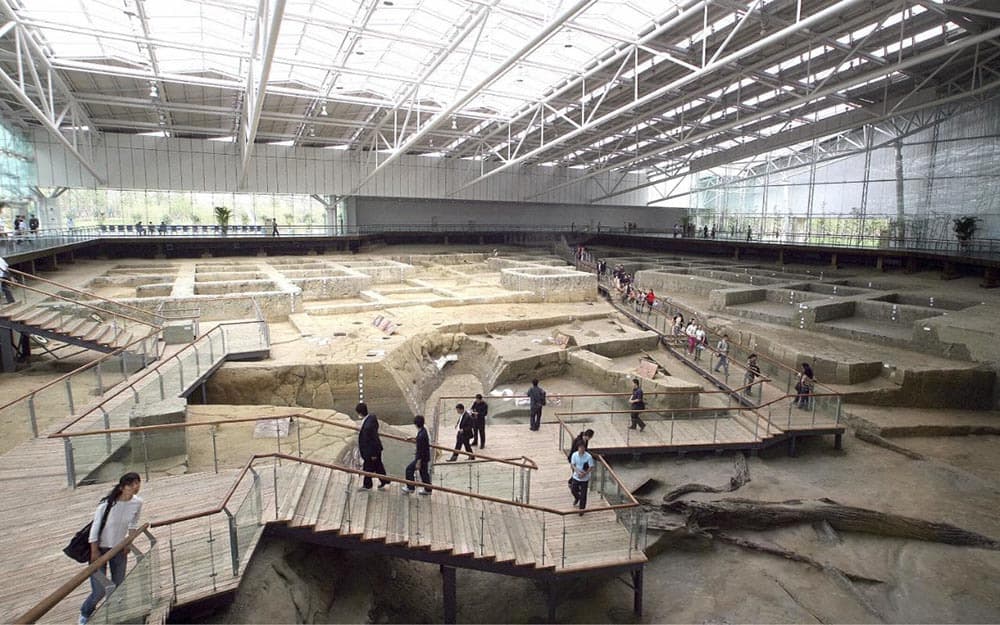
- Relics Section (south of the Modi River): a semi-circular building of 7,588 m² protects the excavation area used as a sacrificial site under the Shang and Zhou. The square pits where objects were found remain visible in situ.
- Exhibition Section (north of the river): a trapezoidal four-story building presents emblematic pieces, including the sun disk with immortal birds that became the symbol of Chengdu's heritage. Multicolored jade jewelry, weapons, instruments and ritual ornaments complete the tour.
- Cultural Heritage Protection Center: located in the western part, it covers more than 8,000 m² and houses laboratories, conference room, theater and education space.
- Landscape park: metasequoias, ginkgos, cherry trees, peach trees, pear trees and bamboo groves structure the museum surroundings and make strolling between buildings pleasant.
Practical information
Allow 2 to 3 hours to explore all sections without rushing. The site is open year-round, generally from 8 a.m. to 6 p.m., with ticket sales closing one hour before. Entry fees remain moderate (around 70 RMB depending on season). English-language audioguides available at the entrance; Chinese labels are partially translated.
When to visit
Jinsha is pleasantly visited from spring to autumn. Late March and April correspond to the blooming of cherry, peach and pear trees in the park, the most photogenic period. Autumn (October-November) offers the intense yellows of ginkgos. Sichuan summers are hot and humid; winters remain manageable but gray. Avoid the Golden Week holidays in early October, when crowds are very heavy.
How to get there
By metro
Line 2 of the Chengdu metro serves Yipintianxia station. Exit B leaves you about 1 km from the east entrance of the site, accessible on foot in about ten minutes.
By bus
Several lines serve the museum area:
- Lines 37, 81, 100 and 809: get off at Jinxi West Road stop, then 300 m on foot.
- Lines 5, 7, 83, 84, 123, 147, 805 and 848: get off at Jinfeng North Road stop, then follow Jinbo Street and turn right.
By taxi or ride-hailing
From downtown Chengdu, allow about twenty minutes by Didi outside rush hours.
What to combine in the region
Jinsha fits naturally into a stay in Chengdu, the capital of Sichuan also known for its giant pandas and gastronomy. To extend archaeological exploration, the Sanxingdui site, 50 km north, presents the earlier phase of Shu culture and completes the visit. Art history enthusiasts can then consider the Bezeklik Thousand Buddhas Caves or the Great Pagoda of the Wild Goose in Xi'an, classic stops on a Chinese cultural itinerary.
Frequently asked questions
Frequently asked questions
Allow 2 to 3 hours to explore the excavation area, exhibition pavilion and park. Archaeology enthusiasts can spend a half-day here.
Online booking is recommended on weekends and during Chinese holidays. On weekdays and outside peak season, on-site purchase remains possible.
It's feasible but tight. The two sites are about 50 km apart. Dedicating one day to each site allows you to appreciate the collections without rushing.
Labels are in Chinese and English. Audioguides exist in English; no French materials currently available. An English-speaking private guide can be arranged from Chengdu.
Preparing your trip
The Jinsha Ruins fit into an itinerary in Sichuan, a key region for understanding the depth of Chinese history. To build a trip that combines archaeological sites, landscapes and living heritage, consult our tailor-made trips to Chine.
Interested in this visit?
We can include it in your personalised itinerary.