Hongcun Historic Village
Hongcun Historic Village
UNESCO village in southern Anhui, Hongcun features 150 Ming-Qing residences, an arc-shaped lake, and an urban plan designed like an ox, 40 km from Huangshan.
The village of Hongcun is located in southern Anhui Province, approximately 11 km northeast of Yixian district and 40 km from Huangshan Mountain. Spanning roughly 0.19 km², it comprises over 150 ancient residences, an arc-shaped artificial lake, and a network of aqueducts running through each alley. Inscribed on the UNESCO World Heritage list in 2000, it showcases one of the finest preserved ensembles of Huizhou architecture in Chine.
Why Visit Hongcun
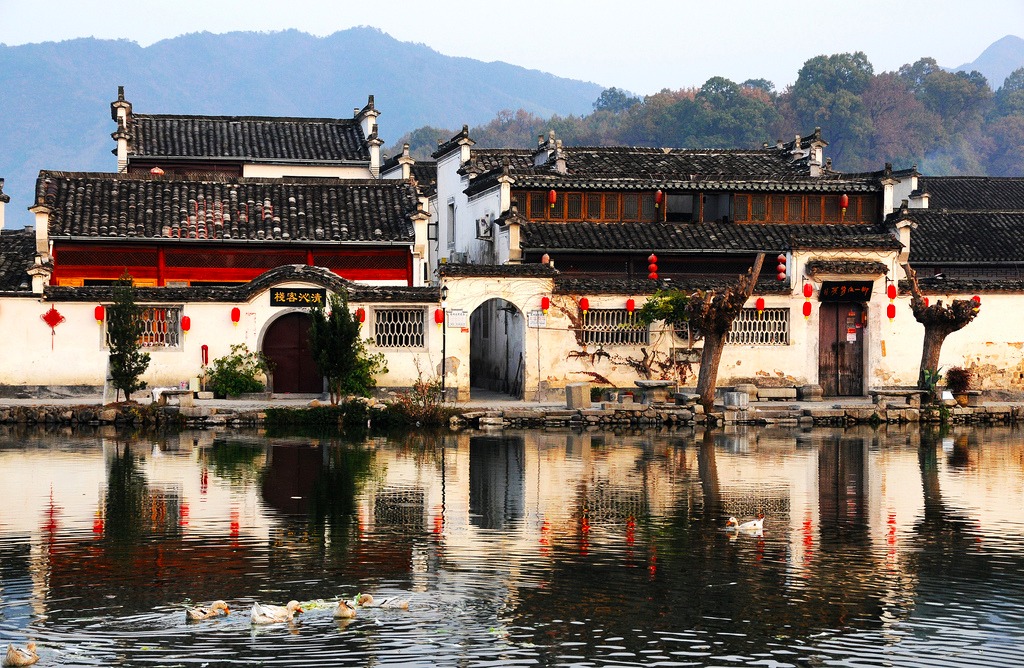
- Intact Huizhou architecture: over 150 residences from the Ming and Qing dynasties, dark tiled roofs, stepped gables, and cobbled lanes.
- Symbolic ox-shaped layout: rare urban planning where each element of the village corresponds to a part of the animal's body.
- UNESCO site since 2000, designated as "ancient villages of southern Anhui."
- Filming location for Crouching Tiger, Hidden Dragon, whose opening rooftop scenes brought Hongcun to international prominence.
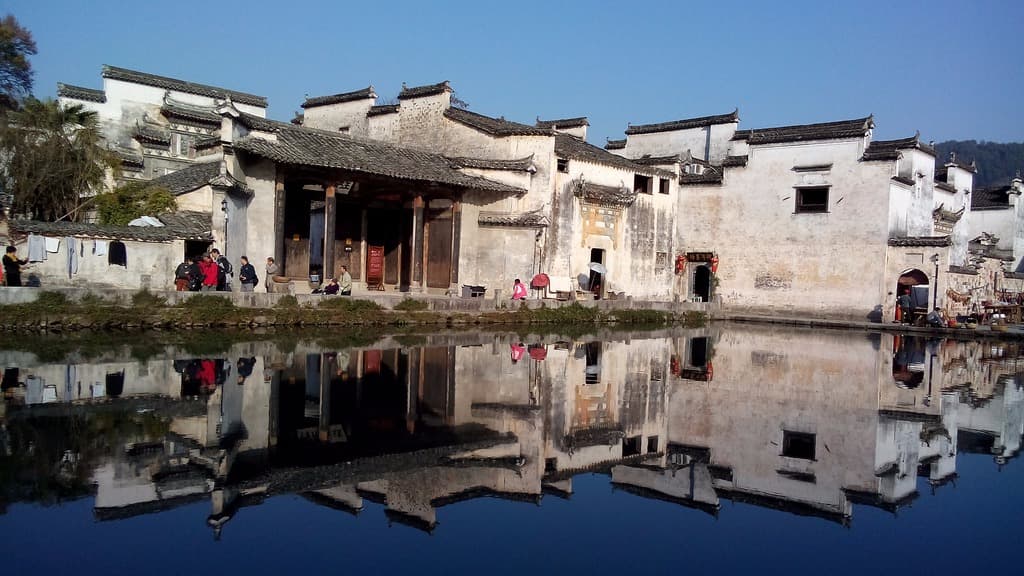
- Known as "the village of Chinese painting" for its reflections on the South Lake, a recurring motif in Chinese art academies.
History of the Village
Hongcun was founded in 1131, during the Song Dynasty, by two brothers of the Wang family. The village initially consisted of only thirteen houses. The gradual arrival of the Wang clan—merchants and scholars—enabled the settlement to thrive during the Ming and Qing dynasties, when most of the residences visible today were built.
On November 30, 2000, Hongcun was inscribed on the UNESCO World Heritage list under the designation "ancient villages of southern Anhui," alongside Xidi. The site subsequently received a national 5-star rating.
Several notable figures have left their mark on the village's recent history. In October 1997, Sino-American architect Ieoh Ming Pei (I.M. Pei), winner of the Pritzker Prize, visited Hongcun and sketched an inscription preserved in Chengzhitang Hall. On May 20, 2001, the former president of the People's Republic of Chine summarized Huizhou culture in five letters: C (Culture), B (Business), M (Medicine), E (Education), and A (Architecture). The village also served as a filming location for Ang Lee's Crouching Tiger, Hidden Dragon.
What to See in Hongcun
The Ox-Shaped Layout
The village's organization replicates the silhouette of a reclining ox. Leigang Mountain represents the head, ancient trees form the horns, residences comprise the body, zigzagging canals depict the intestines, and the four bridges over Jiyin Stream sketch the legs. This geomantic design, dating from the 15th century, incorporates an artificial aqueduct system fed by the stream from Leigang Hill down to the South Lake, passing the foot of each residence. It serves for domestic use, fire prevention, and irrigation.
Chengzhi Pavilion (Chengzhitang)
The most expansive residence in the village, Chengzhi Pavilion belonged to a wealthy salt merchant. It is nicknamed the "Popular Forbidden City" due to its scale and ornamental richness. It contains over 60 rooms and 9 courtyards, intricately carved wooden beams, and wall panels depicting nature, Chinese mythology, and scenes of life under ancient dynasties. Part of the building functions as a small museum.
The South Lake and Its Academy
Built during the Ming Dynasty in the shape of an archer's bow, the South Lake spreads before the village. A long stone bridge crosses it, marking the main entrance. The reflection of the residences and Leigang Hill on the water is the village's most reproduced image.
On the northern bank stands the South Lake Academy, a 6,000 m² structure built in 1814, following the unification of six Huizhou family schools. It illuminates the pivotal role of education in the culture of the region's scholarly merchants.
Local Life
Approximately 1,500 residents still live in Hongcun, predominantly descendants of the Wang clan. You'll encounter painters and fine arts students stationed before their easels: Hongcun is one of the principal plein air studios for contemporary Chinese painting.
Practical Information
- Entrance fee: moderate tariff, valid for three consecutive days (useful for combining with Xidi).
- Hours: the village is accessible throughout the day; residences open to the public (Chengzhitang, academy, etc.) follow standard daytime hours.
- Visit duration: allow 2 to 3 hours for the village, half a day if you include the academy and a lakeside pause.
- Tip: early morning and late afternoon light on the lake and absence of tour groups make the visit far more enjoyable.
When to Visit
Hongcun is visitable year-round, yet each season offers a distinct atmosphere:
- Spring (March-May): rapeseed blossoms in the surrounding countryside, morning mists above the lake, ideal photography conditions.
- Autumn (October-November): copper-toned foliage, cool temperatures, soft light; the most favored season for painters.
- Winter: fewer visitors, hushed ambiance, occasionally light snow on dark roofs.
- Summer: dense greenery but humid heat and heavy crowds during Chinese school holidays.
How to Get There
Hongcun is easily reached from the main access points in the Huangshan region:
- From Yixian: taxi, tuk-tuk, or local bus for the 11 km separating the district capital from the village.
- From Tunxi (Huangshan train station and airport): daily tourist buses connect the bus station to Hongcun, roughly 1.5 hours' drive.
- From Huangshan Mountain: shuttles and organized excursions, approximately 40 km away.
Nearby Attractions
- Xidi: sister village to Hongcun, inscribed simultaneously on the UNESCO list, more austere and less frequented.
- Huangshan Mountain: granite peaks, table-like pines, and seas of clouds, 40 km to the north.
- Tunxi (Old Street): ancient merchant street from the Ming-Qing era, a logical base before or after Hongcun.
- To further explore Chinese architectural heritage, also consider the Great Wall at Juyongguan or the Great Goose Pagoda in Xi'an.
Frequently Asked Questions
Frequently asked questions
Allow 2 to 3 hours to walk the lanes, the South Lake, and Chengzhi Pavilion. Half a day is ideal if you wish to visit the South Lake Academy and enjoy the light on the lake. Since tickets are valid for three days, some travelers return at sunrise.
Yes, this is the most common itinerary in the region. Hongcun and Xidi can be visited in a single day (roughly twenty kilometers apart) and Huangshan Mountain is reachable in approximately one hour's drive. Plan two to three days on-site to enjoy the entirety.
Yes. Several scenes from Ang Lee's film, notably the lake crossing and rooftop chase, were shot in Hongcun. The village has since gained international recognition that complements its UNESCO inscription.
Spring (April-May) for morning mists and rapeseed blossoms, and autumn (October-November) for warm colors. The first hours of daylight offer the sharpest reflections on the South Lake, before tour groups arrive.
Include Hongcun in Your Chine Journey
Hongcun integrates naturally into a circuit around Huangshan, between Huizhou heritage and mountain scenery. Our local advisors can organize your stay, combining Xidi, Tunxi, and an ascent of Huangshan. Explore our bespoke Chine journeys to craft an itinerary at your own pace.
Interested in this visit?
We can include it in your personalised itinerary.