Longjing Tea Village (Dragon's Well)
Longjing Tea Village (Dragon's Well)
South of Hangzhou's West Lake, the village of Meijiawu produces the celebrated Longjing tea. Terraced plantations, tasting lounges and centuries-old tradition.
The Longjing tea village, also called Meijiawu village or "Dragon's Well," stretches south of Hangzhou's West Lake. Known for its terraced plantations and green tea ranked among the ten finest in Chine, it blends agricultural landscape, millennial tradition and tea culture.
Why visit the Longjing tea village
The site offers a concrete glimpse into Chinese tea culture in one of its historical cradles. The hills covered with terraced plantations, drying workshops and tasting lounges allow you to understand the entire production chain, from picking to cup. The village is also known for its local cuisine, which incorporates tea leaves into several traditional dishes, notably Longjing shrimp.
Village history and the Dragon's Well legend
Before becoming a centre for tea, Meijiawu was for several centuries a simple farming village, whose origins date back around six hundred years. Tea cultivation took hold gradually there, benefiting from the humid climate and rolling soils south of West Lake.
The name "Dragon's Well" comes from a Taoist legend. A monk reportedly noticed that a dragon lived hidden in a spring near the village and asked it to bring rain to save the crops. The dragon granted his request, and the spring was later associated with a sanctuary that became the Dragon's Well Monastery. The tea cultivated on the nearby slopes inherited the same name: Longjing, literally "Dragon's Well."
What to see and do on site
Terraced plantations
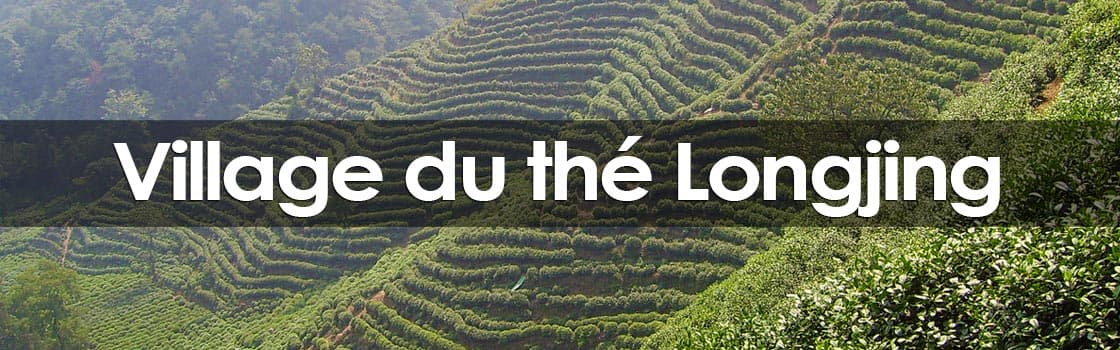
The village spans approximately 355 hectares of terraced plantations, which line the hillsides. Several trails allow you to walk between rows of tea plants and observe the work of pickers during harvest season.
Tea lounges and tastings
There are approximately 160 tea lounges scattered throughout the village. Most offer commented tastings, sometimes accompanied by a presentation of the traditional ceremony. Producers explain how to recognise quality Longjing: flat leaves, jade-green colour, roasted chestnut aroma.
Factory visits
Several workshops open their doors to show the transformation steps. The ritual of Longjing preparation rests on two key movements: hand-wok drying, which halts fermentation, and lengthwise folding of the leaves, which gives them their characteristic flattened shape.
Tea cuisine
The village restaurants serve dishes where Longjing tea is used as an aromatic or as an ingredient in its own right, giving subtle vegetable flavour to preparations.
Longjing tea: classification and characteristics
Longjing tea ranks among the ten most renowned tea varieties in Chine. The traditional classification distinguishes five grades according to production location: Meijiawu, Longjing, Yunqi, Hupao and Shifeng. Each presents nuances of taste and price, with Shifeng historically considered the most prestigious.
Rich in antioxidants, Longjing green tea releases a marked vegetable aroma and a sweet, slightly sugared flavour. It is generally brewed at low temperature (around 80°C) to preserve its aromas.
When to visit the Longjing tea village
The most interesting period falls in spring, between late March and early May. The main harvest takes place around the Qingming festival (early April): leaves harvested before Qingming, called Mingqian, are the most sought-after and most expensive.
Summer and early autumn still allow you to enjoy the landscapes, but without the bustle of harvest. Winter is quieter and more humid; some lounges remain open but the plantations are at rest.
Practical information
- Visit duration: allow half a day to combine walks through the plantations and tasting. A full day allows you to add a factory visit and lunch on site.
- Rates: entry to the village is free. Tastings and guided tours are paid, at moderate rates that vary according to the quality of tea offered.
- Shopping: Longjing prices vary considerably depending on grade. Favour lounges that allow tasting before purchase.
- What to bring: comfortable shoes, sun protection in spring and summer.
How to get there
The village is around ten kilometres from Hangzhou's city centre. Several urban bus lines connect the city to the village, notably from around West Lake; routes change regularly, so best to check current numbers at your hotel or on a local navigation app. Taxi and ride-sharing (Didi) are a practical alternative, especially for a group. Some visitors combine the outing with a bicycle ride from West Lake.
To see nearby
- Hangzhou and its West Lake, listed as a UNESCO World Heritage site, a few kilometres to the north.
- The Lingyin temple, one of Chine's oldest Buddhist monasteries, located in the nearby hills.
- The National Tea Museum, which usefully complements your visit to the plantations.
Frequently asked questions
Frequently asked questions
Spring, between late March and early May, around the Qingming festival, when the main harvest takes place and the landscapes are at their greenest.
No, entry to the village and plantations is free. Only tastings, factory visits and meals are paid.
Half a day is enough for a walk and tasting. A full day allows you to add a factory visit, lunch with tea-infused dishes and a more thorough exploration of the trails.
Meijiawu, Longjing, Yunqi, Hupao and Shifeng designate five historical production zones. Shifeng is traditionally considered the most prestigious; the others offer slightly different aromatic profiles depending on their terroirs.
Leaves should be flat, smooth, uniform jade-green, with no breakage. When steeped, the tea releases a roasted chestnut aroma and a sweet flavour, without marked bitterness.
Plan your trip to Chine
The Longjing tea village fits naturally into a stay in Hangzhou and broader exploration of south-eastern Chine. To build a tailored itinerary, consult our suggestions for travel to Chine.
Interested in this visit?
We can include it in your personalised itinerary.