Yumenguan, the Jade Gate Pass
Yumenguan, the Jade Gate Pass
A fortified relic of the Han dynasty 80 km from Dunhuang, Yumenguan marked the western frontier of the Chinese empire and the passage of jade caravans.
Yumenguan, whose name literally means Jade Gate Pass, is a fortified ruin on the ancient Silk Road, located approximately 80 km southwest of Dunhuang, in Gansu province. A remnant of the western frontier of imperial Chine, this guard post marked one of two mandatory passages between the Han empire and Central Asian territories.
Why visit Yumenguan
The site holds triple significance: historical, archaeological, and scenic. It is one of the rare surviving testimonies of the western frontier of the Han dynasty, inscribed as a UNESCO World Heritage site in June 2014 as part of the Silk Road Network. The rammed-earth structure stands alone in the middle of the Gobi Desert, offering a raw setting with minimal heavy tourist infrastructure. Travelers interested in the history of Sino-Western exchanges will find here a natural complement to a visit to the Mogao Caves, located in the same region.
History
Yumenguan was built under the Han dynasty (206 BCE – 220 CE) on the orders of Emperor Wu. To contain the incursions of the Xiongnu (Huns) and stabilize the empire's western frontier, the emperor erected two passes along the Great Wall: Yumenguan to the north and Yangguan to the south. These two strongholds controlled access to the Hexi corridor, a mandatory route between central Chine and the Tarim oases.
The pass gets its name from the jade trade: caravans from Hetian (Khotan) transported precious blocks through this point destined for inland Chine. Yumenguan thus served as a customs post, a relay station for travelers and merchants, and a point of diplomatic contact with western kingdoms. With the decline of the Silk Road and the shift of commercial routes southward, the site gradually fell into disuse.
What to see on the site
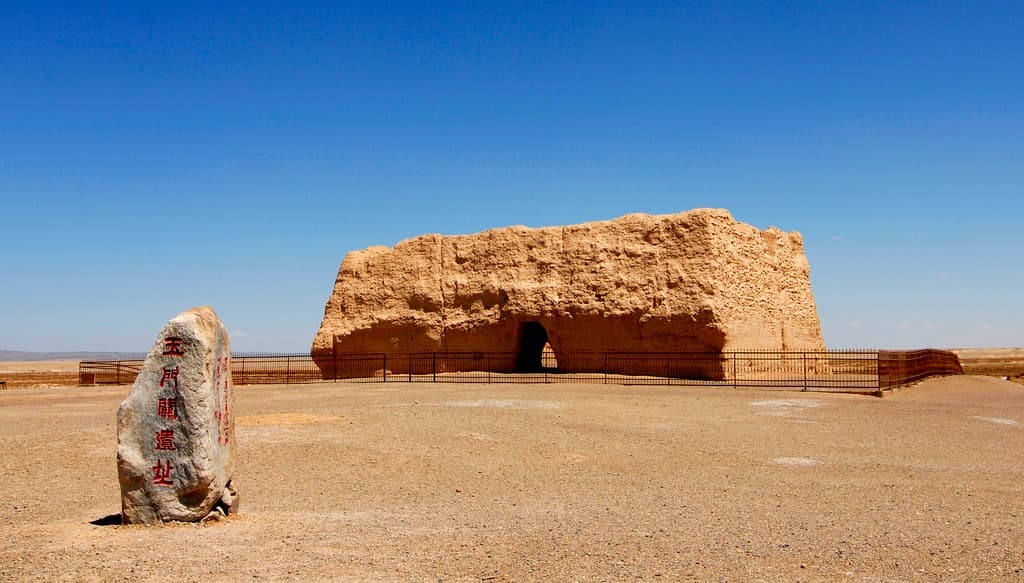
The main fort, called Xiao Fangpan Cheng, is a quadrilateral made of rammed yellow earth, erected directly on the desert floor. It measures approximately 9.7 m in height and 24.5 m in length, with a footprint of approximately 633 m². The walls are pierced with gates and topped with crenellated parapets. The north gate, which serves as the main entrance, measures 3 m in width at the top and 5 m at the base.
Around the fort, the site includes:
- Beacon towers scattered across the desert, spaced approximately 2.5 km apart, which were used to transmit alerts via smoke signals along the frontier;
- Remnant sections of the Han Great Wall, in rammed earth reinforced with reeds;
- A small museum located behind the fort, dedicated to the history of Yumenguan and displaying Han dynasty artifacts found on the site (wooden tablets, weapons, utensils).
From the fort's surroundings, views extend far across the desert steppe and allow you to spot the semi-buried watchtowers that mark the old frontier.
Practical Information
The site is open year-round, generally from early morning until late afternoon. Entrance is charged at a moderate rate, often bundled with other nearby ruins (Han Great Wall, Hecang). Plan 1 to 2 hours for your visit. Bring water, a hat, and sun protection: there is no natural shade.
When to visit
The climate is continental desert, marked by significant temperature variations. The best periods are May-June and September-October, with manageable temperatures and favorable lighting. Summer (July-August) is very hot, with temperatures exceeding 35°C, while winter is harsh and windy, with temperatures sometimes dropping below -10°C. Sandstorms are possible in spring.
How to get there
Yumenguan is reached from Dunhuang, approximately 80 km away. Several options exist:
- Tourist minibuses departing from Dunhuang, offering day-trip circuits including Yumenguan, the Han Great Wall, and sometimes Yangguan;
- Private taxi for a half-day or full day, with prior negotiation of the round-trip fare;
- Rental car with driver, the most flexible solution for combining multiple desert sites.
There is no regular public transport to the site.
Nearby attractions
The Dunhuang region concentrates several major Silk Road sites to explore during the same stay:
- Mogao Caves, a Buddhist complex inscribed as a UNESCO site, approximately 30 km east of Dunhuang;
- Yangguan, Yumenguan's sister pass, south of Dunhuang;
- The Mingsha Dunes and Crescent Moon Lake, at the southern edge of the city;
- Further west, the Thousand Buddha Caves of Bezeklik, in Xinjiang, extend the Buddhist itinerary.
Frequently Asked Questions
Frequently asked questions
Plan your trip
Yumenguan naturally fits into an itinerary along the Hexi corridor, between Xi'an and Xinjiang. To plan a custom journey including Dunhuang, Mogao Caves, and Silk Road remains, consult our trips to Chine.

Interested in this visit?
We can include it in your personalised itinerary.