Tunxi
Tunxi
At the foot of the Yellow Mountains, Tunxi unfolds its ancient Song street and Huizhou architecture. Your guide to planning a stop in Anhui.
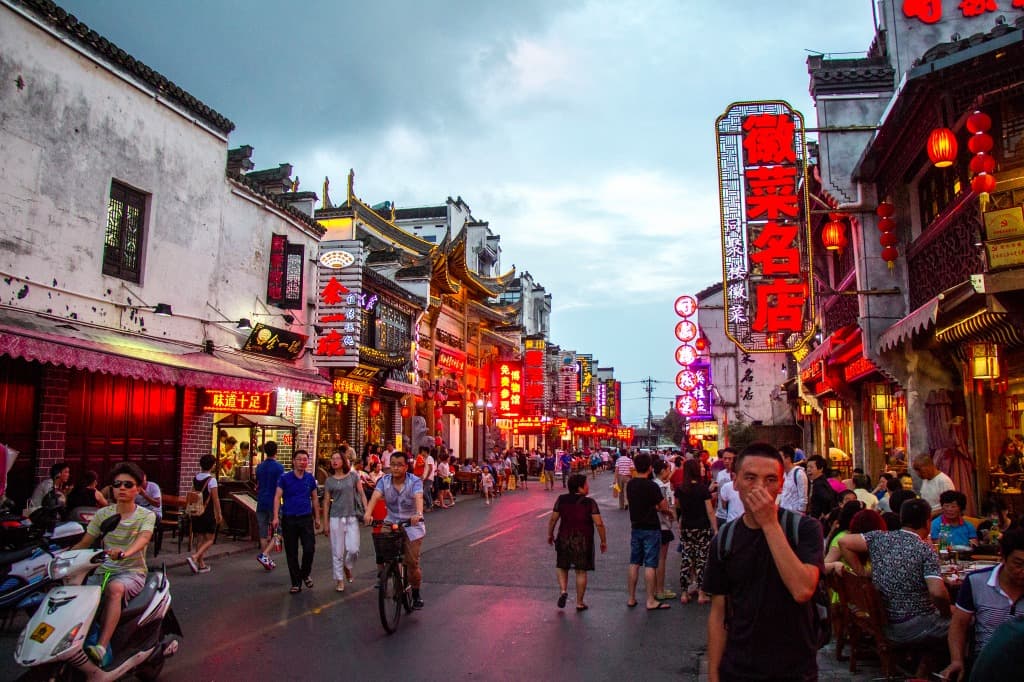
Located in the downtown area of Tunxi District, Tunxi's old street is both a pedestrian thoroughfare and a commercial hub. It also serves as the seat of the Huangshan city government.
It is the most sought-after tourist site in the region, attracting over 6 million visitors each year.
History
Tunxi's old street was built by Huizhou merchants from the Song Dynasty (960–1279) who lived in the city of Tunxi at that time. To develop the salt trade and commerce in local specialty products, and to better manage the accumulation of storage, these merchants began constructing inns and warehouses. By the early Ming Dynasty, this street rapidly became Tunxi's commercial hub. Shops and pavilions were erected by merchants, including one named Cheng Weizong.
Originally, Tunxi's old street was divided into three sections: the main street, the water street facing the Xi'an River, and the back street. After liberation, the latter two were demolished to make way for a national highway, resulting in the loss of several ancient structures. However, in an effort to revive Huizhou culture, the regional government undertook the restoration of the water street in 2001 to recover the original appearance of the old street.
On June 10, 2009, the Ministry of Culture and State Administration of Cultural Heritage decided to include Tunxi's old street in the list of "historic and cultural streets of Chine". This decision was accompanied by the designation of two other major Chinese cultural streets: the Guozijian Street in Beijing and the Pingjiang Street in Suzhou.
Exploring Tunxi's Old Street
Spanning 832 meters in length and 5 to 8 meters in width, Tunxi's old street features construction styles, planning, and layouts dating back to ancient dynasties, most notably the Song Dynasty. For this reason, the old street was historically nicknamed the "Song Street". Each building today presents itself as shops and stores with residences and workshops in the rear, mirroring the construction patterns of large traditional villages south of the Yangtze River.
The old street preserves throughout its buildings the distinctive styles of traditional Huizhou houses featuring white walls, gray tiles, and defensive walls resembling a horse's head. Inside, these dwellings are supported by multicolored columns and beams.
Tunxi's old street is primarily a commercial zone lined on both sides with shops, boutiques, and workshops. For Chinese tea enthusiasts, this part of Tunxi represents a slice of paradise. Numerous tea houses can be found here, with the most renowned being the Huangshan Maofeng and the Taiping Houkui. Often nicknamed the little Shanghai, it is also ideal for shopping. Collectors can purchase various antique objects such as curios, ink stones, brushes, and Mao badges.
As you stroll across the brown stone paving, you may also visit cultural heritage sites including museums such as the Tunxi Museum, which offers several thematic exhibitions. Through the exhibition of Huizhou brick sculptures, the exhibition of Huizhou residents' faces, and the exhibition of furniture from the Ming and Qing dynasties, you can admire the traditions, customs, and ethical codes of ancient Huizhou. This area also allows you to visit the Wancui Pavilion, the city's first private museum. Spanning 2,000 square meters, this museum presents ancient objects of great cultural value to Huizhou heritage.
Beyond sightseeing, gastronomic exploration is among the favorite activities along Tunxi's old street. You can easily discover and enjoy traditional Huizhou dishes.
Located very close to the old quarter of Tunxi city, the ancient street is near the bus lines 6 and 12 stops. You can take these bus lines and then walk to reach the street.
Want to discover this destination?
Our local advisors design your tailor-made trip.