798 Art Zone
798 Art Zone
A former electronic factory from the 1950s converted into a contemporary art district in Dashanzi, 798 Art Zone is one of Beijing's major cultural hubs.
The 798 Art Zone, sometimes called the Qijiuba district, occupies former electronic factories converted at Dashanzi, northeast of Beijing. Spanning approximately 600,000 m², this district combines East German Bauhaus architecture, contemporary art galleries, design studios, bookstores, and cafés. It is one of China's major contemporary art hubs, marked by the industrial heritage of the People's Republic and Beijing's creative scene of the 2000s.
Why visit 798 Art Zone
The site presents a rare singularity in Asia: an industrial complex from the 1950s, designed by East German architects in a functional Bauhaus style, transformed without demolition into an artistic district. The halls, brick chimneys, and original revolutionary slogans coexist with contemporary installations, international galleries, and designer boutiques.
For those interested in contemporary Chinese art—painting, photography, sculpture, performance—798 remains a must-visit destination. For others, it's also an atypical urban stroll through a Beijing usually dominated by ancient hutongs and massive avenues.
History of the site: from Factory 718 to Zone 798
The complex emerged from Factory 718, created in 1950 as part of industrial cooperation between China and the German Democratic Republic. Designed by East German architects, it was meant to produce electronic components destined for the Chinese military. The buildings, made of brick and metal structures, adopted a Bauhaus style inherited from German functionalist tradition.
The factory was later divided into six numbered production units, including 798, which would give its name to the district. Starting in the 1990s, industrial decline left vast halls available at modest rents.
From 2001 onward, artists and designers—including Hong Huang and Li Zongzheng—invested vacant studios, drawn by the volumes and light. In 2003, Time Magazine cited the zone among significant artistic sites on an international scale, contributing to its recognition. In 2004, two sessions of the Dashanzi Beijing International Arts Festival were held there, confirming the site's transformation into a cultural district.
What to see and do
Galleries and institutions
798 houses several dozen contemporary art galleries, ranging from international structures to independent Chinese spaces. Exhibitions change regularly: painting, photography, video, installations. Admission is generally free in commercial galleries; some institutions and temporary exhibitions charge a modest entrance fee.
Industrial architecture
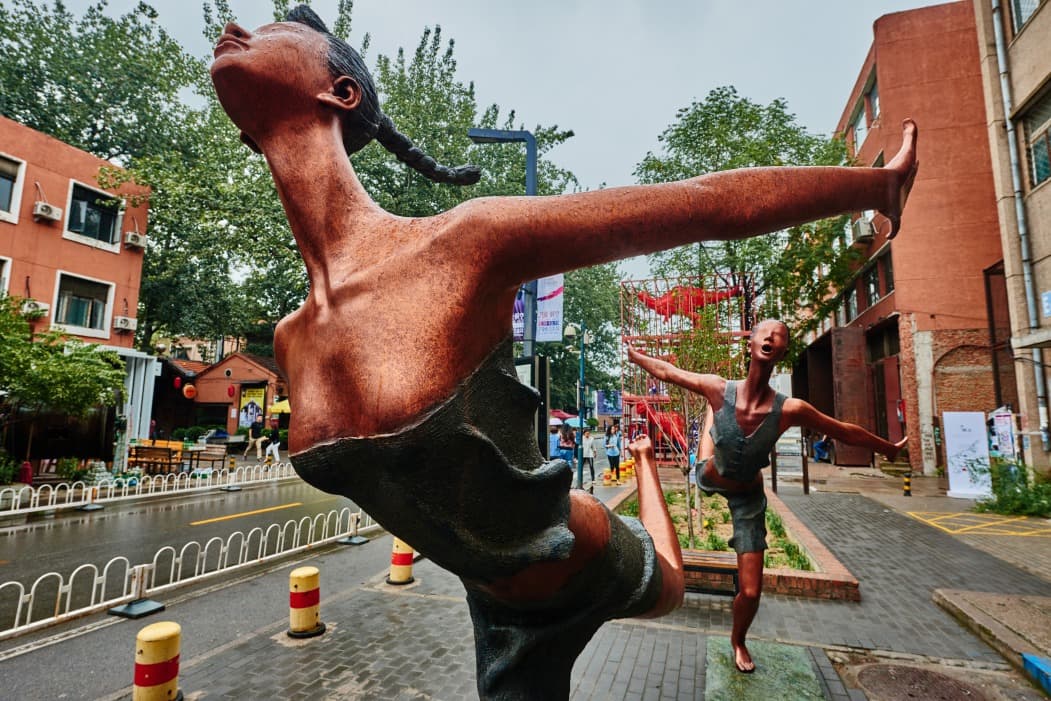
The former halls, their shed roof trusses, exposed ducts, and preserved political inscriptions on walls constitute a tour in themselves. A few monumental sculptures in outdoor spaces punctuate the district's streets.
Shops, design, and dining
The district features numerous design boutiques, art-focused bookstores, independent fashion studios, and a solid selection of cafés and restaurants, both Chinese and international. Plan around 2 to 4 hours for a first visit, longer if you intend to explore several exhibitions.
Practical information
- Address: Dashanzi, Chaoyang district, northeast Beijing.
- Hours: the district is freely accessible at all times; galleries generally open during the day, often closed on Mondays. Hours vary by space.
- Admission: free access to the district; paid entry for certain temporary exhibitions (modest fee).
- Duration: 2 to 4 hours, up to half a day for art enthusiasts.
- On-site: cafés, restaurants, bookstores, design shops.
When to visit
The district is largely visited outdoors, making Beijing's weather decisive. Spring (April-May) and autumn (September-October) offer the most pleasant conditions, with mild temperatures and often clear skies. Summer is hot and humid, sometimes stormy; winter can be very cold and windy, but heated galleries remain comfortable.
On weekdays, crowds are limited. On weekends, especially during openings or artistic events, the district becomes notably busier.
Access
- Subway: Line 10, Sanyuanqiao station, then bus 401 to Dashanzi Lukou Nan stop.
- Bus: lines 401, 402, 405, 445, 909, 946, 955, 973, 988, or 991, get off at Wangyefen stop.
- Taxi / ride-hailing: say "798 艺术区" (798 Yishu Qu). The district is bounded to the east by the Beijing-Baotou railway line and Jiuxianqiao street.
Nearby
798 integrates well into a day devoted to Beijing's cultural facets. You can combine it with:
- The ancient Beijing Observatory, a testament to imperial astronomy.
- The Baigongfang Handicraft Museum, for a counterpoint on traditional craftsmanship.
- The Beijing Botanical Garden, west of the city, for a more nature-focused day.
FAQ
Frequently asked questions
Include 798 in your trip
798 Art Zone lends itself well to a half-day break in a Beijing stay, as a complement to imperial sites. To build a tailor-made itinerary blending historical heritage and the contemporary scene, explore our trips to China.
Nearby
Interested in this visit?
We can include it in your personalised itinerary.