Chaoyang Arch
Chaoyang Arch
Built in 1389 in Jianshui, the Chaoyang Arch is the sole surviving one of four historic gates after 600 years. A central landmark of Yunnan's old town.
At the end of Jiangzhong Street, in the old town of Jianshui (Yunnan), the Chaoyang Arch has stood 28 metres tall in vermilion wood since 1389. Nicknamed the "tower facing the sun," it originally served as the eastern gate of the ramparts, known then as the Yinghui Gate. Today it is the sole survivor of the four cardinal points to have endured six centuries intact, and the central landmark of the city.
Why visit the Chaoyang Arch
The popular comparison to Beijing's Tian'anmen Gate lies chiefly in silhouette: a stone mass crowned by a tower in red wood. Here, the analogy stops at scale. Chaoyang belongs to a different order—that of a southern county town—and its appeal stems as much from its architecture as from the life that has settled at its base: a bird market below, a tea house at the top, tofu and noodle workshops in neighbouring alleys.
For those interested in Chinese urban history, it is one of the rare instances where one can read, on a single structure, the Tang–Ming transition and the longevity of a defensive programme that became a civic landmark.
History: six centuries at the heart of Jianshui
The location dates back to the reign of Yuanhe under the Tang dynasty: an earthen city was built there. In the twentieth year of the Hongwu reign (Ming dynasty, or 1387), the earthen structures were replaced by brick fortifications. Two years later, in 1389, the current arch was erected at the end of Jiangzhong Street as the eastern gate of the defensive system.
The city originally had four monumental arches at the four cardinal directions. Earthquakes, fires, and demolition claimed the other three. Chaoyang alone remains standing after more than 600 years, making it one of the oldest ensembles of its kind preserved in southern Chine.
What there is to see
Architecture
The tower rises over three storeys, covering approximately 414 m². The framework rests on 48 wooden pillars and a dense network of transverse beams, topped by roofs at three levels with upturned eaves. From a distance, the silhouette recalls that of the Huanghe Tower (Wuhan) or the Yueyang Tower (Hunan), with which it is traditionally compared.
Calligraphic inscriptions
Two large stelae frame the arch. To the east, the inscription "Xiong Zhen Dong Nan" ("Majestically dominates the southeast") was calligraphed by Tu Rizhuo, a scholar from the Qing dynasty. To the west, "Fei Xia Liu Yun" ("Flying clouds, brilliant mists") reproduces a work attributed to Zhangxu. These two panels are among the rare major calligraphic testaments still in situ in the region.
The bell
Inside, a bronze bell approximately 2 metres tall and weighing 3 to 4 tonnes is suspended at the uppermost level. Its sound carries for several kilometres when rung.
Life around the arch
The base of the arch hosts a bird market, a legacy of a very vibrant local tradition in Yunnan. On the upper level, a tea house offers evening performances and exhibitions of old photographs of Jianshui. In neighbouring alleys, old wells and artisanal tofu and noodle workshops remain, best explored on foot.
Practical information
- Allow 1 to 2 hours for the visit if you climb to the tea house.
- Modest entrance fee, payable on site; bring cash.
- Access is on foot from any point in the historic centre: the arch is the central landmark.
- The site is managed by the municipality; hours vary by season and evening performances scheduled.
When to visit
Jianshui is most pleasant to visit from October to April, when the climate in southern Yunnan remains dry and temperate. Summer, warmer and more humid, does not prevent a visit but makes climbing the tower more challenging.
Two moments stand out during the day. Early morning offers raking light illuminating the eastern façade—this is when the arch truly deserves its nickname "tower facing the sun"—and the bird market is in full swing. In the evening, the tea house on the top level hosts performances and screenings in a more intimate setting.
If you venture further to the Swiftlet Cave, about thirty kilometres west, August 8 coincides with the Swiftlet Nest Festival, one of the region's most singular events.
What to see nearby
- The Confucius Temple of Jianshui: the second-largest temple dedicated to Confucius in Chine after the one in Qufu, minutes on foot away.
- The Zhu Clan Residence: a traditional ensemble from the late 19th century, organised around courtyards, pavilions and gardens representative of Yunnan architecture.
- The hutongs of Jianshui: paved alleys of the old centre, to explore on foot or by horse cart.
- The Swiftlet Cave: approximately 30 km west, one of Chine's largest natural caves.
How to get there
Jianshui is approximately 3.5 hours from Kunming by train or car. The Kunming–Mengzi high-speed rail line serves Jianshui station several times daily at an affordable fare. The road, longer but more flexible, allows stops at the old town of Tonghai or the Mongol village of Xingmeng. Once there, the historic centre can be crossed on foot: the Chaoyang Arch marks its heart.
To place this stop within a broader itinerary, also see our Bell and Drum Towers, another emblematic example of a Chinese gate-tower, as well as the Beishan Temple to extend the heritage theme.
Frequently asked questions
Frequently asked questions
The general silhouette—a stone mass topped by a red wooden tower—is similar, which explains the local comparison. But Chaoyang predates the current Tian'anmen Gate, is smaller, and belongs to a county-town system, not an imperial palace.
Allow 1 to 2 hours on site: viewing the arch from the square, climbing the tower, visiting the tea house and the bird market at the base.
By high-speed train from Kunming South Station (approximately 3.5 hours depending on connections) or by car via the expressway, with the option of stops at Tonghai and Xingmeng.
Yes, access to the tower is included with the ticket. The top level houses a tea house, exhibitions of old photographs of Jianshui, and offers a clear view over the historic centre.
October to April, for dry and temperate weather. August 8, when the Swiftlet Nest Festival at the Swiftlet Cave, 30 km away, takes place, could justify timing your visit to that date.
Planning your stay in Jianshui
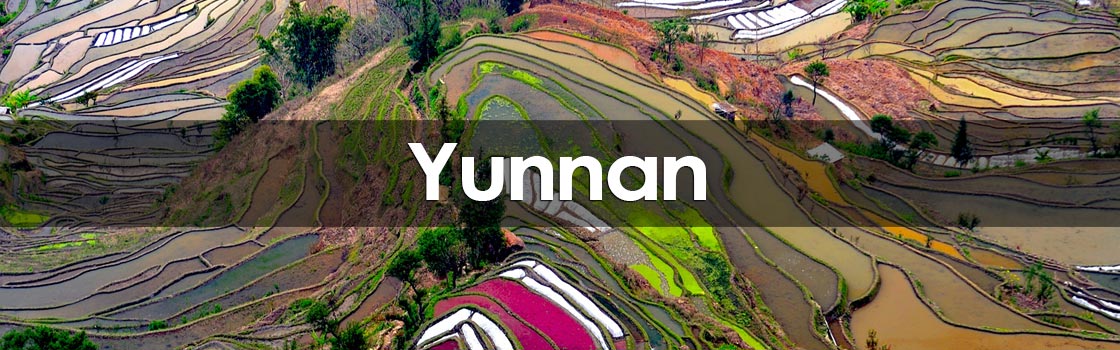
The Chaoyang Arch fits into a broader Yunnan circuit, between Kunming, the rice terraces of Yuanyang and the Vietnamese border. To build a tailor-made itinerary incorporating Jianshui, consult our trips in Chine.
Interested in this visit?
We can include it in your personalised itinerary.